Category Archives: Main Gallery
The Extraordinary Stevens Family, A New Jersey Legacy: 1776-1911
January 25 – July 5, 2015
Click here to take an interactive virtual tour
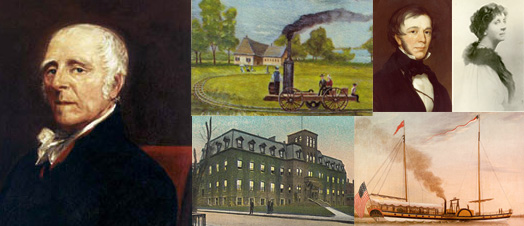
“The Extraordinary Stevens Family, A New Jersey Legacy: 1776-1911” detailed the lives and careers of two generations of the family The New York Times referred to as “one of New Jersey’s first families.” The Stevenses were inventors and designers, engineers and urban planners, and their influence is still very much felt, and seen, in Hoboken, and across the nation.
In addition to planning the city of Hoboken, and building many of the town’s major landmarks (Hoboken Land and Improvement Building, Willow Terraces, and Church of the Holy Innocents), and donating land for important institutions such as City Hall and the Hoboken Free Public Library, Colonel John Stevens III, along with his sons Robert Livingston, Edwin Augustus, and John Cox, made major contributions in the areas of steam transportation, railroads, architecture, and education.
Working with archivists and researchers from Stevens Institute of Technology, the first engineering school in the United States that was founded by Edwin Stevens’ estate, the exhibit featured patent models, military uniforms, maps, photos, 19th century furniture and personal family items from the family estate in Hoboken known as Castle Stevens. The museum also displayed original documents from the Stevens Institute of Technology collection, including correspondence with Alexander Hamilton, Aaron Burr, James Madison, Robert Fulton, Richard Stockton, and many other historic figures. Many of these artifacts have never been seen by the public. The Stevens family were very politically astute and their descendants married into some of the most influential families in the country. The family corresponded with presidents and entertained royalty.
The Stevenses were also slaveholders, and the exhibit lecture series will feature a talk about Peter Lee, a former slave who was with the family from 1804 until his death in 1902, when flags were flown at half-mast at Castle Stevens to honor his passing. He was considered a part of the family and is buried in the Stevens family plot. In addition, the time period for this exhibit (mid-1700s through 1900) provides the Museum with a rare opportunity to explore 18th century life in New Jersey.
While the Stevenses’ legacy can be clearly seen and felt in Hoboken, it is their contributions to New Jersey and the nation that will be the focus of this exhibit. Colonel Stevens and his sons were forward-thinking inventors and their innovative designs were adapted by shipbuilders and railway companies across the country. Robert Livingston Stevens, the Colonel’s middle son, revolutionized how trains were built and operated with his invention of the t-rail and spike, still in use today. Father and son were also interested in using steam to power railroads, and in 1826 the Colonel had a track built on his property in Hoboken so he could experiment with a steam locomotive driven by a multi-tubular boiler that carried passengers around the track at 12 miles an hour. This was the first engine and train that ever ran on a railroad in America.
The land that is now Hoboken had been confiscated by the State of New Jersey from a British loyalist and was won in an auction by Colonel John Stevens III, a revolutionary war hero from Perth Amboy, N.J., for $90,000 in 1784. In order to make Hoboken more appealing to homesteaders, Col. Stevens developed Hoboken as a pastoral getaway for New Yorkers weary of the dirty city. Open meadows, walkways along the river, inns, the “natural spring waters” of Sybil’s Cave, were all designed to entice buyers to purchase plots in the newly laid out community. These plots sold slowly at first, even with the added bonus of advertising Hoboken as being free of “yellow fever,” but after Col. Stevens established the Hoboken Ferry Company, with steam-powered ferries making regular trips between Manhattan and Hoboken, the town began to fill with the area’s first commuters.
The Stevens women were equally progressive-minded contributors to the betterment of society. Martha Bayard Dod Stevens, wife of Edwin Augustus and a descendent of the British loyalist who lost the land that Colonel Stevens won at auction, has contributed as much as any of her in-laws. It is probably Martha Stevens whose influence is most felt in Hoboken. Her interests in education, housing for laborers, and opportunities for working women, drove her to establish a foundling hospital, Holy Innocents Church, the Hoboken Free Public Library (National Register of Historic Places), and an industrial training school for young women and men. In addition, as a result of a trip to the Scottish village of New Lanark, a community founded by utopian social reformer Robert Owen, whose clean, affordable housing for workers inspired Mrs. Stevens to commission similar housing at the Willow Terraces in Hoboken. Widowed at age 37, she was left to carry out her husband’s wishes for a school of higher learning to be built on the family property. It was in honor of her family’s innovative natures that she chose to build a school of engineering.
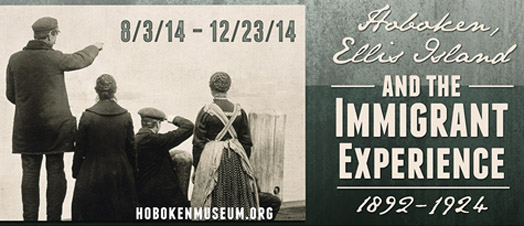
Hoboken, Ellis Island, and the Immigrant Experience, 1892-1924
August 3, 2014 – December 23, 2014
Click here to take an interactive virtual tour of the exhibit.
If Hoboken seems crowded today, with a population just over 50,000, imagine how crowded it was between 1892 – 1924, the peak period of U.S. immigration. Following the Immigration Act of 1891, which established federal control over immigration, Hoboken’s—and the entire country’s—demographics changed dramatically. During the next three decades, 20 million people immigrated to the United States, and more than half, 12 million, passed through the New York and Hoboken.
Hoboken became renowned across the world as “the port of entry to a continent,” according to Daniel Van Winkle’s history of Hudson County, published in 1924. Hoboken’s population swelled from 43,648 in 1890 to 70,324 in 1910 with the surge in European immigration, which was fueled in part by the major passenger shipping lines that docked here, including Hamburg-America Packet Company, North German Lloyd Steamship Company, Scandinavian-American Line, and Holland America Line.
The Hoboken Historical Museum examined this period in a new exhibit, “Hoboken, Ellis Island, and the Immigrant Experience, 1892-1924,” which opened Sunday, Aug. 3. Guest curator Dr. Christina Ziegler-McPherson, an immigration historian who lives in Hoboken, brought to life through images, artifacts, and oral histories the experience of immigrants who passed through Ellis Island and Hoboken during the peak years of U.S. immigration. A companion lecture series, “The Immigrant Experience,” brought noted scholars and authors to the Museum to expand on the topic.
Immigration Transformed Hoboken
In addition to descendants of Dutch and English settlers, German and Irish immigrants had largely shaped Hoboken in the mid- to late 19th century. In 1890, 40 percent of Hoboken’s population of 43,648 was foreign-born—and the majority of the city’s native-born residents had parents born in Germany or Ireland. Only 790 Italian immigrants lived in Hoboken in 1890.
Just two decades later, in 1910, Germans and German-Americans continued to dominate Hoboken, but for the first time, the city had more Italian and Italian-American residents than Irish and Irish-Americans. Hoboken also had a growing number of residents born in Russia, Austria, and Norway.
The exhibition also offered an in-depth look at the conditions immigrants faced before leaving their ports of embarkation, and the class divides on board between first and second class and steerage. The treatment received on arrival in New York Harbor differed by passenger class, too, with the steerage passengers diverted to Ellis Island for screening, while first and second class passengers simply disembarked in Hoboken or New York after an on-board health check, and then were free to go. The exhibit ran through December 23.

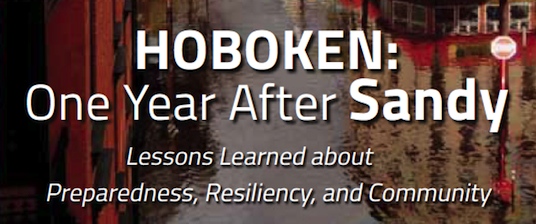
Hoboken: One Year After Sandy, Lessons Learned about Preparedness, Resiliency, and Community
October 2013 - July 2014
Click here to take an interactive virtual tour of the exhibit.
One year after Superstorm Sandy hit, Hoboken still bears the traces, some visible, some invisible. Many flooded homes have been repaired, others have not. Many residents spent days or months cleaning out their homes or businesses, or helping neighbors clean out theirs. Thousands coped with the challenging commute to New York for months while the PATH train was out of service, and hundreds of cars were towed away as total losses.
The storm disrupted all our lives in one way or another, and the Hoboken Historical Museum has been busy collecting the stories and images of its impact on our community to preserve it for history.
On the eve of the first anniversary of the storm, and through the generous support from individuals, corporate donors and community organizations and state agencies, the Museum opened a new exhibit on Saturday, Oct. 26, with a free reception from 5 – 8 p.m. Titled “Hoboken: One Year After Sandy, Lessons Learned about Preparedness, Resiliency, and Community,” the exhibit assembled a range of content — oral histories, images, videos, maps and scientific analyses — to help explain how Hoboken responded and learned new lessons about coping with major storm surges. As a special feature, through the auspices of the United Way of Hudson County, the Museum hosted a Sandy Community Outreach program for residents affected by the storm throughout the course of the exhibit.
The Sandy exhibit included a lecture series involving Stevens professors and guest lecturers from Rutgers Graduate School, plus students from New Jersey Institute of Technology. Funded by a grant from the Robin Hood Foundation and administered by the United Way of Hudson County, the Sandy Community Outreach program offered the services of a licensed Disaster Relief Crisis Counselor, Dawn Donnelly, to anyone in the community still working through issues connected with the aftermath of Superstorm Sandy.
The exhibit was made possible through funding from Hudson County Office of Cultural and Heritage Affairs, the New Jersey Historical Commission, Applied Companies, Bijou Properties, John Wiley & Sons, Rockefeller Development Group, and Stevens Institute of Technology.
The Museum would also like to thank the following donors for their generosity in supporting this Sandy exhibit: Ann Bauer, Agnes Bossolina, Cheryl E. Bracht, Joel and Bernadette Branosky, Gretchen and Julian Brigden, Michael Bruno, John Carey, Jeff Church, Barri and Dan Cillié, Margaret Clarkson, Phil Cohen and Rebecca Kramnick, Francine Colon and Gary Bierman, Marie Crowley, Damian De Virgilio, Dennis English, Cathy Ferrone and David George, Eugene and Joyce Flinn, Marc Gellman, Kirsten Georges, Barbara Gross, Rob and Julie Harari, Edward Heulbig, Bob Foster and Holly Metz, Hudson Place Realty, Valerie Hufnagel, Elizabeth Kennelly, Jane Klueger, Beau and John Kuhn, Susan Lapczynski, Joanne and Craig Laurie, Heidi Learner, Bruce and Jeanne Lubin, Paul Mattheiss, Elaine Mauriello, Penny Metsch, Ryan Mitchell, Ann Murphy, Paul Neshamkin, New Jersey Historical Commission, David Nielsen, Billy Noonan, Jennifer and Patrick O’Callaghan, Jean O’Reilly, Jill and Baz Preston, Janice Reed, Michael Rusignuolo, David H. Sandt, the Schmalzbauer family, Don Sichler, Laura Sigman, Razel Solow and Joel Trugman, Carrie Spindler, Arnold Stern, Strategic Insurance Partners, Bill Tobias, Linda Vollkommer, Joanna and Herman Weintraub, Louise and Bill Zerter.
Mapping the Territory: Hudson County in Maps, 1840-2013
January – September 2013

Click here to take an interactive tour of the exhibit.
Most of us use maps to learn how to get to where we need to go, but maps can also tell us a lot about where we have been and how we arrived at our destination. Maps can convey as much about a region as any unearthed artifact. For instance, an 1860 map of Hoboken shows boardwalks crisscrossing the undeveloped “meadows” in the western half of the city, where roads still called by their traditional names, Paterson Plank and Hackensack Plank, now run.
Maps are a form of universal communication, providing information not just about where people lived, but how they lived. In an exhibit titled Mapping the Territory: Hudson County in Maps, 1840 – 2013, the Hoboken Historical Museum uses maps to examine the development of the County from a group of small, agricultural townships to one of the most densely populated, as well as industrialized, counties in the state.
The exhibit features maps of all varieties: topographical, infrastructure, transportation, sea level and birds-eye views, from both the Museum’s own collections and borrowed from local libraries and historical organizations, including the Hudson County Archives in the Jersey City Public Library, along with digital versions. These maps show how the region evolved geographically from forests, marshes and towering granite cliffs populated by Native Americans; to farms, settlements and villages built and inhabited by the Dutch, followed by the British and the newly independent Americans; and ultimately into the diverse, vibrant communities we live in today.
At the time of Hudson County’s incorporation in 1840, it was primarily a sleepy agricultural area, thickly forested, with only a few settlements scattered around. The population totaled just over 9,000. In addition to farming, residents made their living from the bounty of the rivers and, in the case of enterprising Col. John Stevens, from developing his estate in Hoboken as a popular resort for New Yorkers, where clubs competed in cricket, boating and the loosely organized game of base ball, among other pursuits. Col. Stevens and his sons hastened the increasing industrialization of the area with their experiments and investments in railroads and steam-powered ferry services.
Following the Civil War, the County experienced a growth spurt. Each decade’s census from 1840 – 1870 would show that its population had more than doubled. Its original boundaries encompassed 46 square miles, which would grow by 75% before reaching present-day definitions in 1925. Its original borders stretched from the Hudson River on the east to the Passaic River on the west, down to the southern end of Constable Hook/Bergen Point to the northern border with Bergen County.
Along the way, towns and cities within its borders would merge and separate as citizens voted to incorporate or join other jurisdictions. Jersey City, already the largest and most commercial settlement, grew by absorbing neighboring communities and villages, such as Van Vorst Township, Bergen City, Hudson City and Greenville Township. In 1869, voters approved the consolidation of contiguous towns east of the Hackensack River, with the exception of the township of West Hoboken, which divided the Town of Union and Union Township from Hudson City.
Each of the 12 towns, townships and cities is represented in the exhibit, identified through their seal and flag. Digital frames display interactive maps so that visitors can study the development of each municipality in greater detail. Representatives from each of the municipalities will be invited to give talks about what makes their communities special, from the architecture, food, and cultural activities, to historic points of interest.
The schedule of talks will be announced by email and on the events page of this website. The exhibit, which runs through Sunday, September 29, is made possible through funding from the the Hudson County Division of Cultural and Heritage Affairs/Tourism Development, Thomas A. DeGise, County Executive, and the Board of Chosen Freeholders. Additional support for this exhibit and programming comes from Applied Companies, John Wiley & Sons, and the Rockefeller Development Group.
I Belong: A History of Civic and Social Clubs in Hoboken
July – December 2012
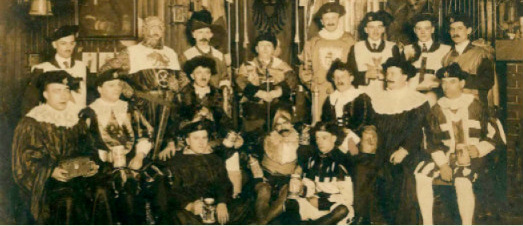
Hoboken has always been a haven for newcomers. So perhaps it’s not surprising that from as early as the 1700s, social clubs have sprung up as a way for people to connect with others around shared interests. From purely social groups like the Turtle Club—an eating and drinking society—to organizations devoted to civic and social philanthropy, along with special-interest clubs for theater, debate and sports, Hoboken has spawned a colorful array of clubs that reflect its citizens’ diverse interests and backgrounds.
I Belong: A History of Civic and Social Clubs in Hoboken traced a colorful history of a wide variety of organizations that have forged bonds among Hoboken’s residents over the years. Exhibit curators Bob Foster, Dr. Christina Ziegler-McPherson, and Eileen Lynch have unearthed more than 250 clubs, and tell their stories through displays of photographs, uniforms, medals, event programs, trophies and other artifacts from the Museum collections and other sources. A photograph of one of the clubs was blown up to life-size, so visitors could photograph themselves as a member of the club.
The show was on view for six months and included talks and lectures by noted historians such as historian, author and local resident Dr. Ziegler-McPherson and Daniel Soyer, a historian who writes about mutual aid societies and fraternal organizations.
Buildings erected by a few of these clubs are visible today around Hoboken. Some groups built impressive club headquarters, like the Benevolent and Protective Order of Elks, Lodge 74, built in 1906 at 1005 Washington St., which continues today as an active civic group, and the Independent Order of Odd Fellows, which no longer has a local chapter, but met at a building that stood at 412 – 414 Washington St., which until recently housed a Blockbuster video store at street level.
The Columbia Club at 1101 Bloomfield St. was built to impress in 1891 by some of the most prominent men in Hoboken. Designed in the once-fashionable “Richardson Romanesque” style, with rounded arches and contrasting color bands, the Columbia Club continues to impress. Its spacious, mahogany-paneled rooms for receptions and lectures reflected the group’s lofty aspiration to promote cultural and civic improvement projects, but within 20 years, the group had disbanded, and the building was taken over by a Masonic lodge for a few decades. In the 1980s, the building was rescued, restored and converted into four condominiums that retain many of the original architectural details.
Still standing on Newark St. is the clubhouse of the Hudson County Pigeon Club, built shortly after World War II (and now rented to a recording studio of the same name). Founded in 1922, HCPC once had over 70 members and sponsored the Hoboken Derby, one of the most famous races in North America. Members kept pigeon coops on rooftops, much like the one seen in the movie “On the Waterfront.” Club member Vinnie Torre still maintains his Hillside Loft on Monroe St. and shared his memories of the group’s glory days in an oral history chapbook, “The Pigeon Guys,” available at the Museum or downloadable on our website; click here to visit the oral history page.
Some former clubhouses have been replaced by modern interpretations of the original structure. The Union Club at 6th and Hudson Streets was originally built by the Deutscher Club in 1863 – 64, but the group changed names during World War I when German-Americans were closely monitored on suspicion of espionage. The building that stands there now sports a columned portico reminiscent of the original.
Another homage to a famous Hoboken-based club is the small building on Maxwell Place Park built to resemble one that belonged to the New York Yacht Club. Despite its name, the group had a clubhouse in Hoboken, and elected John Cox Stevens as its first commodore. With his brother Edwin, these sons of Hoboken founder Col. John Stevens helped design and sail the famous yacht America to Britain in 1851 to capture the cup that became the coveted trophy of the America’s Cup Yacht Race. The New York Yacht Club was just one of many boating clubs based in Hoboken, which competed fiercely in local and international races.
One of Hoboken’s earliest social groups dates to 1796, when dozens of gourmands came from all over the region to dine on turtle soup and indulge their palates in an smorgasbord of food and drink. There’s a fascinating story behind the original Turtle Club, whose reputation was such that its feasts—and accounts of prodigious drinking—were reported in The New York Times. These groups and others, including Masonic lodges, mutual-aid societies and theater clubs, are echoed in the many social clubs that make Hoboken such a welcoming place for newcomers today.
The exhibit was made possible through funding from the New Jersey Historical Commission, Applied Companies, Bijou Properties, Provident Bank, United Way of Hudson County, and John Wiley & Sons.
Driving Under the Hudson: A History of the Holland and Lincoln Tunnels
January – June 2012
Click here to take an interactive virtual tour of the exhibit.
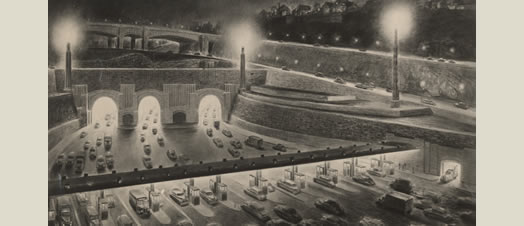
Through this exhibition, we celebrated the 85th anniversary of the Holland Tunnel and the 75th birthday of the Lincoln Tunnel. Love them for the access they provide to New York City, or curse them for the rush-hour traffic that ensnares Hudson County drivers, the tunnels define Hoboken’s northern and southern borders. Today we take them for granted, but when they were built, they were marvels of both engineering prowess and public works initiatives.
For hundreds of years before either tunnel was built, the Hudson River could only be crossed by boat. While railroads transported goods easily across the country, once they arrived at the Hudson River, delivering them to New York City was more complicated. A system of lighters, private ferries, barges, and car floats was employed by the railroad companies, but this was a slow, inefficient and very costly way of moving goods. Shippers were at the mercy of ever-changing river conditions, which dictated when—or whether—goods could be moved.
By the beginning of the 20th century, what the region needed most was a freight rail tunnel. Passenger access was improved in 1908 and 1910 with the construction of the Hudson & Manhattan Tubes and rail tunnel to Pennsylvania Station. But they weren’t keeping up with population growth. The story behind how the two new vehicular tunnels were planned, funded and constructed reveals a fascinating struggle between public and private sector powers against daunting physical and financial obstacles. It is also a testament to the workers—known as sandhogs—who risked their lives under highly pressurized conditions until engineers figured out how to improve worker safety. Indeed, when it was completed in 1927, the Holland Tunnel, named for its chief engineer, was called the “Eighth Wonder of the World.”
The public is invited to explore the tunnels’ back story and ongoing significance in the Museum’s online virtual gallery for the exhibition, Driving Under the Hudson: The History of the Holland and Lincoln Tunnels, which was on view at the Museum from Jan. 29 through July 1, 2012.
Waterfront reformers and political progressives wanted a freight tunnel, but that would have threatened the power of racketeers and politicians, especially Mayor Hague of Jersey City, who used the piers as a source of job patronage. It was agreed, however, that something was needed to link the eastern edge of New Jersey with Manhattan.
As America’s love affair with automobiles grew, engineers and sociologists argued for building a bridge, assuming drivers would prefer light, air and a view to a long, claustrophobic, dingy tube. But a 1913 engineering study concluded that a bridge would cost $42 million, versus $11 million for a two-tube vehicular tunnel. Ultimately, money and the lack of space to build a bridge would decide the debate in favor of a tunnel.
Two things precipitated matters. The harsh winter of 1917-1918—when the Hudson River froze over as temperatures dipped well below zero—made getting fuel and food to New York City almost impossible. The following winter, a strike by the Marine Workers’ Affiliation affected freight deliveries as well as commuter ferries. As tens of thousands of ferry travelers poured into the Hudson and Manhattan Railroad (now PATH), police were called in to deal with extreme overcrowding on the trains.
Cooperation and obstruction
In September 1919, New York and New Jersey quickly came to consensus and signed an agreement that provided for the joint construction, operation, repair, and maintenance of the tunnel, with the costs shared equally by both states. Tolls would be instituted to pay each state back within 20 years. Clifford Holland, the youngest chief tunnel engineer in the U.S., was appointed to direct and design the largest vehicular tunnel ever built. Again, the biggest challenge would prove to be Jersey City’s Mayor Frank Hague, who found many ways to hold up the project and extort money and concessions for his office and supporters.
Eventually, Holland planned a secret groundbreaking for May 31, 1922. With a small crew and a few officials, Holland clandestinely crossed into Jersey City, where he was photographed with a shovel in the ground. With the photograph in all the papers, Hague had been outmaneuvered.
Planning for the Midtown Hudson Tunnel, as the Lincoln was originally named, seemed to go much smoother, at least at first. With the technical knowledge gained from the Holland Tunnel, the construction of the Lincoln Tunnel would be the turn out to be the easiest part of the project. But the crash of 1929 and the advent of World War II delayed construction of the first two tunnel tubes for many years and by 1937 only one was completed. Each decade brought a new impediment: In the 1930s it was a lack of capital; the ’40s saw a lack of manpower and materials due to the war, and by the ’50s, a postwar building boom on both sides of the river meant complex real estate transactions had to be negotiated. Work on the second tube wasn’t completed until 1945, and the third tube delayed until 1957.
The exhibition featured original documents such as official correspondence and engineering plans, plus historic newsreel footage, and objects such as a now-defunct “catwalk car,” which was driven along specially constructed side rails to deal with vehicle emergencies. Photographs and oral histories from the original sandhogs involved in the construction of the Lincoln Tunnel will tell their history.
Curators Bob Foster and David Webster were advised by Dr. Angus Gillespie, Professor of American Studies at Rutgers University and author of Crossing Under the Hudson, The Story of the Holland and Lincoln Tunnels (Rutgers Press, 2011); and historian and engineer Robert W. Jackson, author of Highway Under the Hudson: A Story of the Holland Tunnel (New York University Press, 2011). Both authors came to the Museum to give lectures, along with architectural historian John Gomez, a member of the Museum’s History Advisory Board and a founder of the Jersey City Landmarks Conservancy, and Steven Hart, author of The Last Three Miles: Politics, Murder, and the Construction of America’s First Superhighway, which documents the construction of the Pulaski Skyway.
The exhibit is made possible through funding from the New Jersey Historical Commission, Applied Companies, Bijou Properties, T&M Contracting, United Way of Hudson County, and Wiley & Sons.
Yum Yum, Tootsie Rolls, and Chocolate Bunnies on Motorcycles… A Sweet History of Hoboken
January – December 2011
Buddy Valastro put Hoboken on the national culinary map with his popular TLC cable network show, “Cake Boss,” but did you know that Hoboken has been a confectionary powerhouse since the mid-19th century?
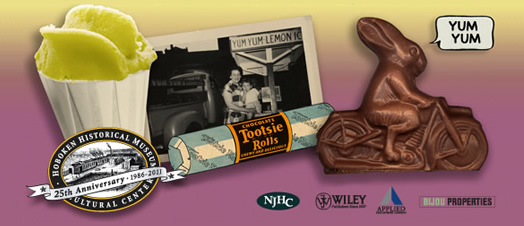
It’s such a rich (and tasty) legacy, the Museum has traced a history of the city from its earliest days through its many commercial bakers, candy manufacturers and family-owned bakeries, including a smorgasbord of different immigrant groups’ food customs. Named for three of Hoboken’s signature treats, the Museum’s exhibit, Yum Yum, Tootsie Rolls, and Chocolate Bunnies on Motorcycles…A Sweet History of Hoboken, opened on Sunday, Jan. 30, 2011.
Telling the history of a community through its gastronomic traditions may seem a bit unorthodox, but the subject neatly illustrates Hoboken’s dual role as a manufacturing center—because of its transportation links and plentiful labor pool—and as a haven for newly arrived entrepreneurs, who catered to the tastes of their fellow immigrants. In addition to factories, Hoboken boasted many small bakeries and candy makers specializing in their national treats. Before Valastro’s father moved Carlo’s Bakery from Adams St. to Washington St. in 1990, the site opposite City Hall was occupied by German bakeries, first Wordelmann’s (from before World War I) and later Schonings (from 1930). And the 2010 House Tour included a Garden St. building that was once a marzipan factory.
Catering to the great ocean liners that docked in Hoboken, Germans also opened and operated successful commercial bakeries, like John Schmalz’s Sons Inc.’s “Model Bakery” at 8th and Clinton Sts. Established in 1867, it became famous for its Jersey Cream Malt Bread and boasted a production rate of 5,000 loaves in 10 hours. Eventually, the factory became part of the Continental Baking Corporation, which made Wonder Bread at that site and opened a Hostess bakery at 14th and Park, making cupcakes and Twinkies.
 On the heels of the Germans, the Italians soon were baking their own delicious crusty bread at family-run bakeries, many of which supplied restaurants, delis, and home kitchens—and a few still do today. The Italians also popularized ice cream and flavored ices, including a flavor called “Yum Yum,” sold from carts throughout the sweltering urban cityscape. One Italian ice cream vendor, Italo Marchiony, who arrived in 1895, invented and patented (in 1903) a waffle cup to solve the problem of carrying fragile glass cups. When he ran out of them at his booth at the 1904 World’s Fair in St. Louis, he twisted the thin waffles made by a nearby vendor into a cone shape, and entered the history books!
The heyday of mom-and-pop ice cream parlors, pastry shops and luncheonettes was the early 1900s to the 1950s. A few remain, including Schnackenberg’s, located at 11th and Washington for over 75 years, where the family continues to make chocolate confections by hand, using whimsical molds at Easter, such as a bunny on a motorcycle. Nearby, the Castiello family still makes traditional Italian treats at Giorgio’s Pasticcerie, founded it in 1975. Both businesses have been documented in the Museum’s oral history chapbook series, in conjunction with the Hoboken Public Library.
Many national companies moved factory operations to Hoboken as an economical alternative to New York City. The Sweets Company of America made Tootsie Rolls in a “modern” factory building at 16th and Willow starting in 1938. Kids in Hoboken recall catching candies tossed to them by workers there after school. Other major factories included the R.B. Davis Co., which made baking powder, My-T-Fine puddings and Cocomalt chocolate beverages, and was a major sponsor of the iconic “Buck Rogers” radio show. Franklin Baker Company, maker of Baker’s Coconut and other commercial brands, such as Log Cabin Products, also operated factories in Hoboken.
The exhibit was made possible through funding from the New Jersey Historical Commission, Applied Companies, Wiley & Sons, and Bijou Properties.
Surveying the World: Keuffel & Esser + Hoboken, 1875–1968
January - December 2010

Hoboken’s Keuffel & Esser Made Instruments that Drove an Age of Progress
K&E, the initials carved into the roofline of the building at the corner of Third & Adams, are the only visible trace of a company that played a significant role in America’s phenomenal age of discovery and growth. Keuffel & Esser, a precision engineering instrument manufacturer that was based in Hoboken from 1875 to 1968, provided the tools that explorers and builders relied on for expeditions to the North Pole and across the American continents and for such engineering marvels as the Brooklyn Bridge and Panama Canal. It also created jobs for thousands of Hoboken residents, including many of the German immigrants who shared the heritage of the company’s founders, William J.D. Keuffel and Hermann Esser.
And anyone who remembers using a slide rule for complex calculations can thank K&E for popularizing the tool, its best-selling item among the thousands in its catalog. In over 90 years of operations in Hoboken, K&E’s rapid growth matched the expansion of the nation’s industrial base. It became the leading purveyor of tools and instruments used by engineers, surveyors, and the military, selling more than 10,000 items from nearly 300,000 square feet of office and factory space in Hoboken. Examples of many of these instruments will be on display in the Museum’s Main Gallery starting Sunday, Jan. 31 for Surveying the World: Keuffel & Esser + Hoboken, 1875 – 1968.
Visitors will be able to interact with some of the items on display, including slide rules, surveying instruments, lettering systems, and drafting tools. Descriptive plaques will describe how these tools were used in building railroads, farming, and exploration. One of the displays will explain a fascinating aspect of K&E’s Hoboken operations: A spider ranch! Read about how spider web filaments were used as crosshairs for telescopic sights, and the “Spider Lady,” Mary Pfeiffer, who ran K&E’s spider ranch from 1889 to World War II. The exhibit is made possible in part through a Special Project grant from the New Jersey Historical Commission, and the generosity of corporate sponsors: The Applied Companies, John Wiley & Sons, and Bijou Properties.
Keuffel and Esser opened their first office at 96 Nassau Street in New York City in 1867 to sell drawing materials and drafting tools, mostly imported from Europe. The company grew quickly and moved to larger quarters in Manhattan before leasing a small loft building at the southwest corner of Third and Adams in Hoboken in 1875. As their business expanded, they built a large, three-story structure at the northeast corner of Third and Adams in 1880, which was soon replaced with a massive building, covering most of Third St. between Grand and Adams Streets, in 1887.
By 1889, the partnership evolved into the Keuffel & Esser Company, which was privately held. After a fire in 1905 destroyed part of the Hoboken factory, the company constructed a fireproof concrete building on the west side of Adams, covering the full length of Third St. to Jefferson St. Opened in 1907, this nearly half-block-long building became the main offices for the company, until it closed in 1968 and moved to Morristown, N.J.
In 1975-76, the concrete “West” building became one of the first examples of adaptive re-use of an industrial building, known as The Clock Tower Apartments for its iconic four-sided clock, and joined the National Register of Historic Places in 1985. The “East” building was converted in 1984 to residential use.
Up and Down the River: A History of the Hudson, 1609–2009
March – December 2009
A hundred years ago, New York City threw a two-weeklong public celebration of a double anniversary: the tricentennial of Henry Hudson’s voyage up the river and the centennial (plus two) of Robert Fulton’s first successful steamboat crossing in 1807. One of the largest public anniversaries in the country’s history, offices and factories closed and the number of commuter trains doubled to handle the crowds for the banquets, parades, historical floats, theatrical performances, lectures, fireworks and an airplane flight by Wilbur Wright around the Statue of Liberty. Authentic recreations of Hudson’s ship the Half Moon and Fulton’s steamboat the Clermont participated in a U.S. Naval parade up the Hudson.
Up and Down the River: A History of the Hudson 1609 – 2009 joins many celebrations along both sides of the river during this historic quadricentennial year. The Museum’s exhibit, made possible through a special project grant from the New Jersey Historical Commission, extends through the end of the year to accommodate a full agenda of talks, events, educational programs and art celebrating our city’s relationship with the river that shaped its fortunes.
The exhibition and lecture series will trace the important roles the river has played in the life of the Mile Square City: Providing food and commerce to the area’s first inhabitants, the Lenape Indians; Connecting 19th century New Yorkers and sailing enthusiasts to the Hoboken shoreline during its incarnation as a resort called “Elysian Fields” and home of the cup-winning yacht America; bringing to its piers the grand passenger ships from Europe and later a bustling cargo trade, as depicted in the film On the Waterfront; inspiring generations of students and professors at the Stevens Institute of Technology to contribute to the legacy of groundbreaking maritime research; and providing recreational activities along miles of New Jersey waterfront walkway, thanks to the advocacy of citizen activists.
Though Robert Fulton gets credit for inventing the first steam-driven ferry, Hoboken founder Colonel John Stevens and his son Robert, both prolific inventors, were tinkering at the same time with a steam engine and a screw propeller on a ferryboat. In 1811 Stevens launched the first steam-powered commercial ferry service to cross the Hudson. Fulton’s designs and a biography of the inventor and others who were instrumental in helping him develop and refine his steam engine will covered.
For the exhibition, the Museum commissioned an original mural of the outline of Hoboken’s waterfront along the entire length of the main wall, painted by local artist Ray Guzman. Scale models of vessels from the Hudson River are on display, including New York Central Tug #18 by John Marinovich, and excerpts from Hudson’s first mate’s journal describe the first encounters between the Europeans and native inhabitants. A portion of the exhibit features memorabilia from the 1909 Hudson-Fulton celebration. Items on display come from the Museum’s own collections, as well as from the private collections of a Hudson County-based model shipmaker, the South Street Seaport Museum, Stevens Institute of Technology and the Bayonne Historical Society.
Heaven, Hell or Hoboken: A City Transformed by World War I
September 2008 – January 2009
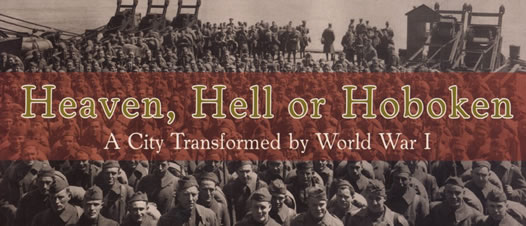
The designation as a port of embarkation meant national fame for Hoboken – General John J. Pershing’s promise to the troops that they’d be in “Heaven, Hell or Hoboken” by Christmas of 1917 became a national rallying cry for a swift end to the war, which actually dragged on for another year. But it also meant economic hardship for the small city after the federal government seized Hoboken’s piers and the German shipping lines that were major employers, closed most of its bars and beer gardens, and displaced or interned hundreds of German nationals who were not yet naturalized U.S. citizens as “enemy aliens.”
Between June 1917 and November 1918, some 1.5 – 2 million soldiers passed through Hoboken, but most were fed and housed by the U.S. military, while local businesses saw the local population decline and the city saw its revenues drop sharply. At the time, German citizens and Americans of German descent made up about 25 percent of Hoboken’s population, far outnumbering the next largest immigrant groups, Irish and Italians.
The exhibit tells the story through research and talks by Christina Ziegler-McPherson and other historians, as well as through personal letters and artifacts of soldiers and residents of Hoboken. Director Bob Foster and collections manager David Webster assembled displays from the Museum’s collections and other sources, comprising uniforms, helmets, gas masks, rifles and other gear, as well as letters and photographs from Hoboken’s soldiers, 70 of whom lost their lives on the European battlefields. The exhibition includes Hoboken’s draft registration book, on loan from the City Clerk’s office. Also on view – government-sponsored posters and advertisements by prominent artists and illustrators exhorting Americans to contribute to the war effort, through volunteering, war bonds, and general morale-boosting.
Ziegler-McPherson explores the federal government’s struggle to build the infrastructure necessary to conduct the war, using a combination of persuasion, exhortation and coercion to drum up volunteers both to fight and to muster supplies and logistics for the effort. Most of the local draft boards, for example, were staffed by volunteers, as were the medical experts who examined the new recruits, she says. The government hired so-called dollar-a-year men, professionals who donated their time and expertise to the war effort. The Red Cross mobilized volunteers to help gather medical supplies. Sometimes, volunteerism went too far, however, according to Ziegler-McPherson, as large networks of self-appointed vigilantes developed, such as the “American Protective League,” which numbered some 10,000 members nationally, who opened mail and spied on neighbors in the name of helping the government identify possible German operatives.