Category Archives: Exhibitions
Jennifer Place & Jodie Fink – “Local Motion”
May 18, 2014 - July 6, 2014
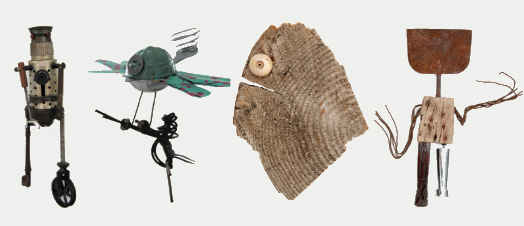
Bowerbirds don’t merely “feather their nests” — they create elaborate art installations to impress prospective mates, using colorful materials collected from around their environment, such as cast-off bottle caps, buttons and trinkets. Jennifer Place identifies with the impulse to collect. The artist and her friend Jodie Fink have been making sculptures from detritus that attracts their eye from their walks around Hoboken for many years. They had a joint show, “Friends and Relations,” at the Museum three years ago.
Lately, Place has been thinking a lot about the bowerbirds, since she’s had to re-feather her own nest after superstorm Sandy swept through her lower Madison Street home and washed out many of her collected supplies—mostly the larger pieces—that were stored in her garden shed. Consequently, she’s working in a smaller format these days—with lots of rusty bits of hardware and small items picked up in the environment.
Superstorm Sandy also wiped out a lot of Fink’s supplies, inundating her basement storage space with five feet of water. She now looks at the storm philosophically, learning the truth of the saying that, sometimes, “less is more.” Her work is increasingly minimalist; one piece is simply an expressive piece of driftwood with a fishing bobber affixed for an eye, making it into a fish named “Henry.” The other trend in her recent work is incorporating an element of motion, with pieces that hang or parts that move.
The two artists are teaming up again for a show they’re calling “Local Motion: Mixed Media Sculptures by Jennifer Place and Jodie Fink.” The exhibit opens in the Museum’s Upper Gallery on Sunday, May 18, with a free reception from 2 – 5 p.m., and remains on view through July 6. Each artist is exhibiting about a dozen works.
Both artists started out working in other media: Fink studied photography in college and Place is a professional graphic artist who started out in drawing and printmaking and now works primarily in jewelry and sculpture, including working with hot glass beads. Fink is now gravitating toward painting and drawing, part of her trend toward simplifying.
The two artists both say that the changes in the city’s demographics have changed the materials they use in their work. When they arrived in the early 1980s, Hoboken was an ethnically diverse town, with lots of local characters, gritty bars, pop-up art galleries and a dynamic music scene. Back in those days, they say, scrounging for “art stuff” was a constant thrill, and artists would call each other on moving days when a particularly rich pile of stuff appeared on the curb. Now, the cast-offs are likely to be less interesting, Ikea furniture and the like. However, the constant construction projects and greater access to the waterfront are supplying more interesting bits and pieces.
Half the fun of seeing a Fink-Place art installation is trying to figure out the origins of the individual parts. One of Fink’s pieces, “Ballerina,” is composed of an element from a gas stove, a pushmower handle, and a lamp bracket. Both artists have exhibited extensively at galleries around the region.
The exhibit is supported by a block grant from the State/County Partnership program for the Arts, administered by the Hudson County Division of Cultural and Heritage Affairs.
Click here to see a virtual gallery of the exhibit.
Tim Daly – “Important Clouds”
March 23, 2014 - May 11, 2014
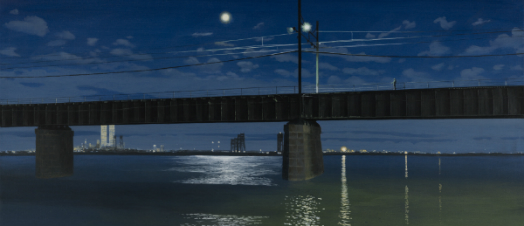
Most of us deliberately tune out the scenery along New Jersey highways as we drive past the railroad and highway bridges crisscrossing the Meadowlands marshes. It’s hard to categorize what we’re seeing—neither planned architectural landscaping nor unfettered nature, it’s a hybrid environment that evolved haphazardly. But these overlooked scenes take on entirely new significance when interpreted by the skilled hands of Hoboken artist Tim Daly.
Many of his landscapes are dominated by luminous skies filled with cumulus clouds, or skies that are empty but for streaky jet contrails floating over utility towers or highway overpasses. Or lonely night skies eerily lit by highway light fixtures. Daly’s pastels and paintings capture these scenes at those moments during the day or night when the light is at its most beautiful and mysterious, so that it almost doesn’t matter what is in the scene. Except that it does—these stretches are as much a part of our physical environment as the intentionally designed ones. Daly’s pastels and paintings help us appreciate them with new eyes.
“I’ve been told several times over the years that I create, in my believable realist landscapes, a psychological space as well,” he says. “It’s ephemeral, darkness visible, at times. I was drawn then as now to lights in the dark and to telling details. I’m a sucker for Ailanthus trees and the spectacles of bright and dark skies over wild industrial and urban landscapes.”
As a Jersey City native, who explored the Meadowlands as a boy, he began sketching that landscape during the eight years he worked at two Postal Service facilities located in the heart of the marshy no-man’s-land. He considers it his graduate school, after studying at New York’s School of Visual Arts from 1971 – 73, when video and photography were all the rage and the Dutch and English realist landscape schools of painting he so admired had fallen out of fashion. He honed his skills there, drawing and painting scenes from sea level and from the top of Snake Hill, the stone outcropping by the NJ Turnpike’s Eastern Spur.
Daly’s latest series of landscapes rendered in pastels with nearly photographic detail, plus giclée prints from earlier paintings, were on display in the Upper Gallery of the Hoboken Museum. Titled “Important Clouds: Pastels and Giclées by Tim Daly,” the exhibit opened on March 23, 2014 with a free reception from 2 – 5 pm, and remained on view through May 11.
Click here to see a virtual gallery of the exhibit.
In addition to his lifelong fascination with the Meadowlands, Daly has been working on scenes from around Los Angeles—not the glamorous California seen on TV and movie screens. His California scenes are of surfers at Venice beach, or stretches of highway with brush fires in the distant hills. Some of the recent works were inspired by scenes from Long Island City, where he works as a scenic artist, a proud member of the United Scenic Artists Local 829. He’s painted sets for such shows as HBO’s “The Sopranos,” “Girls,” and “Boardwalk Empire,” among others. See more examples of his work at timdaly.artspan.com.
Daly moved to Hoboken in 1977, when it was a different world: Maxwell’s was a funky bar, the Washington St. bus cost $.25, and rents were low enough for an artist to afford, he says. “I met my lovely wife, Sheilah Scully, and was drawn with her into Hoboken’s progressive political campaigns, including Mayor Tom Vezzetti’s victory, and a four-year long condo conversion battle.” He advises anyone interested in that period to seek out Nora Jacobsen’s documentary film, “Delivered Vacant,” in which he and Sheilah make cameo appearances.
The exhibit is supported by a block grant from the State/County Partnership program for the Arts, administered by the Hudson County Division of Cultural and Heritage Affairs.
Robert Forman – “Uncommon Threads”
January 26, 2014 - March 16, 2014
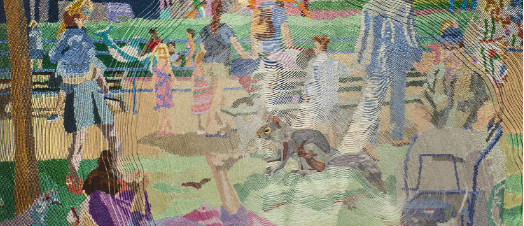
From a distance, an artwork by Robert Forman appears to be many paintings at once, layered in some mysterious way. Up close, the mystery deepens: Instead of paint, the surface is composed of many colored threads, laid downwith as much complex color theory as any Impressionist painting—or maybe more so, because Forman’s pictures have added dimensions of overlapping images and patterns.
For example, one piece, Engine Co. 5, depicts Forman’s home, an 1898 firehouse he bought at a city auction in 1982 and converted into a four-family residence. The building’s outline, its iconic red, arched door and its steep, green copper roof with dormer window are easy to pick out of the scene. However, interwoven with that image are ghostly images of the people past and present that have lived or worked in the building or in the neighborhood, including the artist’s family and neighbors, firefighters, and Frank Sinatra, whose father was captain there. Overlaying it all is a wave pattern crisscrossing the picture, alluding to the inundation from Superstorm Sandy that the artist and his family were rebuilding from while he worked on the artwork in 2013.
Engine Co. 5 is one of the highlights of the exhibit, “Uncommon Threads: String Pictures by Robert Forman,” which opened at the Hoboken Museum on January 26. The exhibit will remain on view until March 16, when the artist will give a talk about his work at 4 p.m.
Another picture in the exhibit depicts a squirrel on the grass in Church Square Park, surrounded by people lying on the grass, mowing the lawn, playing on the sea creatures in the water park. Once again, Forman incorporates a pattern in the threads to create a focal point around the squirrel, showing his dog’s view of the world, where everything else in the visual field fades out, except his crystal-clear target.
Click here to see a virtual gallery of the exhibit.
Forman’s website, robertforman.net, explains his process: “I begin with full-size drawings (cartoons). I trace the drawings and transfer them to Clayboard with carbon paper. In the case of multiple images, I use different colored carbon paper. I then glue yarn of different weights, colors and material to the Clayboard using Elmer’s Glue. I use cotton, silk, linen and rayon yarns. The finished picture is sealed with Fabric Guard. The final step is the frame, which I mill and build in my wood shop.”
Forman’s technique is self-taught; he began “painting with yarn” in high school, in Englewood, N.J., and continued while majoring in painting in college at Cooper Union in Manhattan. He kept the string pictures a secret until a professor asked the class about what they had worked on during vacation. His professor recognized his originality and encouraged him to keep at it. Like a lot of artists, he has supplemented his income as a fine art framer, and consequently, his frames often have complementary qualities to the work they contain.
In the 1990s, he came across some kindred spirits: The Huichol, a native tribe from northern Mexico, had a tradition of yarn paintings, using thicker yarns and beeswax. He earned a Fulbright scholarship in 1992 to study with them in the cities and villages of the western Sierra Madre mountains.
It can take a whole year to produce a large picture, and he works on two or three pictures a year. “It’s a slow process,” he says. “Instead of going faster, as I get more experience, I try more things and it can even take longer. I just don’t want to repeat the same thing—new ideas are what interest me.” His work has evolved from focusing on “retinal” effects—replicating the surface colors and texture, as in the picture, “Hoboken Station” to more layered compositions.
Forman’s work has been exhibited in the Newark, Brooklyn, Jersey City and Montclair Museums, and at the Francis M. Naumann Gallery on 57th Street. Visit his website, glueyarn.com, to learn more about his many exhibits and articles on his unique art.
The exhibit is supported by a block grant from the State/County Partnership program for the Arts, administered by the Hudson County Division of Cultural and Heritage Affairs.
Hiro Takeshita – “Slices of Beauty on the Hudson”
December 15, 2013 - January 19, 2014
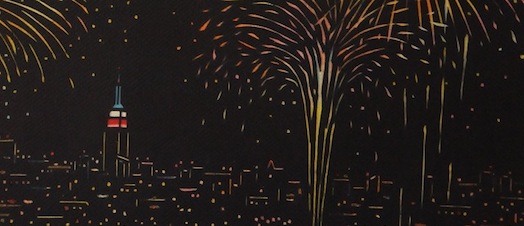
Hiro Takeshita was born in Nagasaki, Japan, and from an early age was interested in art and American culture. Born two years after the atomic bomb blast in his native city, he can still recall his mother’s searing memories of that day. However, he also recalls the kindness of American soldiers and being captivated by American television shows on television, which ultimately motivated him to move to the U.S. in 1977 after studying art and print-making in Tokyo.
The bright colors of his native city and his fascination with American pop culture led him to admire artists of the post-Impressionist period, particularly Henri Matisse, Abstract Expressionists like Richard Diebenkorn and Pop Artists, especially Andy Warhol.
He moved to Hoboken in 1985, where he creates artwork that reflects his fascination with the Hudson River and its views of New York City. If you stroll along Hoboken’s waterfront walkway, you may have seen him with a large 14”x17” sketchbook, finding inspiration in the ever-changing panorama it offers.
“I always enjoy sketching scenes on the Hoboken waterfront, of people enjoying the outdoors, walking, kids playing, the happy moments,” he says. “Art is communication; I like to share the joy and beauty with other people.”
At first glance, his works appear to be delicately painted in saturated colors and fine lines. The lights of New York City twinkle across the Hudson, a fine tracery of fireworks showers down over the river, tree branches twist in the wind. But step up closer to the pictures and you just might be able to detect the sliced paper. In some cases, there might be four or five layers, but he uses fine origami paper, so the surface is virtually flat. It’s a technique known as “kirigama,” in Japan, but is practiced in many forms, including much of Matisse’s late work.
Click here to see a virtual gallery of the exhibit.
The Museum’s Upper Gallery featured his latest creations in a show titled, “Slices of Beauty on the Hudson, Cut-Paper Works by Hiro Takeshita,” on view from Deccember 19, 2013 – January 19, 2014. View more of his work at www.hirotakeshita.com.
This is Takeshita’s second exhibit at the Hoboken Museum, and his work has been exhibited in New York City and elsewhere. He has also created works in oil paints, pastels, watercolors, and print-making, but his prime concentration these days is in cut-paper works. Each year, he contributes works to a group art show dedicated to the Peace memorial at Nagasaki on the anniversary, August 9, of the atomic bomb blast.
The exhibit is supported by a block grant from the State/County Partnership program for the Arts, administered by the Hudson County Division of Cultural and Heritage Affairs.
Peter Gutierrez – “Let It Fly!”
November 3 - December 8, 2013
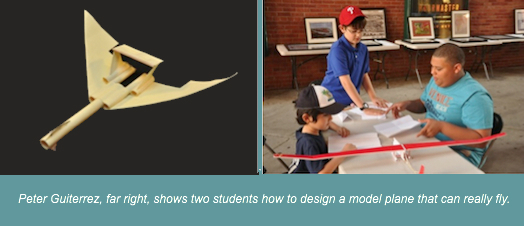
Ever since his mother took him to an airshow and let him take a ride in a B-24, at age 9, Peter Gutierrez has been fascinated by airplanes. He started making drawings of aircraft, and then his grandfather, a civil engineer who spent a career working on cars, trains and other machines, encouraged him to work on model aircraft and gave him books on how to fold paper into airplanes. Before long, he ran out of room to display all the models he’s made from kits or from balsa wood or paper.
Part of his growing collection of invented aircraft were displayed in an Upper Gallery exhibit titled, “Let it Fly: Model Airplanes by Peter Gutierrez,” which opened Sunday, Nov. 3, 2013 with a free reception from 2 – 5 p.m. Peter returned to the Museum to give a demonstration of his aircraft-making skills on Sunday, Nov. 17, during the city’s regular Third Sunday Gallery Walk.
Peter has read nearly every book he could find on the history of flight, from Leonardo Da Vinci to the Wright brothers to the airplane manufacturers Boeing and Lockheed, and can identify most fighter planes and other planes, even the Russian models. He’s also a big fan of World War II movies, including Memphis Belle and Saving Private Ryan. For inspiration, he transcribes quotes that he finds in his reading about inventors and scientists and posts them on his walls. A recent one, very appropriately, was Carl Sagan’s “Somewhere, something is waiting to be known.”
Peter has channeled his passion for making airplanes into his science club, which met on Mondays at his old elementary school, as well as the robotics club. With other members of the club, he would make bomber-style planes out of paper, and devise wind-tunnel tests for them using a fan and string. Through persistent experimentation, he learned which designs would sustain flight the longest – he estimates that about 90% of his designs will fly. He credits his grandfather’s advice, “Just stick with it!” for the persistence to keep trying new models and figuring out how to make his robotic Lego sets work.
Now entering the 9th grade at Hoboken High School, Peter has set his sights on studying aerospace engineering in college, eventually working at an aircraft manufacturer like Boeing or Lockheed and then hopes to start his own aeronautics company someday. He’s also an invaluable assistant in the Museum’s summer camp and family day programs..
This exhibition was made possible by a Block Grant from the State/County Partnership program for the Arts administered by the Hudson County Division of Cultural and Heritage Affairs/Tourism Development, Thomas A. DeGise, County Executive, and the Board of Chosen Freeholders.
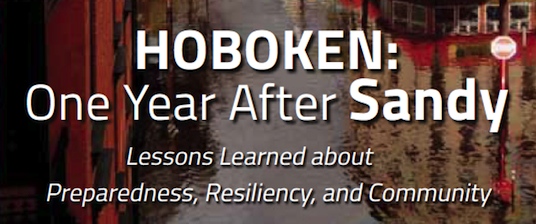
Hoboken: One Year After Sandy, Lessons Learned about Preparedness, Resiliency, and Community
October 2013 - July 2014
Click here to take an interactive virtual tour of the exhibit.
One year after Superstorm Sandy hit, Hoboken still bears the traces, some visible, some invisible. Many flooded homes have been repaired, others have not. Many residents spent days or months cleaning out their homes or businesses, or helping neighbors clean out theirs. Thousands coped with the challenging commute to New York for months while the PATH train was out of service, and hundreds of cars were towed away as total losses.
The storm disrupted all our lives in one way or another, and the Hoboken Historical Museum has been busy collecting the stories and images of its impact on our community to preserve it for history.
On the eve of the first anniversary of the storm, and through the generous support from individuals, corporate donors and community organizations and state agencies, the Museum opened a new exhibit on Saturday, Oct. 26, with a free reception from 5 – 8 p.m. Titled “Hoboken: One Year After Sandy, Lessons Learned about Preparedness, Resiliency, and Community,” the exhibit assembled a range of content — oral histories, images, videos, maps and scientific analyses — to help explain how Hoboken responded and learned new lessons about coping with major storm surges. As a special feature, through the auspices of the United Way of Hudson County, the Museum hosted a Sandy Community Outreach program for residents affected by the storm throughout the course of the exhibit.
The Sandy exhibit included a lecture series involving Stevens professors and guest lecturers from Rutgers Graduate School, plus students from New Jersey Institute of Technology. Funded by a grant from the Robin Hood Foundation and administered by the United Way of Hudson County, the Sandy Community Outreach program offered the services of a licensed Disaster Relief Crisis Counselor, Dawn Donnelly, to anyone in the community still working through issues connected with the aftermath of Superstorm Sandy.
The exhibit was made possible through funding from Hudson County Office of Cultural and Heritage Affairs, the New Jersey Historical Commission, Applied Companies, Bijou Properties, John Wiley & Sons, Rockefeller Development Group, and Stevens Institute of Technology.
The Museum would also like to thank the following donors for their generosity in supporting this Sandy exhibit: Ann Bauer, Agnes Bossolina, Cheryl E. Bracht, Joel and Bernadette Branosky, Gretchen and Julian Brigden, Michael Bruno, John Carey, Jeff Church, Barri and Dan Cillié, Margaret Clarkson, Phil Cohen and Rebecca Kramnick, Francine Colon and Gary Bierman, Marie Crowley, Damian De Virgilio, Dennis English, Cathy Ferrone and David George, Eugene and Joyce Flinn, Marc Gellman, Kirsten Georges, Barbara Gross, Rob and Julie Harari, Edward Heulbig, Bob Foster and Holly Metz, Hudson Place Realty, Valerie Hufnagel, Elizabeth Kennelly, Jane Klueger, Beau and John Kuhn, Susan Lapczynski, Joanne and Craig Laurie, Heidi Learner, Bruce and Jeanne Lubin, Paul Mattheiss, Elaine Mauriello, Penny Metsch, Ryan Mitchell, Ann Murphy, Paul Neshamkin, New Jersey Historical Commission, David Nielsen, Billy Noonan, Jennifer and Patrick O’Callaghan, Jean O’Reilly, Jill and Baz Preston, Janice Reed, Michael Rusignuolo, David H. Sandt, the Schmalzbauer family, Don Sichler, Laura Sigman, Razel Solow and Joel Trugman, Carrie Spindler, Arnold Stern, Strategic Insurance Partners, Bill Tobias, Linda Vollkommer, Joanna and Herman Weintraub, Louise and Bill Zerter.
John Cheney – “Spontaneous Hoboken”
August 25 - September 29, 2013
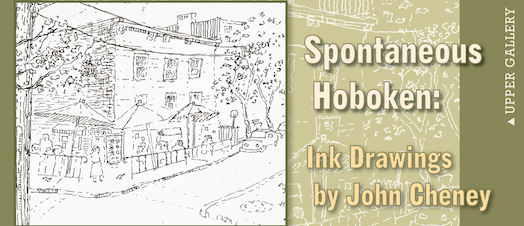
Hoboken resident and longtime Macy’s Parade Studio float builder John Cheney loves the challenge of drawing in ink. “Ink won’t allow you to go back and erase – you can accommodate errors, but just like in life, you can’t go back and erase a mistake,” he says.
He often takes a sketchpad and a foam cushion and looks for a perch where he can observe scenes of typical Hoboken life. Using good drawing pens with archival ink, Cheney launches right in to a sketch, with no pencil underdrawing. Unlike other media, such as charcoal or pencil or paint, which require the artist to push the medium around on the paper, “ink is excited to come out of the pen,” because of the way paper pulls ink out of the pen. “I know it’s going to be good if the line tingles as it flows out of the pen,” he adds.
His ink drawings fairly dance with vitality. About a dozen were on display from August 25 – September 29, 2013 in the Museum’s Upper Gallery, in an exhibition titled “Spontaneous Hoboken: Ink Drawings by John Cheney.” The exhibit opened with a free reception at the Museum from 2 – 5 pm on Aug. 25.
Click here to see a virtual gallery of the exhibit.
Cheney has been doing these types of drawings since he was about 20 years old. Like many of his generation, he grabbed a knapsack and left his hometown of Manchester, New Hampshire to travel the world, with a sketchpad and ink pens at hand, learning his craft as he went along. “Many of my drawings are pen-and-ink sketches of my travels to Egypt and France, but many are inspired by my adopted home, Hoboken, where I have lived and worked for almost 40 years.”
Cheney returned from his travels to enroll in some classical art training, so he would be comfortable in many media, from large-scale constructions to quick, impressionistic line drawings. He studied art at the University of New Hampshire, the Art Students League in New York, the New York Academy, and the National Academy, but he often prefers working in the medium he fell in love with before his formal schooling, as an itinerant hippie in the ’60s. “My drawings still reflect some elements of what I learned along the way.”
He moved to Hoboken in 1981 after landing a job at Macy’s Parade Studio in 1976, when it was based in the former Tootsie Roll factory at 15th St. and Willow Ave. He obviously enjoys his work, as he has been there ever since! “My career as float builder with the Macy’s Parade Studio enables me to engage all aspects of my artistic training and allows me to construct large-scale innovative parade floats, some as large as 70 feet long, made to be collapsible for easy transport through the Lincoln Tunnel.”
Last year, he applied his skills as a float builder as a lark with some friends for the Coney Island 30th Annual Mermaid Parade. They built and pulled by hand an elaborate 30-foot float, in the theme of Cleopatra’s barge, to honor the anniversary.
This exhibition was made possible by a Block Grant from the State/County Partnership program for the Arts administered by the Hudson County Division of Cultural and Heritage Affairs/Tourism Development, Thomas A. DeGise, County Executive, and the Board of Chosen Freeholders.
Benjamin Roman – “A Child’s Innocence”
May 5 - June 30, 2013; June 9, 4 pm: Artist Talk
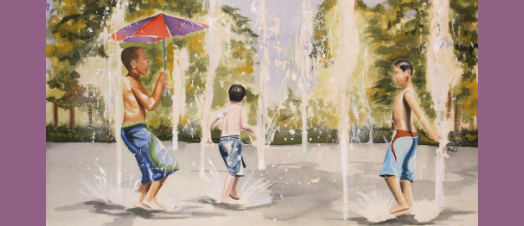
Growing up in the Bronx under the watchful eye of a very protective grandmother, Benjamin Roman Jr. and his sister had a lot of time to while away indoors. He would fill hours sketching scenes of his apartment, images from TV, whatever was in front of him. He enjoyed drawing, but didn’t consider pursuing art as a career until he enrolled in New Jersey City University and met his faculty advisor, Professor Dennis Dittrich, who was also acting President of the Society of Illustrators in New York.
“He encouraged me and inspired me to be a better artist,” Roman says. “He told me, ‘You don’t need a degree to be an artist, but there’s a lot you can learn here.’” In Roman’s final year at NJCU, Professor Dittrich encouraged him to try his hand at watercolors, a medium he had been avoiding because he’d heard it was difficult. He quickly fell in love with the medium, and only regrets he didn’t try it sooner.
A series of Roman’s watercolor portraits of children were on display from May 5 – June 30, 2013 in the Upper Gallery of the Museum in an exhibit titled, “Portraits of Childhood, Watercolors by Benjamin Roman.” The Museum invited the public to an opening reception from 2 – 5 p.m. on May 5, and again for an artist’s talk on June 9 at 4 p.m.
Roman earned a B.A. in Art Communication with a minor in Early Childhood Education, and has been an art teacher for kindergarten, pre-K and pre-school children in area schools for the past 16 years. He now teaches at Beyond Basic Learning, in Hoboken, and paints at least three or four times a week, working on commissioned portraits as well as paintings just for the sake of painting.
Naturally, as a teacher, he finds children a fascinating subject matter, but he also paints portraits of adults, and landscapes. He’s fascinated with the challenge of depicting in his subjects’ expressions the essence of what it means to be young and innocent. “To capture the warmth and heart revealed in a child’s face is my ultimate goal.”
One of his paintings, “Treasure of Innocence,” depicts a group of children in a grassy park, and hangs in the collections of the Union City Museum of Art at the William V. Musto Cultural Center. He’s also self-published two books of his paintings, as well as a book of poetry. Find out more about his work at benswatercolor.com.
Roman likes to work in layers, to give his paintings more detail and depth, almost like working in oils. He finds inspiration in artists as varied as Norman Rockwell, Mary Cassatt, Vermeer and Rembrandt. Though their styles are very different, they have in common the ability to tell a story and convey a moment in time that seems special. He’s also learned a lot about working with watercolors by studying the work of New Mexico-based Steve Hanks and Peruvian Rogger Oncoy. “Children are unpredictable, watercolor is too.”
This exhibition was made possible by a Block Grant from the State/County Partnership program for the Arts administered by the Hudson County Division of Cultural and Heritage Affairs/Tourism Development, Thomas A. DeGise, County Executive, and the Board of Chosen Freeholders.
Mac Hartshorn – “Photographs”
March 17 - April 28, 2013; April 13, 4 pm: Artist Talk
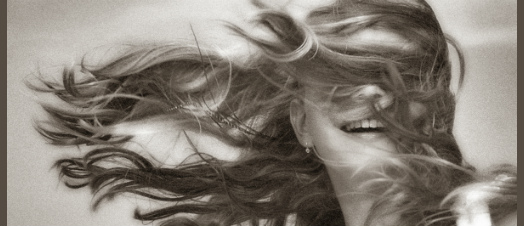
The Museum is pleased to open a new Upper Gallery art exhibit on the same day as Hoboken’s 3rd Sunday Gallery Walk, March 17, with “Mac Hartshorn, Photographer,” an exhibit of artistic photographs of babies and children by professional portrait photographer, Mac Hartshorn. The exhibit opens with a free reception from 2 – 5 pm, and all are welcome.
This exhibit consists of photos Hartshorn has taken for the art of the image, which usually results in something more abstract than a typical family portrait session. Describing his process, Hartshorn explains, “I approach the photo session being open to whatever happens. I want families to feel totally comfortable and interact naturally. That’s when the magic happens. Little toes or a baby’s tiny hand grasping a father’s finger can be appreciated by all, not just the parents.”
The artwork is both as unique as the people he’s taking pictures of, and universal enough to be appreciated by all. Please stop by on Sunday, or before April 28.
Visit his website at hartshornportraiture.com.
This exhibition was made possible by a Block Grant from the State/County Partnership program for the Arts administered by the Hudson County Division of Cultural and Heritage Affairs/Tourism Development, Thomas A. DeGise, County Executive, and the Board of Chosen Freeholders.
Thomas F. Yezerski – “Meadowlands, A Wetlands Survival Story”
January 27 - March 10, 2013
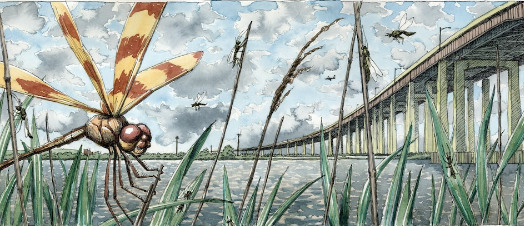
For Tom Yezerski, all roads seemed to lead to the Meadowlands. Literally.
As a recent transplant to New Jersey from Allentown, Pa., Yezerski moved to Rutherford 14 years ago seeking a reasonably affordable community close enough to New York City for him to pursue his dream of becoming an established children’s book artist and author. As so many newcomers discover, the dizzying array of the area’s highway signage conspired to lead him astray, and more often than not, he found himself driving into this vast wilderness with the reputation as the source of what made New Jersey the butt of many jokes in Pennsylvania.
Click here to see a virtual gallery of the exhibit.
A nature-lover, Yezerski found his curiosity piqued, so he did some research into the history of the Meadowlands and visited the nature center at the heart of it, and soon hatched a project that became his fourth work as a writer and artist of children’s books, Meadowlands, A Wetlands Survival Story, published in 2011 by Farrar, Straus & Giroux. The Museum is pleased to present an exhibit of the original watercolor and ink paintings that comprise the book, with an opening reception on Sunday, Jan. 27, from 2 – 5 p.m. The show will be on view in the Upper Gallery until March 10.
Ten years in the making, the book plunged Yezerski into research not only about the history of the place, but the biodiversity of the species that once teemed in the tidal marshlands and are now returning, after a concerted effort by federal, state, and local authorities and environmental activist groups. His book details in images and text—simple enough for elementary school readers but complex enough to suit the enormous scale—the fascinating story of the return to health of this natural treasure at the western edge of Hudson County.
Yezerski wrote Meadowlands and sketched the drawings while living in Rutherford, but painted the final art after moving to Hoboken. He currently lives in Hoboken on Garden Street, with his wife, and says they both enjoy hiking and canoeing through “the Meadows” and excursions with the Hackensack Riverkeepers organization.
Yezerski’s first work as a professional artist came in creating prints for children’s clothing. Eager to return to illustration, he started writing and illustrating his own book, about his Polish and Irish immigrant grandparents, a Romeo-and-Juliet love story set in the coal-mining country of eastern Pennsylvania. That story became his first published book, Together in Pinecone Patch, in 1998. Subsequent picture books Queen of the World and A Full Hand also depict family members as comic or historic characters. He has also illustrated 10 other books for other authors. The New York Times listed Meadowlands in its Notable Children’s Books of 2011, and the New York Public Library listed it among its Best Non-Fiction Books of 2011. It earned an inaugural Cook Prize Honor from Bankstreet College.
Yezerski took his first art lessons while in the third grade, riding his bike to an artist’s studio every Saturday morning to copy greeting cards in chalk pastel. During high school, he studied drawing and color theory at The Barnstone Studios, in Coplay, Pa. Yezerski earned his B.F.A. in Illustration in 1991, at Syracuse University. Visit his website at http://www.thomasfyezerski.com/index.html.
This exhibition was made possible by a Block Grant from the State/County Partnership program for the Arts administered by the Hudson County Division of Cultural and Heritage Affairs/Tourism Development, Thomas A. DeGise, County Executive, and the Board of Chosen Freeholders.