Collections Item Detail
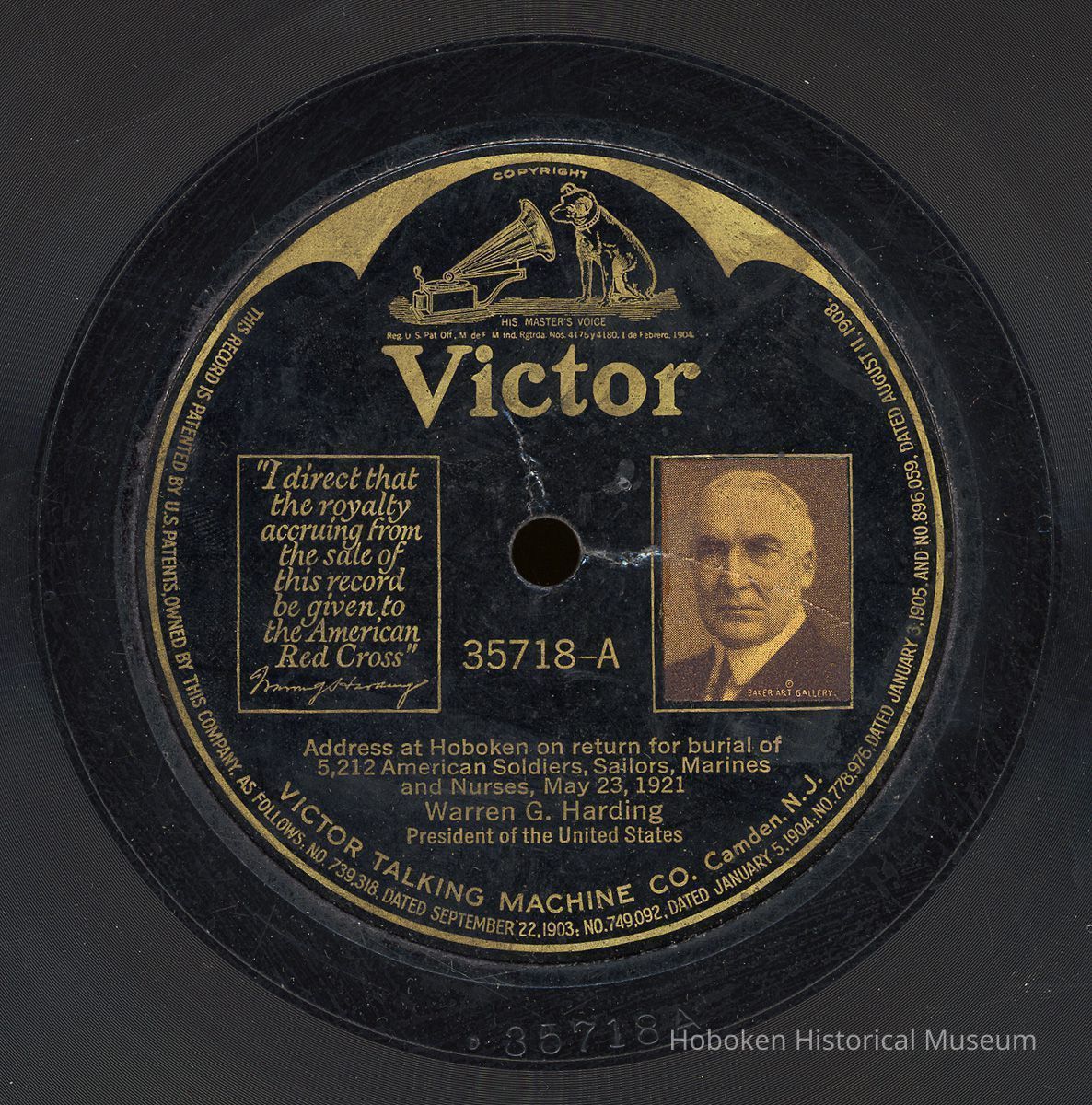
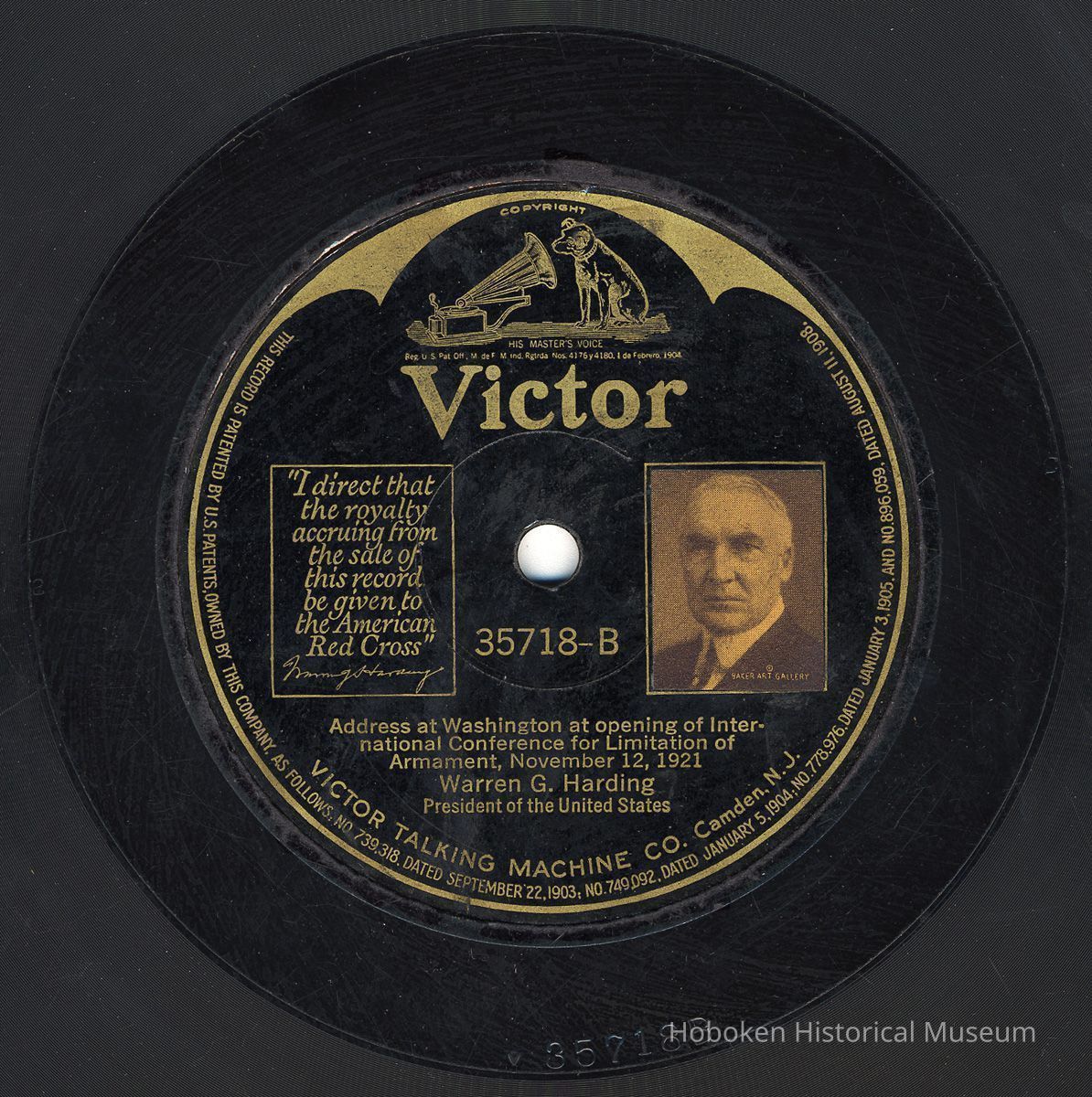
Record: Harding's Address; Ceremony for War Dead at Hoboken pier, May 23, 1921. Victor 35178.
2003.006.0017
2003.006
Heliker, John
Donation
Gift of John Heliker.
1921 - 1923
Date: 1921-1923
Good
Notes: Victor 35718-A: transcription for Harding's Hoboken address was found in 2010 at this URL: http://www.ebooksread.com/authors-eng/warren-g-warren-gamaliel-harding/addresses-of-president-harding-may-23-1921-dra.shtml [note text from that source has been regularized as many mis-spellings were present] Hoboken, N. J., on the Occasion of the Return of 5,212 Bodies of Soldiers, Sailors, Marines, and Nurses Who Lost Their Lives in the Great War. There grows on me the realization of the unusual character of this occasion. Our Republic has been at war before, it has asked and received the supreme sacrifices of its sons and daughters, and faith in America has been justified. Many sons and daughters made the sublime offering and went to hallowed graves as the Nation's defenders. But we never before sent so many to battle under the flag in foreign land, never before was there the impressive spectacle of thousands of dead returned-to find eternal resting place in the beloved homeland. The incident is without any parallel in history that I know. These dead know nothing of our ceremony today. They sense nothing of the sentiment or the tenderness which bring their wasted bodies to the homeland for burial close to kin and friends and cherished associations. These poor bodies are but the [ ] tenements once possessed of souls which flamed in patriotic devotion, lighted new hopes on the battle grounds of civilization and their sacrifices sped on to accuse autocracy before the court of eternal justice. We are not met for them, though we love and honor and speak a grateful tribute. It would be futile to speak to those who do not hear or to sorrow for those who can not sense it or to exalt those who can not know. But we can speak for country, we can reach those who sorrowed and sacrificed through their service, who suffered through their going, who glory with the Republic through their heroic achievements, who rejoice in the civilization their heroism preserved. Everbearing, every memorial, every tribute is for the dying — an offering in compensation of sorrow. When the light of life goes out there is a new radiance in eternity, and somehow the glow of It relieves the darkness which is left behind. Never a death but somewhere a new life; never a sacrifice but somewhere an atonement; never a service but somewhere and somehow an achievement. These had served, which is the supreme inspiration in living. They have earned everlasting gratitude, which is the supreme solace in dying. No one may measure the vast and varied affections and sorrows centering on this priceless cargo of bodies — once living, fighting for, and finally flying for the Republic. One's words fail, his understanding is halted, his emotions are stirred beyond control when contemplating these thousands of beloved dead. I find a hundred thousand sorrows touching my heart, and there is ringing in my ears, like an admonition eternal, an insistent call, "It must not be again ! It must not be again!" God grant that it will not be and let a practical people join in cooperation with God to the end that it shall not be. I would not wish a Nation for which men are not willing to fight and, if need be, to die, but I do wish for a Nation where it is not necessary to ask that sacrifice. I do not pretend that millennial days have come, but I can, believe in the possibility of a Nation being so righteous as never to make a war of conquest and a Nation so powerful in righteousness that none will dare invoke her wrath. I wish for us such an America. These heroes were sacrificed in the supreme conflict of all human history. They saw democracy challenged and defended it. They saw civilization threatened and rescued it. They saw America affronted and resented it. They saw our Nation's rights imperiled and stamped those rights with a new sanctity and renewed security. They gave all which men and women can give. We shall give our most and best if we make certain that they did not die in vain. We shall not forget, no matter whether they lie amid the sweetness and the bloom of the homeland or sleep in the soil they crimsoned. Our mindfulness, our gratitude, our reverence shall be in the preserved Republic and the maintained liberties and the supreme justice for which they died. [end transcription of May 23, 1921 address] _________________ Victor35718-B: transcription of the text for Harding's Address on November 12, 1921 as found in 2010 at this URL: http://www.ebooksread.com/authors-eng/united-states-president-1921-1923--harding/conference-on-the-limitation-of-armament-address-of-the-president-of-the-uni-tin.shtml [note text has not been fully regularized] CONFERENCE ON THE LIMITATION OF ARMAMENT ADDRESS OF THE PRESIDENT OF THE UNITED STATES AT THE OPENING OF THE CONFERENCE ON THE LIMITATION OF ARMAMENT AT WASHINGTON, NOVEMBER 12, 1921 Mr. Secretary and Members of the Conference, Ladies and Gentlemen : It is a great and happy privilege to bid the delegates to this Conference a cordial welcome to the Capital of the United States of America. It is not only a satisfaction to greet joii be- cause we were lately participants in a common cause, in which shared sacrifices and sorrows and triumphs brought our nations more closely together, but it is gratifying to address 3'OU as the spokes- men for nations whose convictions and attending actions have so much to do with the weal or woe of all mankind. It is not possible to overappraise the importance of such a confer- ence. It is no unseemly boast, no disparagement of other nations which, though not represented, are held in highest respect, to declare that the conclusions of this body will have a signal influence on all human progress — on the fortunes of the world. Here is a meeting, I can well believe, which is an earnest of the awakened conscience of twentieth centur}^ civilization. It is not a convention of remorse, nor a session of sorrow. It is not the con- ference of victors to define terms of settlement. Nor is it a council of nations seeking to remake humankind. It is rather a coming together, from all parts of the earth, to apply the better attributes of mankind to minimize the faults in our international relationships. Speaking as official sponsor for the invitation, I think I may say the call is not of the United States of America alone, it is rather the spoken word of a war-wearied Avorld, struggling for restoration, hungering and thirsting for better relationship ; of humanity crying for relief and craving assurances of lasting peace. It is easy to understand this world-wide aspiration. The glory of triumph, the rejoicing in achievement, the love of liberty, the de- votif)n to country, the pangs of sorrow, the burdens of debt, the desolation of ruin — all these are appraised alike in all lands. Here in the United States we are but freshly turned from the burial of an unknown American soldier, when a nation sorrowed while paying liim tribute. Whether it was spoken or not, a hundred millions of our peoples were summarizing the inexcusable causes, the incalculable cost, the unspeakable sacrifices, and the unutterable sorrows, and there was the ever iiii])elling (luestir)n : How can humanity justify or God forgive? Human hate demands no such toll; ambition and preed must be denied it. 1 i' nusundej'standing must take the blame, th(in let us banish it, and let understanding rule and make good will regnant everywhere. All of us (h^ninnd liberty and justice. There cannot be one without the other, and they must be held the un- questioned possession of all peoples. Inherent rights are of God, and the tragedies of the world oiiginate in tlieir attempted denial. The world to-day is infringing ihcir enjoyment by arming to defend or deny, when simple sanity calls for their recognition through common understanding. Out of the cataclysm of the World War came new fellowships, new convictions, new aspirations. It is ours to make the most of them. A world stao-gerinoj with debt needs its burden lifted. Humanity which has been shocked by wanton destruction would minimize the agencies of that destruction. Contemplating the measureless cost of war and the continuing burden of armament, all thoughtful peoples wish for real limitation of armament and would like war outlaAved. In sober- est reflection the world's hundreds of millions who pay in peace and die in war wish their statesmen to turn the expenditures for de- struction into means of construction, aimed at a higher state for those who live and follow after. It is not alone that the world can not readjust itself and cast aside the excess burdens without relief from the leaders of men. War has grown progressively cruel and more destructive from the first re- corded conflict to this pregnant day, and the reverse order would more become our boasted civilization. Gentlemen of the Conference, the United States welcomes you with unselfish hands. We harbor no fears; we have no sordid ends to serve; we suspect no enemy; we contemplate or apprehend no con- quest. Content with what we have, we seek nothing which is an- other's, we only wish to do with you that finer, nobler thing which no nation can do alone. We wish to sit with you at the table of international understand- ing and good will. In good conscience we are eager to meet you frankly, and invite and offer cooperation. The world demands a sober contemplation of the existing order and the realization that there can be no cure without sacrifice, not by one of us, but bv all of us. I do not mean surrendered rights, or narrowed freedom, or denied aspirations, or ignored national necessities. Our Republic would no more ask for these than it would give. No pride need be humbled, no nationality submerged, but I would have a mergence of minds committing all of us to less preparation for war and more enjoyment of fortunate peace. The higher hopes come of the spirit of our coming together. It is but just to recognize yarying needs and peculiar positions. Nothing can be accomplished in disregard of national apprehensions. Rather, we should act together to remove the causes of apprehensions. This is not to be done in intrigue. Greater assurance is found in the ex- changes of simple honesty and directness, among men resolved to accomjolish as becomes leaders among nations, when civilization itself has come to its crucial test. It is not to be challenged that government fails when the excess of its cost robs the people of the way to happiness and the oppor- tunity to achieve. If the finer sentiments were not urging, the cold, hard facts of excessive cost and the eloquence of economics would urge us to reduce our armaments. If the concept of a better order does not appeal, then let us ponder the burden and the blight of continued competition. It is not to be denied that the world has swung along throughout the ages Avithout heeding this call from the kindlier hearts of men. But the same world never before was so tragical!}- brought to reali- zation of the utter futility of passion's sway when reason and con- science and fellowship point a nobler way. I can speak officially only for our Ignited States. Our hundred millions frankly want less of armament and none of war. Wholly free from guile, sure in our own minds tliat we harbor no unworthy designs, we accredit the world with the same good intent. So I wel- come YOU, not alone in good will and high purpose, but with high faith. We are met for a service to mankind. In all simplicity, in all honesty and all honor, there may be written here the avowals of a world conscience refined by the consuming fires of war, and made more sensitive by the anxious aftermath. I hope for that under- standing which will emphasize the guarantees of peace, and for com- mitments to less burdens and a better order which will tranquilize the world. In such an accomplishment there will be added glory to our flags and ours, and the rejoicing of mankind will make the transcending music of all succeeding time. [end] Status: OK Status By: dw Status Date: 2010-12-02