Collections Item Detail
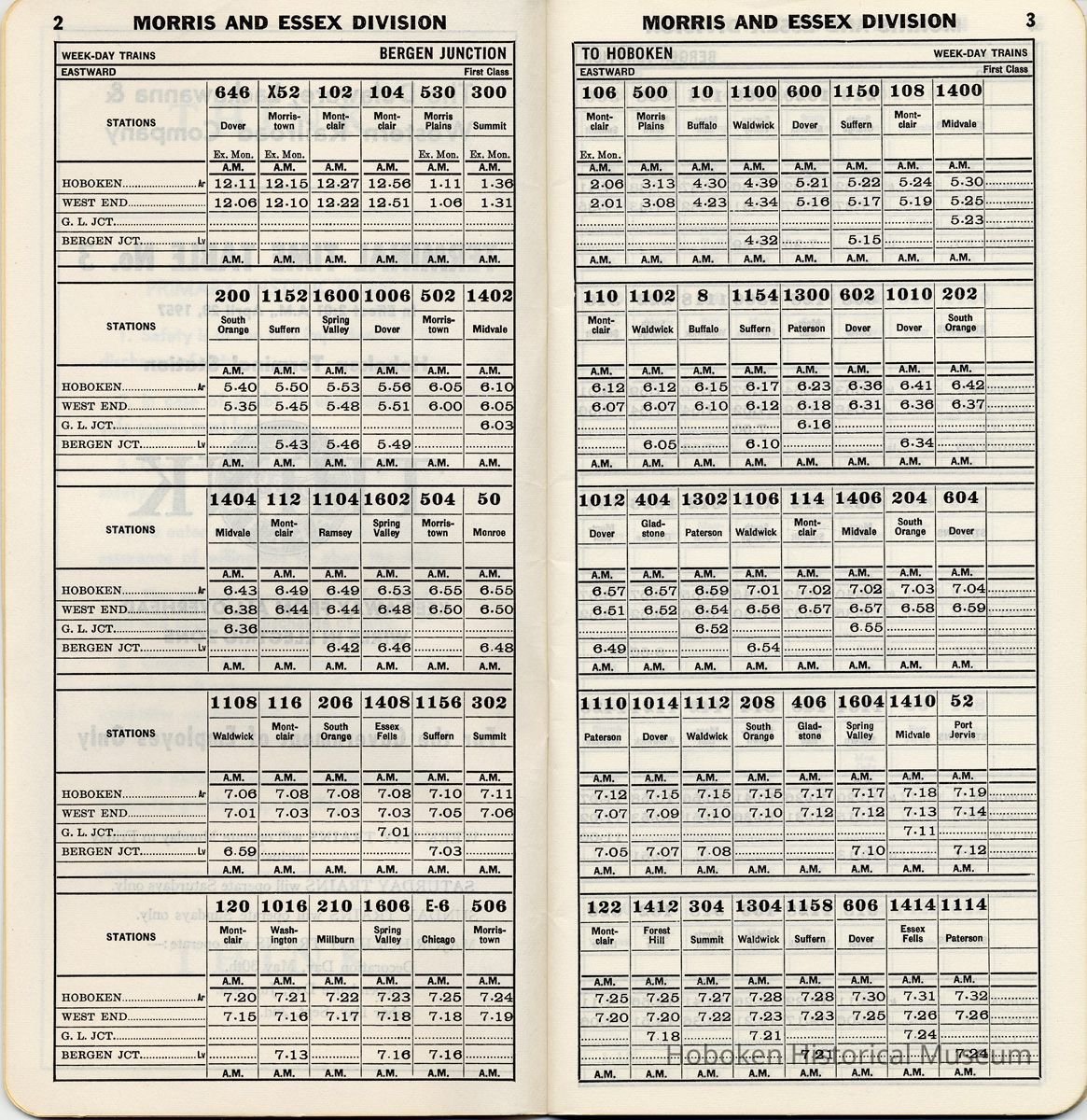
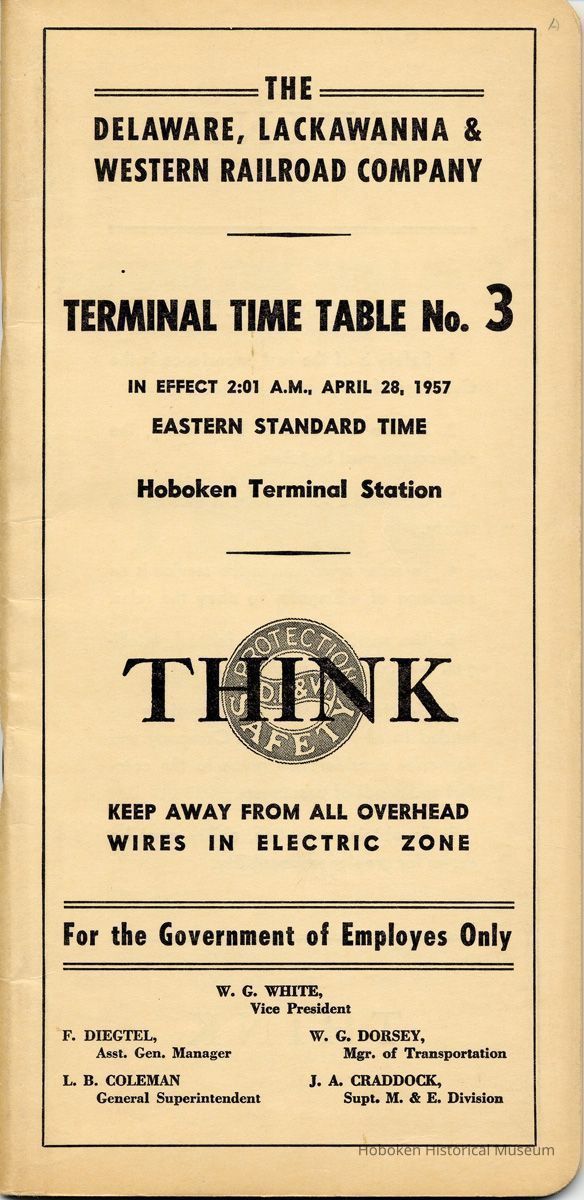
Timetable (ETT): D.L. & W. R.R., Hoboken Terminal Station; Terminal Time Table No. 3. Eff. Apr.28, 1957.
2012.001.0149
2012.001
Purchase
Purchase
Museum Collections.
1957 - 1957
Date(s) Created: 1957 Date(s): 1957
Good
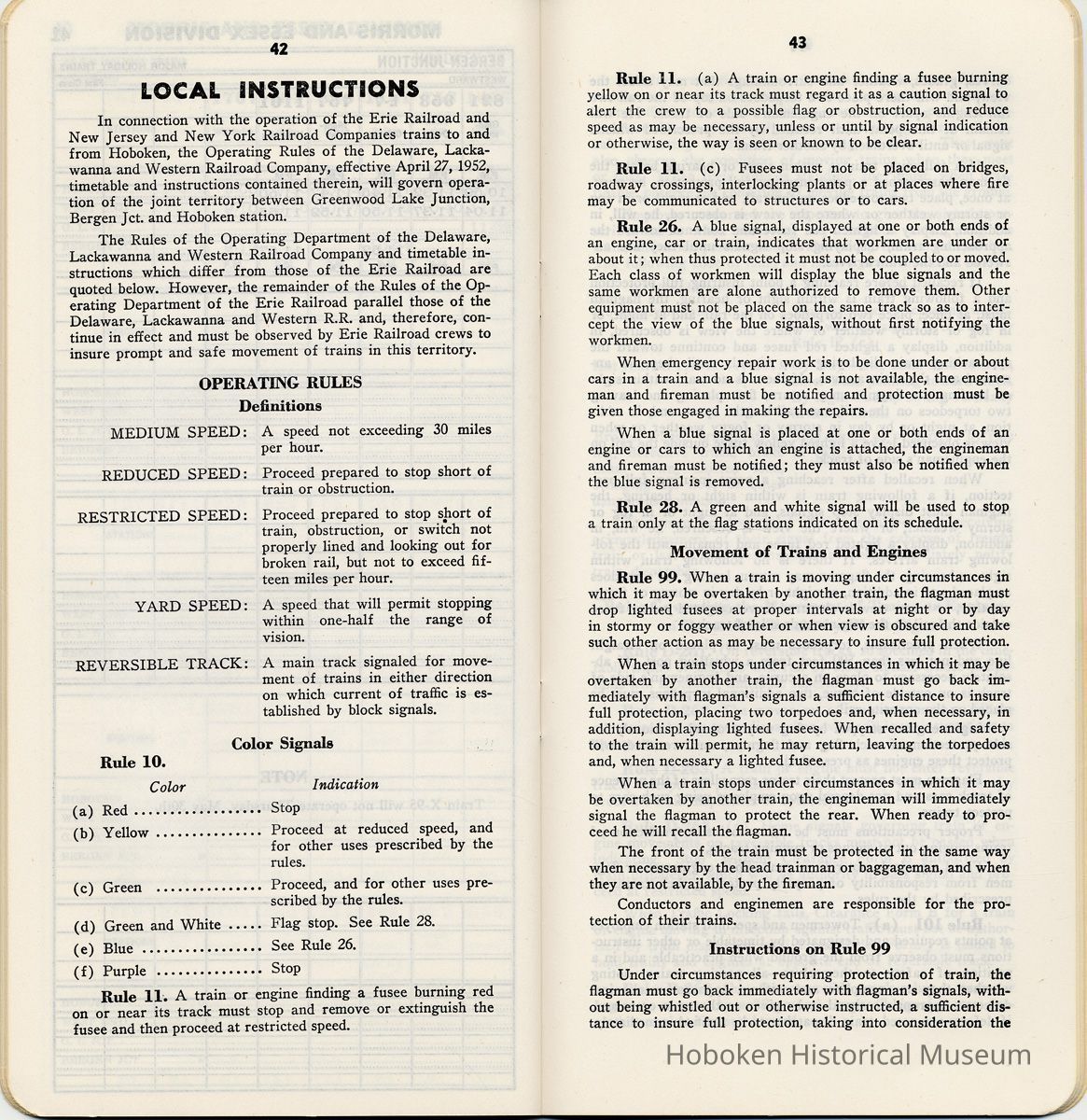
Notes: pages 42-43 LOCAL INSTRUCTIONS In connection with the operation of the Erie Railroad and New Jersey and New York Railroad Companies trains to and from Hoboken, the Operating Rules of the Delaware, Lackawanna and Western Railroad Company, effective April 27, 1952, timetable and instructions contained therein, will govern operation of the joint territory between Greenwood Lake Junction, Bergen Jet. and Hoboken station. The Rules of the Operating Department of the Delaware, Lackawanna and Western Railroad Company and timetable instructions which differ from those of the Erie Railroad are quoted below. However, the remainder of the Rules of the Operating Department of the Erie Railroad parallel those of the Delaware, Lackawanna and Western R.R. and, therefore, continue in effect and must be observed by Erie Railroad crews to insure prompt and safe movement of trains in this territory. OPERATING RULES Definitions MEDIUM SPEED: A speed not exceeding 30 miles per hour. REDUCED SPEED: Proceed prepared to stop short of train or obstruction. RESTRICTED SPEED: Proceed prepared to stop short of train, obstruction, or switch not properly lined and looking out for broken rail, but not to exceed fifteen miles per hour. YARD SPEED: A speed that will permit stopping within one-half the range of vision. REVERSIBLE TRACK: A main track signaled for movement of trains in either direction on which current of traffic is established by block signals. Color Signals Rule 10. Color Indication (a) Red.................. Stop (b) Yellow............... Proceed at reduced speed, and for other uses prescribed by the rules. (c) Green ............... Proceed, and for other uses prescribed by the rules. (d) Green and White..... Flag stop. See Rule 28. (e) Blue ................. See Rule 26. (f) Purple ............... Stop Rule 11. A train or engine finding a fusee burning red on or near its track must stop and remove or extinguish the fusee and then proceed at restricted speed. Rule 11. (a) A train or engine finding a fusee burning yellow on or near its track must regard it as a caution signal to alert the crew to a possible flag or obstruction, and reduce speed as may be necessary, unless or until by signal indication or otherwise, the way is seen or known to be clear. Rule 11. (c) Fusees must not be placed on bridges, roadway crossings, interlocking plants or at places where fire may be communicated to structures or to cars. Rule 26. A blue signal, displayed at one or both ends of an engine, car or train, indicates that workmen are under or about it; when thus protected it must not be coupled to or moved. Each class of workmen will display the blue signals and the same workmen are alone authorized to remove them. Other equipment must not be placed on the same track so as to intercept the view of the blue signals, without first notifying the workmen. When emergency repair work is to be done under or about cars in a train and a blue signal is not available, the engine-man and fireman must be notified and protection must be given those engaged in making the repairs. When a blue signal is placed at one or both ends of an engine or cars to which an engine is attached, the engineman and fireman must be notified; they must also be notified when the blue signal is removed. Rule 28. A green and white signal will be used to stop a train only at the flag stations indicated on its schedule. Movement of Trains and Engines Rule 99. When a train is moving under circumstances in which it may be overtaken by another train, the flagman must drop lighted fusees at proper intervals at night or by day in stormy or foggy weather or when view is obscured and take such other action as may be necessary to insure full protection. When a train stops under circumstances in which it may be overtaken by another train, the flagman must go back immediately with flagman's signals a sufficient distance to insure full protection, placing two torpedoes and, when necessary, in addition, displaying lighted fusees. When recalled and safety to the train will permit, he may return, leaving the torpedoes and, when necessary a lighted fusee. When a train stops under circumstances in which it may be overtaken by another train, the engineman will immediately signal the flagman to protect the rear. When ready to proceed he will recall the flagman. The front of the train must be protected in the same way when necessary by the head trainman or baggageman, and when they are not available, by the fireman. Conductors and enginemen are responsible for the protection of their trains. Instructions on Rule 99 Under circumstances requiring protection of train, the flagman must go back immediately with flagman's signals, without being whistled out or otherwise instructed, a sufficient distance to insure full protection, taking into consideration the ============== Status: OK Status By: dw Status Date: 2012-09-20
![inside front cover & page [1]](https://d8e7jbdw4fu0e.cloudfront.net/11047/f32f1aa0-fa33-11ed-a641-b3912f9925a9-wx0aPxc.lg@2x.jpg)