Collections Item Detail
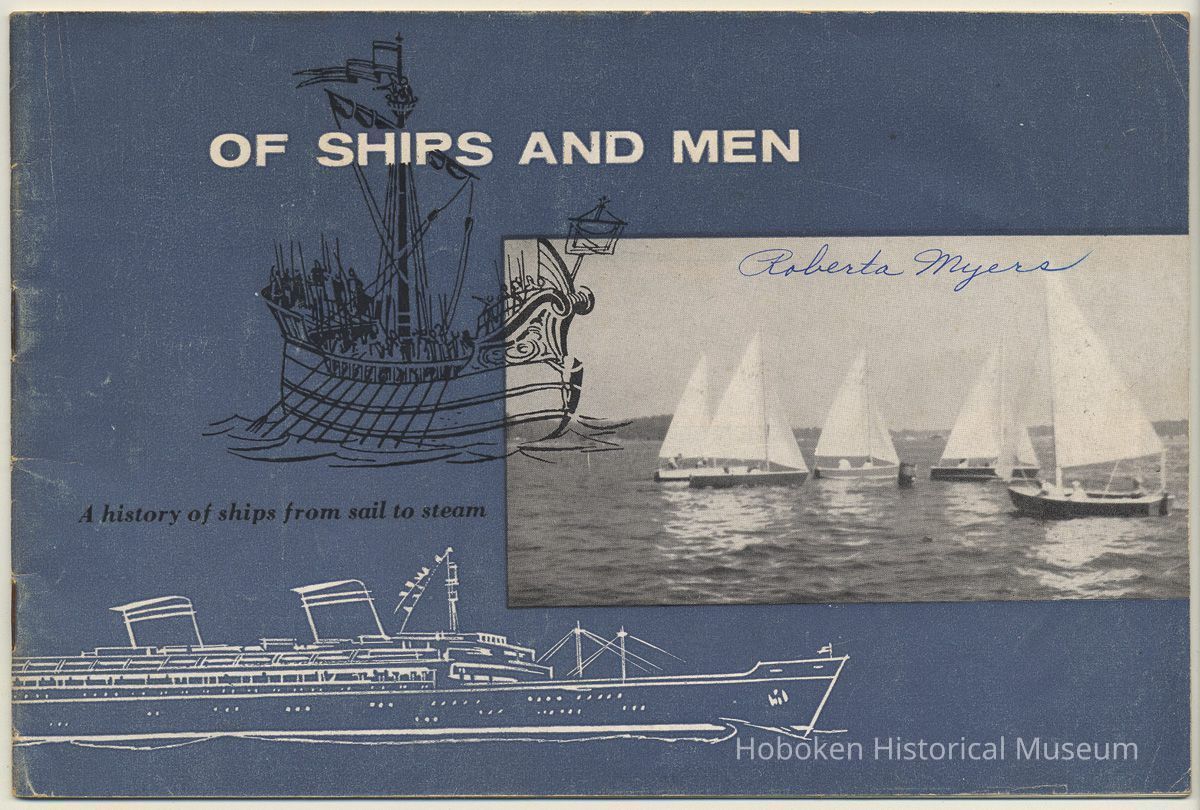
Of Ships and Men: A history of ships from sail to steam. Published by Thomas J. Lipton, Inc., Educational Dept., 1500 Hudson St., Hoboken, N.J.. N.d. (ca. winter or spring 1958.)
2013.005.0028
2013.005
Lukacs, Claire
Gift
Museum Collections. Gift of a Friend of the Museum.
1958 - 1958
Date(s) Created: 1958 Date(s): 1958
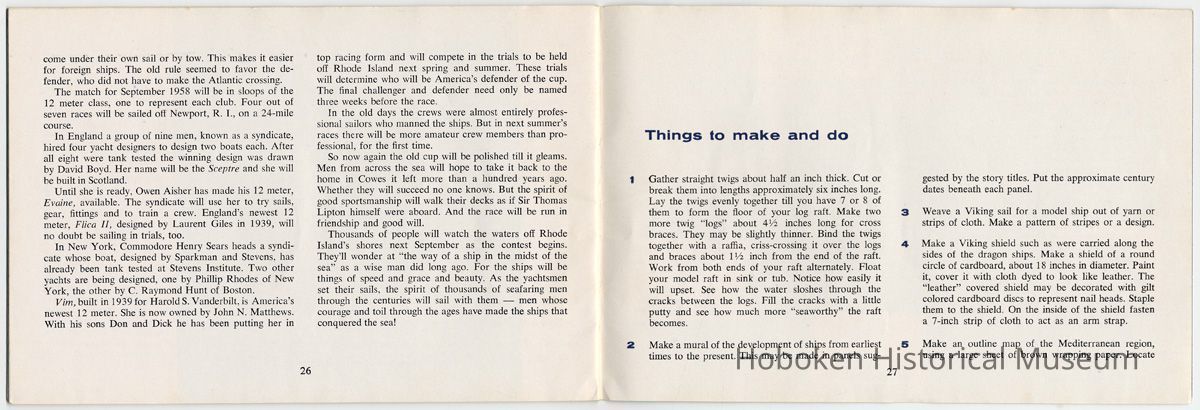
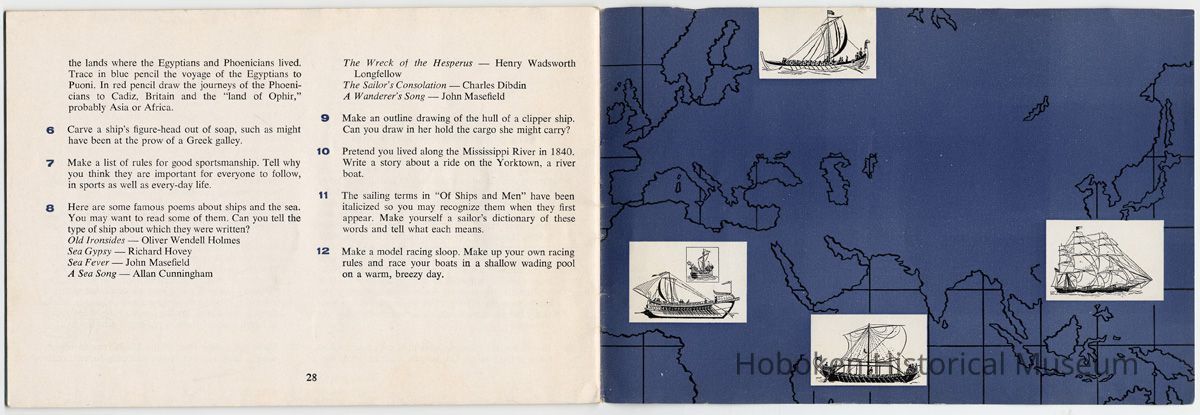
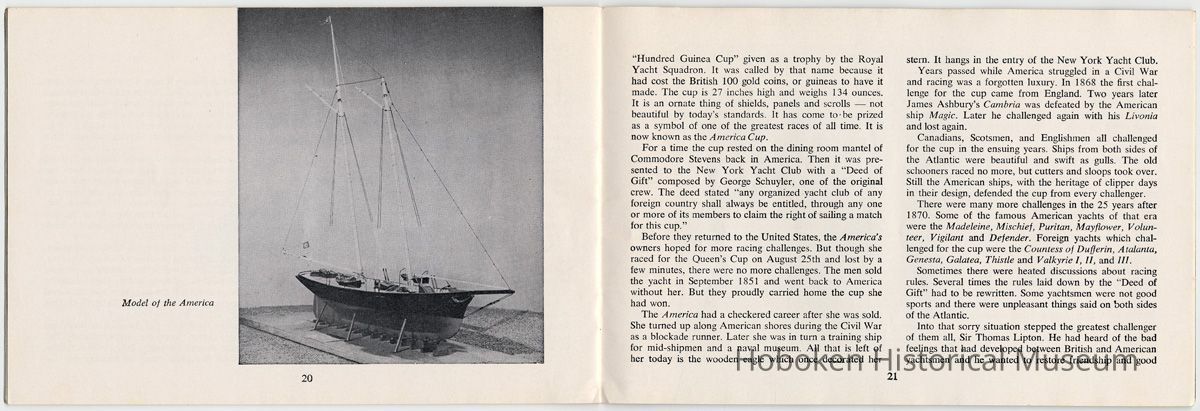
Notes: Archives 2013.005.0028 text of full sections: SAILING SHIPS and RACING, pages 19-26; Things to do, pp. 27-28. ===== SAILING SHIPS and RACING Sailing ships no longer bring cargo from the seven seas. But when the wind is right and the weather fair, thousands of sails dot the horizon along the coasts and lakes of the world. They are not the ghosts of the galleons and clippers. They are modern pleasure ships with crews of boys and girls and men and women who want the thrill of sailing themselves. With the wind in their hair and the spray in their faces they sail for the joy of it and for the sport of racing with their neighbor. Every year thousands of dinghies, sloops, yawls and ketches compete with each other and with wind and tide in one of the world's favorite sports. No longer must the builders of these craft worry about guns and cargo. Their designers are concerned with creating seaworthy ships of speed, style and beauty. The most famous of all sailboat races is the America's Cup Race which will be sailed off Newport, R. I., in September 1958. Yachtsmen in England and America are preparing for it, just as they did when the first race was held over a hundred years ago. It all began on a summer's day in 1851, when 13 men aboard the schooner America sailed to England. John Cox Stevens, Commodore of the New York Yacht Club, had accepted for them the invitation to be guests of the British yachtsmen at Cowes, Isle of Wight. The ship in which they sailed had been built by George Steers in the yard of William Brown. They hoped she would match the fastest ships abroad. She was a schooner with an 81 foot mainmast and 19V2 foot foremast. She had a long, hollow bow and her beams broadened aft like a clipper's. She measured 102 feet overall length (from tip of prow to tip of stern), with 11 foot draft. Her sails spread 5,263 square feet. The America made the crossing to Le Havre in 20 days, six hours. (For five days, four hours, she had been becalmed). She was the first yacht to cross the Atlantic going east or west. It was a foggy day when she was forced to anchor six or seven miles out of Cowes. The fastest British cutter, Laverock, came out to meet her. When the fog lifted the vessels raced to port. The America left the cutter far behind. That was an ominous warning to the British yachtsmen. They were afraid to take the America's challenges to race. The "London Times" jeered at the British yachtsmen. "Was a Yankee boat to find none to take her challenge?" The America's crew applied for her entry into the Royal Yacht Squadron races of August 22, 1851. At last the British decided "not to deny the visitor a fair race." Eighteen yachts, including the America, entered, but only 15 started (seven schooners, eight cutters). The America was the last to get away, but she soon outdistanced the whole fleet. Her prize for winning was the ==== "Hundred Guinea Cup" given as a trophy by the Royal Yacht Squadron. It was called by that name because it had cost the British 100 gold coins, or guineas to have it made. The cup is 27 inches high and weighs 134 ounces. It is an ornate thing of shields, panels and scrolls — not beautiful by today's standards. It has come to-be prized as a symbol of one of the greatest races of all time. It is now known as the America Cup. For a time the cup rested on the dining room mantel of Commodore Stevens back in America. Then it was presented to the New York Yacht Club with a "Deed of Gift" composed by George Schuyler, one of the original crew. The deed stated "any organized yacht club of any foreign country shall always be entitled, through any one or more of its members to claim the right of sailing a match for this cup." Before they returned to the United States, the America's owners hoped for more racing challenges. But though she raced for the Queen's Cup on August 25th and lost by a few minutes, there were no more challenges. The men sold the yacht in September 1851 and went back to America without her. But they proudly carried home the cup she had won. The America had a checkered career after she was sold. She turned up along American shores during the Civil War as a blockade runner. Later she was in turn a training ship for mid-shipmen and a naval museum. All that is left of her today is the wooden eagle which once decorated her stern. It hangs in the entry of the New York Yacht Club. Years passed while America struggled in a Civil War and racing was a forgotten luxury. In 1868 the first challenge for the cup came from England. Two years later James Ashbury's Cambria was defeated by the American ship Magic. Later he challenged again with his Livonia and lost again. Canadians, Scotsmen, and Englishmen all challenged for the cup in the ensuing years. Ships from both sides of the Atlantic were beautiful and swift as gulls. The old schooners raced no more, but cutters and sloops took over. Still the American ships, with the heritage of clipper days in their design, defended the cup from every challenger. There were many more challenges in the 25 years after 1870. Some of the famous American yachts of that era were the Madeleine, Mischief, Puritan, Mayflower, Volunteer, Vigilant and Defender. Foreign yachts which challenged for the cup were the Countess of Dufferin, Atalanta, Genesta, Galatea, Thistle and Valkyrie I, II, and III. Sometimes there were heated discussions about racing rules. Several times the rules laid down by the "Deed of Gift" had to be rewritten. Some yachtsmen were not good sports and there were unpleasant things said on both sides of the Atlantic. Into that sorry situation stepped the greatest challenger of them all. Sir Thomas Lipton. He had heard of the bad feelings that had developed between British and American yachtsmen and he wanted to restore friendship and good ==== will. The cup was again to become "a challenge cup for friendly competition." In 1898 a challenge went out on his behalf from the Royal Ulster Club of Belfast. Sir Thomas Lipton was not himself a skilled yachtsman, for he had never been a helmsman of a sailing ship. He did have a beautiful steam yacht called the Erin. Now his challenge yacht had another Irish name. She was the Shamrock. Sir Thomas made an ideal challenger. He was never unreasonable in his demands, and always courteous and fair. He was born on Crown Street, Rutherglen Road, Glasgow, Scotland. His parents had migrated there from their potato farm in Ulster, Ireland, during a famine in 1850-From the time he was ten he had earned his own living. At 15 he left Scotland to spend four years in America. When he returned to Scotland at 19 he had saved some $500 which he had earned in America doing all sorts of odd jobs. In 1871 he opened his own grocery store, and in nine years he had more than twenty of them. By 1890 he had gone into the tea business so widely that he was known as "Mr. Tea-" He was even commissioned to supply Her Majesty, Queen Victoria, with that beverage. Perhaps it was the China trade, the tales of the clippers running the tea cargo, that first interested him in yachting. Or it may have been his good friend the Prince of Wales who introduced him to that sport. He knew and understood American sailing men from his youthful years in this country. He wanted to see the friendly spirit of the America's Cup race restored. He decided he would try for the cup! The Shamrock was designed by William Fife, Jr., of Scotland. She measured 128 feet overall. Her narrow keel had a bulb of lead weighing 75 tons. This was outside ballast, added weight to give her stability in the water. She was no match for the American defender Columbia, designed by Nathanael G. Herreshoff. Charlie Barr, the Columbia's helmsman was a better skipper too. Sir Thomas Lipton was a gracious loser. "I'll be back," he promised. And back he came, not once more, but four more times to strive for the cup. Each of his ships were named Shamrock, and were identified by the numbers I, II, III, IV, V. It took the best of America's yachts to beat his five Shamrocks. The defenders were the Columbia, Reliance, Resolute and the Enterprise. World War I was to interrupt Sir Thomas' fourth challenge for the cup. When the race was finally held in 1920 all New York wildly welcomed "dear old Tommy," as they called him. He was 70 years old then, but as game as ever. Many Americans hoped in their hearts he would win at last. They had become very fond of this gallant old sportsman. The swift Resolute kept the cup for America. Sir Thomas again took defeat in his stride. ". . . the most graceful loser we have ever seen" cried the newspapers. — And back he came again nine years later — the grand old man of racing! New rules had given more leeway in the yachts' design. ==== The development of aviation had taught many lessons to shipbuilders. Top sail and gaff were discarded and the undivided mainsail appeared on racing sloops. The tall mast was so elaborately braced by wires that it looked like a Marconi wireless station. Ships so equipped were said to be "Marconi rigged." In Sir Thomas's last challenge, Shamrock V was no match for the Enterprise, designed by W. Starling Burgess. With Harold S. Vanderbilt at her helm, the Enterprise took all four of the races and it was four out of seven to win. The old America's Cup was still safe in the New York Yacht Club. But thousands of Americans wished that Sir Thomas had won it — and they were determined that he should have a cup of his very own. Will Rogers proposed in "The New York Times" that the people of America buy Sir Thomas a loving cup. In ten days $16,000 was subscribed, so greatly was the old man loved. "You have been a benefit to mankind, Sir Thomas," said Will Rogers. "You have made losing worthwhile!" A beautiful cup was bought with the money and presented to Sir Thomas inscribed "In the name of hundreds and thousands of Americans and well wishers." "Although I have lost, you make me feel I have won," said Sir Thomas when he accepted the cup. "But I will try again — yes, I will try again!" He would have, too, but in 1931 death overtook him and his sailing days were over. Thomas Octave Murdoch Sopwith challenged for the cup in 1933 but the American Rainbow beat his Endeavour in the first challenge. In 1936 the Ranger designed by Starling Burgess and Olin Stephens was to be the defender. Her hull plan was developed at Massachusetts Institute of Technology. Tank tests of her model had been conducted at Stevens Institute. Charles Nicholson, who designed the British Endeavour II, said of her that she showed the most revolutionary advance in hull design in 50 years. Science and Yankee ingenuity made the Ranger the greatest yacht of them all — she was victor! It has been more than 21 years since that last great race. In May 1957 another challenge came at last from the Royal Yacht Squadron. Behind the scenes, talks had been going on for some time. Everyone felt that the days of the great Class J yachts were over. They were far too expensive to build and operate. It might cost more than a million dollars to build, equip and sail such a yacht in competition today. In order for smaller boats to compete, the "Deed of Gift" had to be changed. The Supreme Court of New York at the request of the New York Yacht Club, changed the rules of the deed in December 1956. Twelve meter boats may now race. The term meter does not mean just the length of the ship alone. It is the result of a formula which includes many of the boat's dimensions. The actual length of the ships should be approximately 45 feet at the water-line and approximately 70 feet overall. Another change in the deed makes it possible for competing boats to be shipped to America, and not forced to ==== ome under their own sail or by tow. This makes it easier for foreign ships. The old rule seemed to favor the defender, who did not have to make the Atlantic crossing. The match for September 1958 will be in sloops of the 12 meter class, one to represent each club. Four out of seven races will be sailed off Newport, R. I., on a 24-mile course. In England a group of nine men, known as a syndicate, hired four yacht designers to design two boats each. After all eight were tank tested the winning design was drawn by David Boyd. Her name will be the Sceptre and she will be built in Scotland. Until she is ready, Owen Aisher has made his 12 meter, Evaine, available. The syndicate will use her to try sails, gear, fittings and to train a crew. England's newest 12 meter, Flica II, designed by Laurent Giles in 1939, will no doubt be sailing in trials, too. In New York, Commodore Henry Sears heads a syndicate whose boat, designed by Sparkman and Stevens, has already been tank tested at Stevens Institute. Two other yachts are being designed, one by Phillip Rhodes of New York, the other by C. Raymond Hunt of Boston. Vim, built in 1939 for Harold S. Vanderbilt, is America's newest 12 meter. She is now owned by John N. Matthews. With his sons Don and Dick he has been putting her in top racing form and will compete in the trials to be held off Rhode Island next spring and summer. These trials will determine who will be America's defender of the cup. The final challenger and defender need only be named three weeks before the race. In the old days the crews were almost entirely professional sailors who manned the ships. But in next summer's races there will be more amateur crew members than professional, for the first time. So now again the old cup will be polished till it gleams. Men from across the sea will hope to take it back to the home in Cowes it left more than a hundred years ago. Whether they will succeed no one knows. But the spirit of good sportsmanship will walk their decks as if Sir Thomas Lipton himself were aboard. And the race will be run in friendship and good will. Thousands of people will watch the waters off Rhode Island's shores next September as the contest begins. They'll wonder at "the way of a ship in the midst of the sea" as a wise man did long ago. For the ships will be things of speed and grace and beauty. As the yachtsmen set their sails, the spirit of thousands of seafaring men through the centuries will sail with them — men whose courage and toil through the ages have made the ships that conquered the sea! [end of section: SAILING SHIPS and RACING] ==== Things to make and do 1 Gather straight twigs about half an inch thick. Cut or break them into lengths approximately six inches long. Lay the twigs evenly together till you have 7 or 8 of them to form the floor of your log raft. Make two more twig "logs" about 4 1/2i inches long for cross braces. They may be slightly thinner. Bind the twigs together with a raffia, criss-crossing it over the logs and braces about 1 1/2 inch from the end of the raft. Work from both ends of your raft alternately. Float your model raft in sink or tub. Notice how easily it will upset. See how the water sloshes through the cracks between the logs. Fill the cracks with a little putty and see how much more "seaworthy" the raft becomes. 2. Make a mural of the development of ships from earliest times to the present. This may be made in panels sug- gested by the story titles. Put the approximate century dates beneath each panel. 3 Weave a Viking sail for a model ship out of yarn or strips of cloth. Make a pattern of stripes or a design. 4 Make a Viking shield such as were carried along the sides of the dragon ships. Make a shield of a round circle of cardboard, about 18 inches in diameter. Paint it, cover it with cloth dyed to look like leather. The "leather" covered shield may be decorated with gilt colored cardboard discs to represent nail heads. Staple them to the shield. On the inside of the shield fasten a 7-inch strip of cloth to act as an arm strap. 5 Make an outline map of the Mediterranean region, using a large sheet of brown wrapping paper. Locate ==== the lands where the Egyptians and Phoenicians lived. Trace in blue pencil the voyage of the Egyptians to Puoni. In red pencil draw the journeys of the Phoenicians to Cadiz, Britain and the "land of Ophir," probably Asia or Africa. 6 Carve a ship's figure-head out of soap, such as might have been at the prow of a Greek galley. 7 Make a list of rules for good sportsmanship. Tell why you think they are important for everyone to follow, in sports as well as every-day life. Q Here are some famous poems about ships and the sea. You may want to read some of them. Can you tell the type of ship about which they were written? Old Ironsides — Oliver Wendell Holmes Sea Gypsy — Richard Hovey Sea Fever — John Masefield A Sea Song — Allan Cunningham The Wreck of the Hesperus — Henry Wadsworth Longfellow The Sailor's Consolation — Charles Dibdin A Wanderer's Song — John Masefield 9 Make an outline drawing of the hull of a clipper ship. Can you draw in her hold the cargo she might carry? 10 Pretend you lived along the Mississippi River in 1840. Write a story about a ride on the Yorktown, a river boat. 11 The sailing terms in "Of Ships and Men" have been italicized so you may recognize them when they first appear. Make yourself a sailor's dictionary of these words and tell what each means. 12 Make a model racing sloop. Make up your own racing rules and race your boats in a shallow wading pool on a warm, breezy day. [end of section: Things to make and do] [end of publication] ==== ==== Status: OK Status By: dw Status Date: 2013-02-27
![pp 22-[23]](https://d8e7jbdw4fu0e.cloudfront.net/11047/aa5afbf0-fb23-11ed-a641-b3912f9925a9-vd29Z86.lg@2x.jpg)
![pp 24-[25]](https://d8e7jbdw4fu0e.cloudfront.net/11047/ab8c5000-fb23-11ed-a641-b3912f9925a9-vd29Z86.lg@2x.jpg)