
Collections Item Detail
Songbook: The World's Best Stephen Foster Songs. Arranged by Milton James. Amsco Music Publishing Co., N.Y., 1942.
2014.071.0001
2014.071
Heliker, John
Donation
Gift of John Heliker.
1942 - 1942
Date(s) Created: 1942 Date(s): 1942
Notes: page [1] CONTENTS AH! MAY THE RED ROSE LIVE ALWAY 44 ANGELINA BAKER 66 AWAY DOWN SOUTH 70 BEAUTIFUL DREAMER 16 COME WHERE MY LOVE LIES DREAMING 20 COMRADES. FILL NO GLASS FOR ME 18 DE CAMPTOWN RACES 4 DOLCY JONES 68 DOLLY DAY 73 DOWN AMONG THE CANE-BRAKES 59 ELLEN BAYNE 88 EULALIE 64 FAIRY BELLE 78 FAREWELL MY LILLY DEAR 85 GENTLE ANNIE 24 GLENDY BURK, THE 42 HARD TIMES COME AGAIN NO MORE 32 JEANIE WITH THE LIGHT BROWN HAIR 6 JENNY JUNE 56 JENNY'S COMING O'ER THE GREEN 80 KATY BELL 62 LAURA LEE 61 LILY RAY 96 LINGER IN BLISSFUL REPOSE 54 LITTLE ELLA 81 LOUISIANA BELLE 72 LULA IS GONE 90 MASSA'S IN DE COLD GROUND 34 MELINDA MAY 58 MY BRUDDER GUM 87 MY OLD KENTUCKY HOME 28 NELLIE WAS A LADY 36 NELLY BLY 52 OH! SUSANNA 10 OLD BLACK JOE 12 OLD DOG TRAY 26 OLD FOLKS AT HOME 14 OLD UNCLE NED 50 OPEN THY LATTICE LOVE 38 RING. RING DE BANJO 30 SOME FOLKS 37 SWEETLY SHE SLEEPS. MY ALICE FAIR 40 UNDER THE WILLOW SHE'S SLEEPING 84 WE ARE COMING, FATHER ABRAAM 46 WHEN OLD FRIENDS WERE HERE 94 WHERE IS THY SPIRIT. MARY? 92 WILLIE. WE HAVE MISSED YOU 76 ==== page [2] Stephen Collins Foster Born near Pittsburgh, Pa., July 4, 1826 Died in New York City, January 13, 1864 Of all American composers, none is more beloved by his countrymen than Stephen Collins Foster. His grand old melodies are favorites, not only in the United States, but in many parts of the world. Foster’s music was written during the most romantic period of our country’s history, the late 1840’s, the 1850’s, and the Civil War years. Through his genius, he caught the spirit of this period, tender, sentimental, gay, brave, and tragic, and crystalized it in song. With little first-hand knowledge of the pre-Civil War South, he nevertheless portrayed in immortal lines its feudal society, its virtues of courage, courtesy and chivalry, and the “peculiar institution” which gave it an unstable foundation—Slavery. He sang of the Negro slave with such deep sympathy, that even though Slavery has been a dead issue for three quarters of a century, we are still moved by the negroes in MASSA’S IN DE COLD GROUND, weeping over the death of their beloved master, or those in MY OLD KENTUCKY HOME, who are leaving their happy home in the Blue Grass, to he sold “down the river” to endure the hardships of life on a sugar plantation. Of the 201 original songs and compositions which Foster is known to have written, about fifty are worthy of preservation. Stephen Foster was born in Lawrenceville, Pennsylvania, now a part of the city of Pittsburgh, on July 4, 1826. His family were prominent in the political, business, and social life of the community. His father, of Scotch-Irish stock, became mayor of Allegheny City, now the North Side of Pittsburgh. His mother, of English origin, was descended from an aristocratic family of the Eastern Shore of Maryland. One of his brothers was the chief engineer in the construction of the Pennsylvania Railroad over the Allegheny Mountains, between Harrisburg and Pittsburgh. Another brother was captain of a Mississippi River steamboat. Stephen, to the surprise of his family, early in life showed an intense interest in music. He learned, unaided, to play on several musical instruments. While attending the Athens Academy, at Athens, Pa., in 1841, he wrote his first composition, THE TIOGA WALTZ. His inspiration was Tioga Point, the beautiful junction of the Susquehanna and the Chemung Rivers, not far from the Academy. He was then fourteen years old. The WALTZ was not published for more than half a century, long after his death. After a brief period of attendance at Jefferson College, Canonsburg, Pa. (now Washington and Jefferson College at Washington, Pa.) Stephen returned to his parents’ home at Pittsburgh in 1841, where he spent the next five years in the study and composition of music. His first published song, OPEN THY LATTICE, LOVE, appeared in 1844, when Stephen was eighteen, and although he probably earned nothing from its sale, he received the encouragement of seeing his work in print. Although Foster’s family were proud of his musical talents, they could not foresee the composition of music as his life work. He thought vaguely of a military or a naval career—for which he was most unsuited by temperament. When he failed to receive an appointment to West Point, he left Pittsburgh and went to Cincinnati, late in 1846, to work for a firm of steamboat agents, in which one of his brothers was a partner. He was then twenty years old. He spent three happy and formative years in Cincinnati, a cultured, music-loving city. Here he made the acquaintance of black-face minstrels and music publishers. He continued to study music and write songs. Two compositions published in 1848 — OLD UNCLE NED and OH! SUSANNA — made him famous almost overnight. When the Forty-Niners crossed the plains to the gold fields of California, they adopted OH! SUSANNA as their marching song. He earned little or nothing from the sale of these two works, but their world-wide success caused him to change his career. He decided to abandon business and to become a professional composer. In 1849, he entered negotiations with Firth, Pond & Company of New York, the leading music publishing house of that day. After they had issued his NELLY WAS A LADY, a wistful melody of life on the Mississippi, he signed a contract with them, according to the terms of which he was to receive royalties on all of his songs which they published thereafter. Early in 1850, he left Cincinnati and returned to Pittsburgh. He was immediately successful in his new work. The early months of that year saw the publication of NELLY BLY, CAMPTOWN RACES, ANGELINA BAKER, and thirteen other melodies. By summer, he was earning enough to marry Jane Denny McDowell of Pittsburgh, daughter of a prominent physician of that city. A daughter, Marion, was born to them the following year. She was their only child. Altogether, Stephen Foster has had fourteen descendants, of whom twelve are alive today. His daughter and one granddaughter died several years ago. 1851 saw the composition of the greatest of all Foster’s works — OLD FOLKS AT HOME. This famous song, about the Suwanee River of Georgia and Florida (a river which Foster never saw) established him as the leading American writer of popular melodies. From the financial point of view, it was his most successful song. It earned him $1,647.46 in less than six years. Other favorites published in 1851 were RING DE BANJO and OH! BOYS, CARRY ME ’LONG. ==== page [3] Stephen Collins Foster In 1852, Stephen and his wife took a steamboat trip from Pittsburgh to New Orleans. It was the first time he had ever been in the Deep South, even though many of his songs had been about Southern plantation life. This was his most creative and financially successful period. In the years from 1852 to 1855, he published more than forty works, including MASSA’S IN DE COLD GROUND, MY OLD KENTUCKY HOME, OLD DOG TRAY, JEANIE WITH THE LIGHT BROWN HAIR, HARD TIMES COME AGAIN NO MORE. COME WHERE MY LOVE LIES DREAMING and SOME FOLKS. The year 1856 marked a turning point in Stephen’s life. He wrote only one song which brought in a financial return — GENTLE ANNIE. This was the year of the Buchanan-Fremont presidential election, and Stephen seems to have forgotten the necessity of earning a living for himself and his family, in his eagerness to share in the excitement of the political campaign. He wrote political songs for the Buchanan Glee Club, a Democratic singing society of Pittsburgh, of which he was Musical Director. Then followed a period of idleness, of financial problems, and of frantic efforts to solve them by selling all his future rights in his previously published songs. This was followed by a period of renewed activity, when he wrote a number of songs of little merit, in an attempt to earn more money. This attempt was only slightly successful. By 1860, Stephen Foster’s fortunes were at a low ebb. In addition to his financial problems, his life was complicated by domestic troubles. His marriage to Jane McDowell was not altogether a happy one, probably due to what we would today call “incompatibility of temperament.” Between 1855 and 1860, four members of his family, including his beloved mother, had died. He seemed to be losing the ability to express himself in his music. All these experiences were emotionally upsetting, and Stephen, like many another highly strung personality of insufficient strength, began to seek escape in alcohol. Some time in 1860, he decided to leave Pittsburgh and go to New York, to be near his publishers. Perhaps he felt that he could begin his life anew in the metropolis, but it was a great mistake. Stephen needed his family and friends to protect him from the world; without them he was lost. Before leaving for New York he wrote one of his masterpieces — OLD BLACK JOE. If Stephen ever sang straight from his own heart, it is in this song. Simple and sincere, like all of his best works, it expresses his emotions on leaving the city of his birth and starting out on an unknown adventure. The last years of Stephen’s life were tragic. From 1860 to 1864, he lived in New York, separated from his family and sinking deeper and deeper into an abyss of poverty, loneliness, and despair. His unfortunate craving for drink became ever more firmly established. Although he wrote many songs during this period, most of them are quite mediocre in quality. His genius was almost gone, yet during these last dark days enough of it remained for him to write BEAUTIFUL DREAMER, a tender song of sentiment, in which we see Stephen remembering the happiness of days gone by. He died in Bellevue Hospital, New York City, on January 13, 1864, as the result of injuries received in a fall. He was only 37 years old. Although his songs were universally sung, and became increasingly popular, he himself was to a great extent forgotten, for half a century. However, the last twenty-five years have seen a remarkable revival of interest in the man, as well as in his music. Many memorials have been established in his honor. On May 27, 1941, a bust of Stephen Collins Foster was unveiled in the Hall of Fame for Great Americans, on the campus of New York University, in New York City. No finer honor can be paid an American than election to this famous institution. Stephen Foster, composer of America’s heart songs, is where he deserves to be. Fletcher Hodges, Jr. Curator, Foster Hall Collection, University of Pittsburgh, Pittsburgh, Pa. ---- The Publishers are indebted to Mr. Fletcher Hodges, Jr., Curator of the Foster Hall Collection of The University of Pittsburgh, for the above biographical sketch of Stephen Foster, and also for the many interesting notes which appear in the following pages. We take this opportunity to acknowledge with thanks and gratitude the help and cooperation he so generously gave us in compiling this book. AMSCO MUSIC PUBLISHING CO. ==== ==== Status: OK Status By: Webster, David Status Date: 2014-11-20
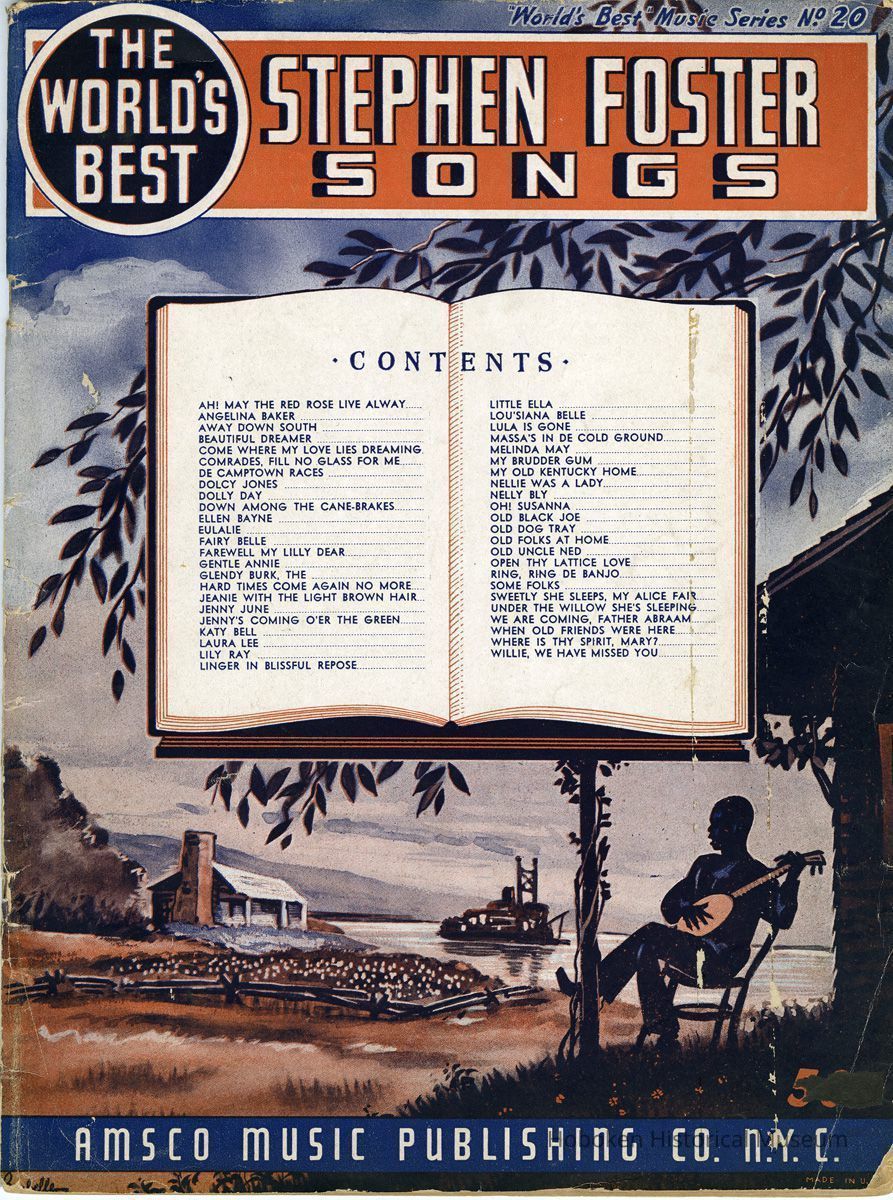
![inside front cover + pg [1] Contents](https://d8e7jbdw4fu0e.cloudfront.net/11047/7cf10bb0-fb54-11ed-a641-b3912f9925a9-wx0aVcu.lg@2x.jpg)
![pp [2-3] Introduction and biography Stephen Collins Foster by Hodges, Jr.](https://d8e7jbdw4fu0e.cloudfront.net/11047/7e21c380-fb54-11ed-a641-b3912f9925a9-wx0aVcu.lg@2x.jpg)
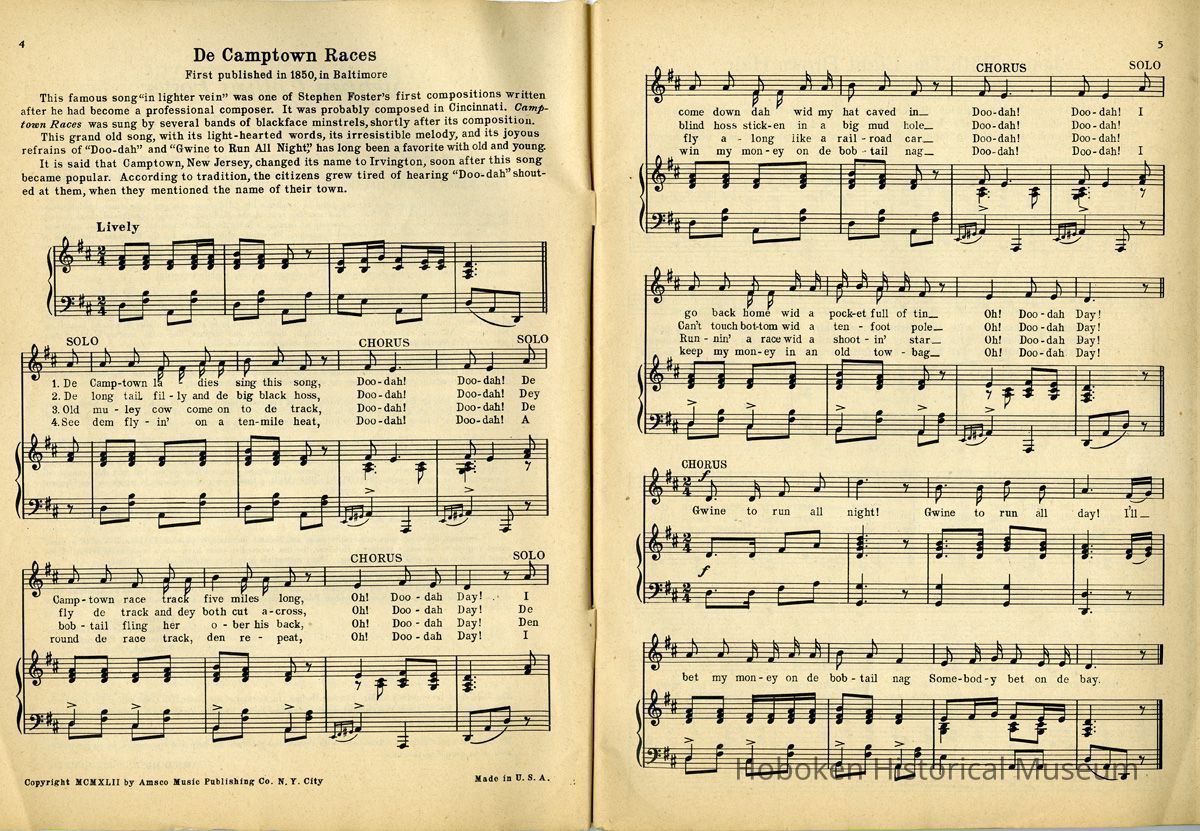
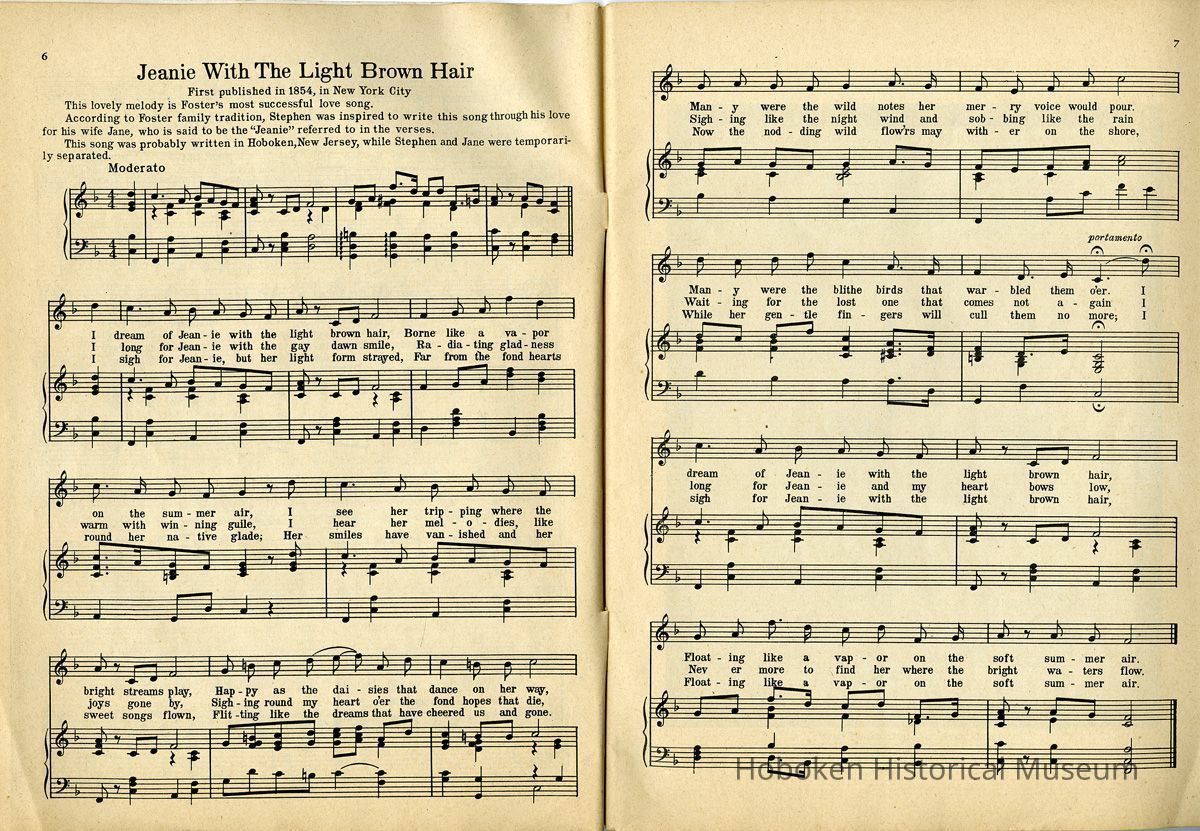
![pp [8-9] sheet music covers: Jeanie With the Light Brown Hair; Oh! Susanna](https://d8e7jbdw4fu0e.cloudfront.net/11047/81b60dd0-fb54-11ed-a641-b3912f9925a9-wx0aVcu.lg@2x.jpg)