Collections Item Detail
Slide rule, Chemist's Adjustable Duplex, 4160, made by Keuffel & Esser Co., n.d., ca. 1936-1940.
Object/Artifact
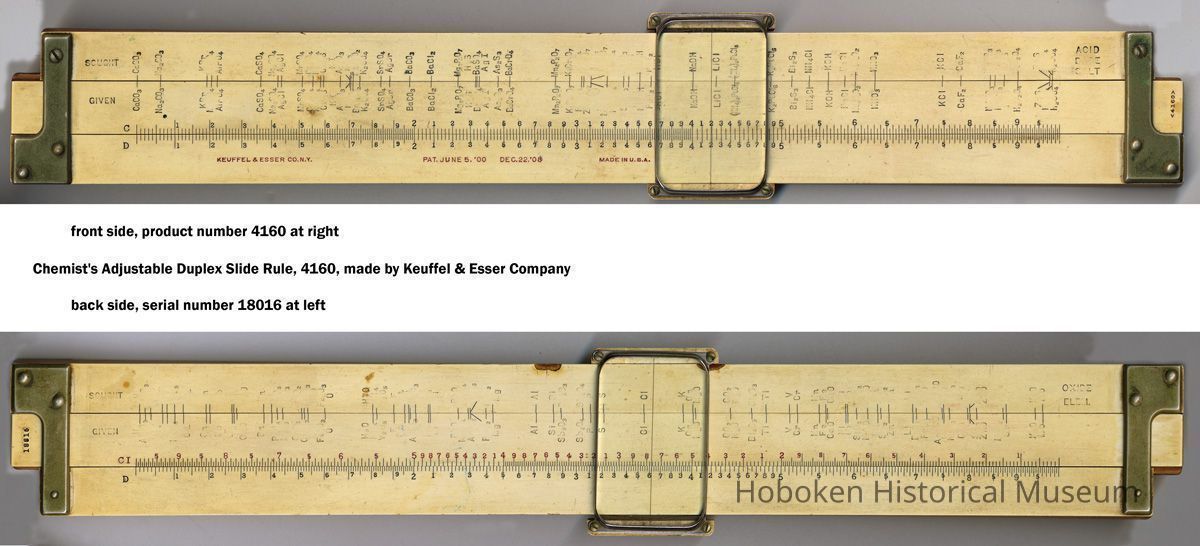
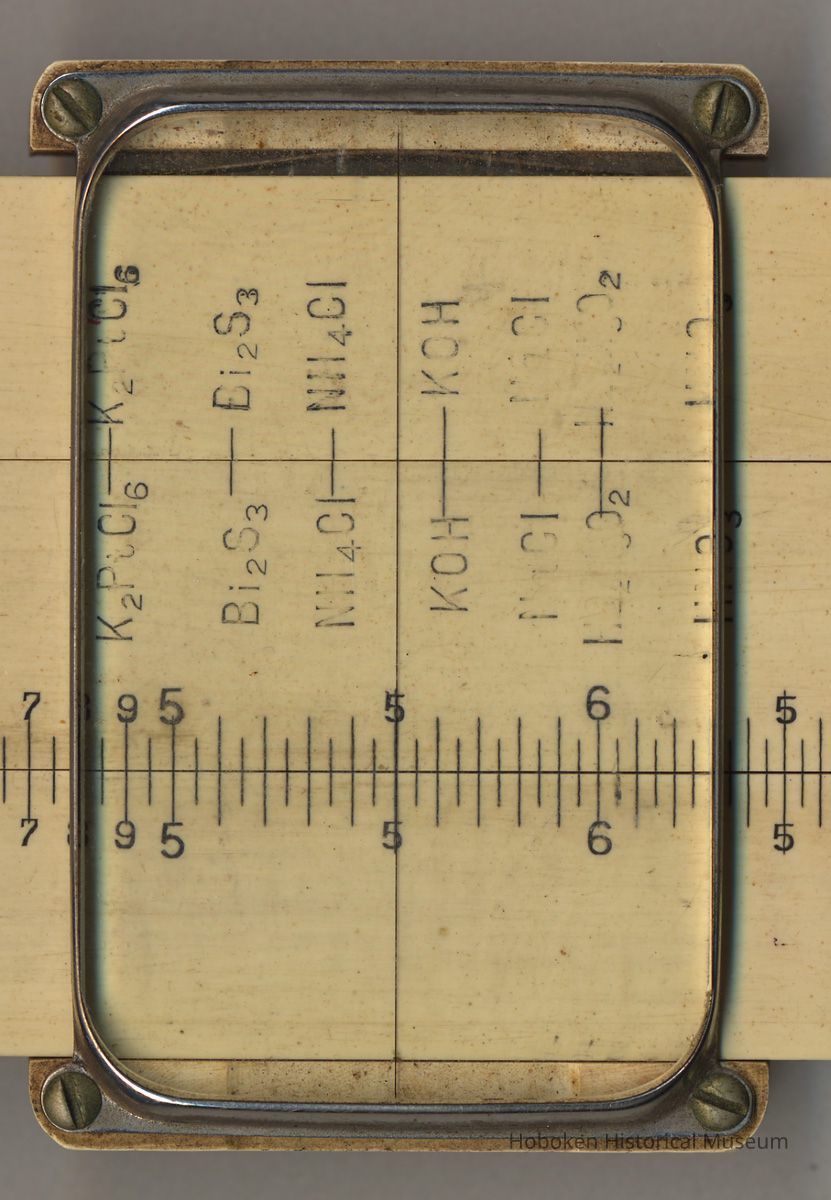
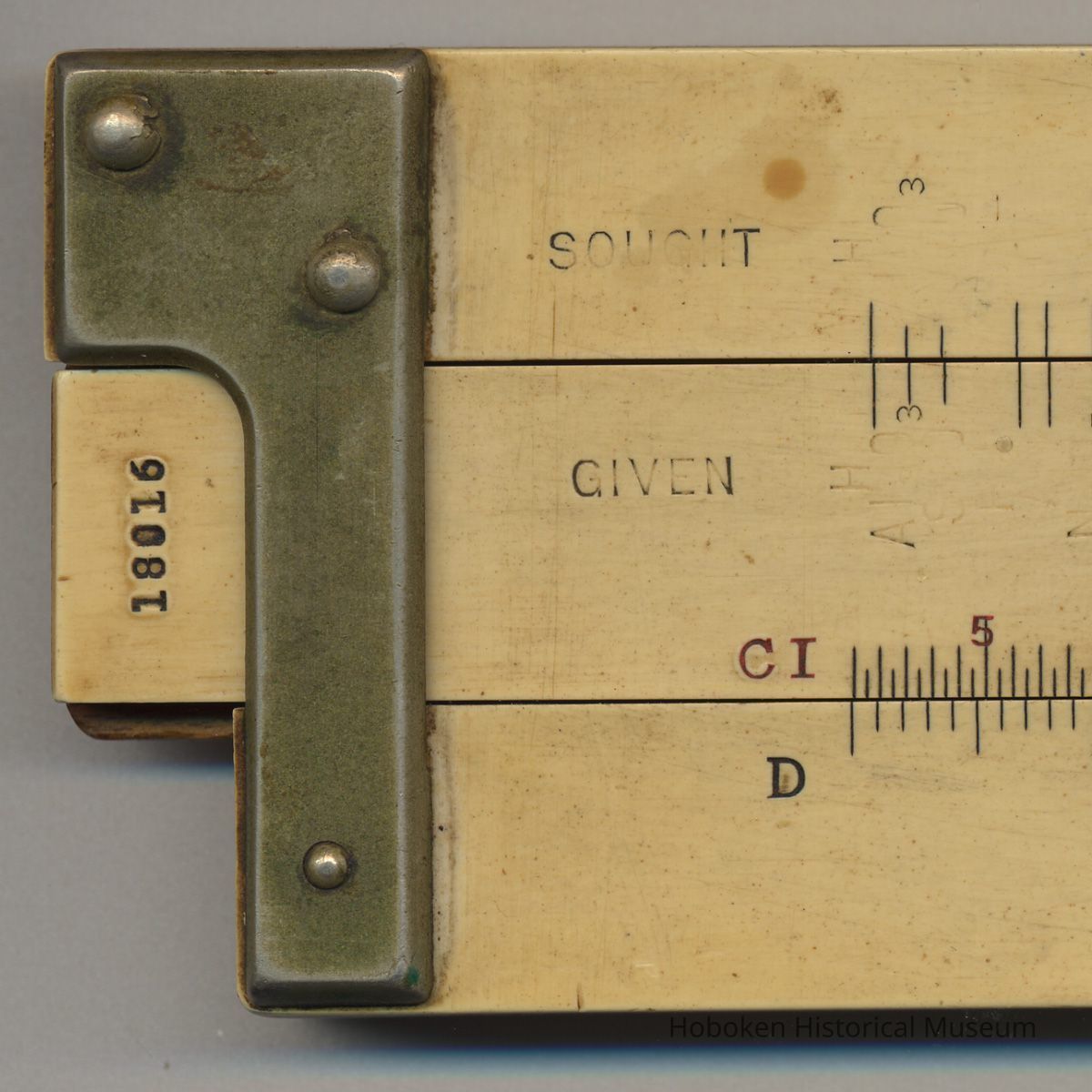
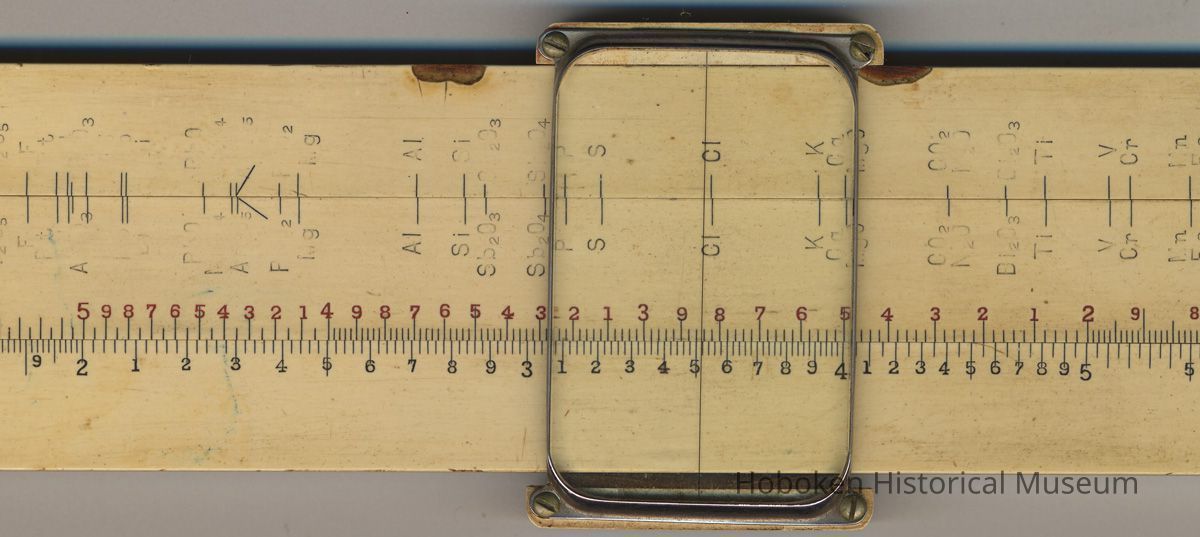
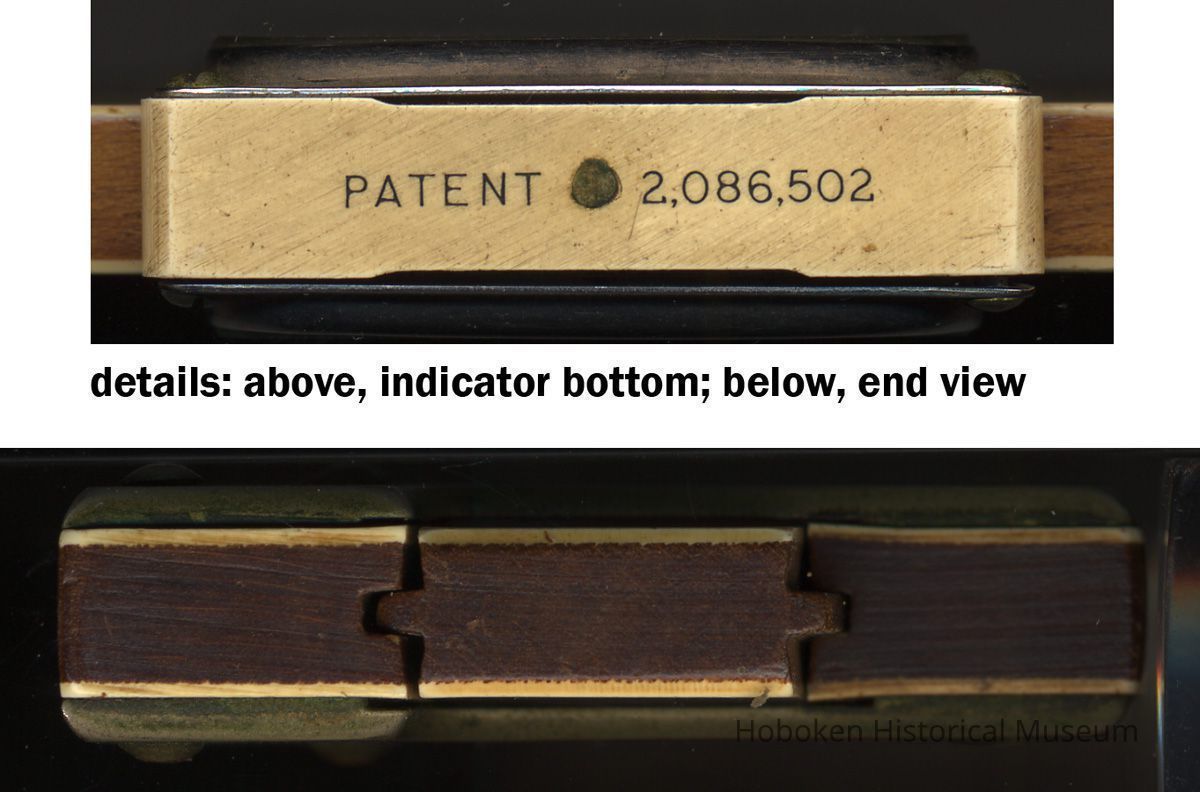
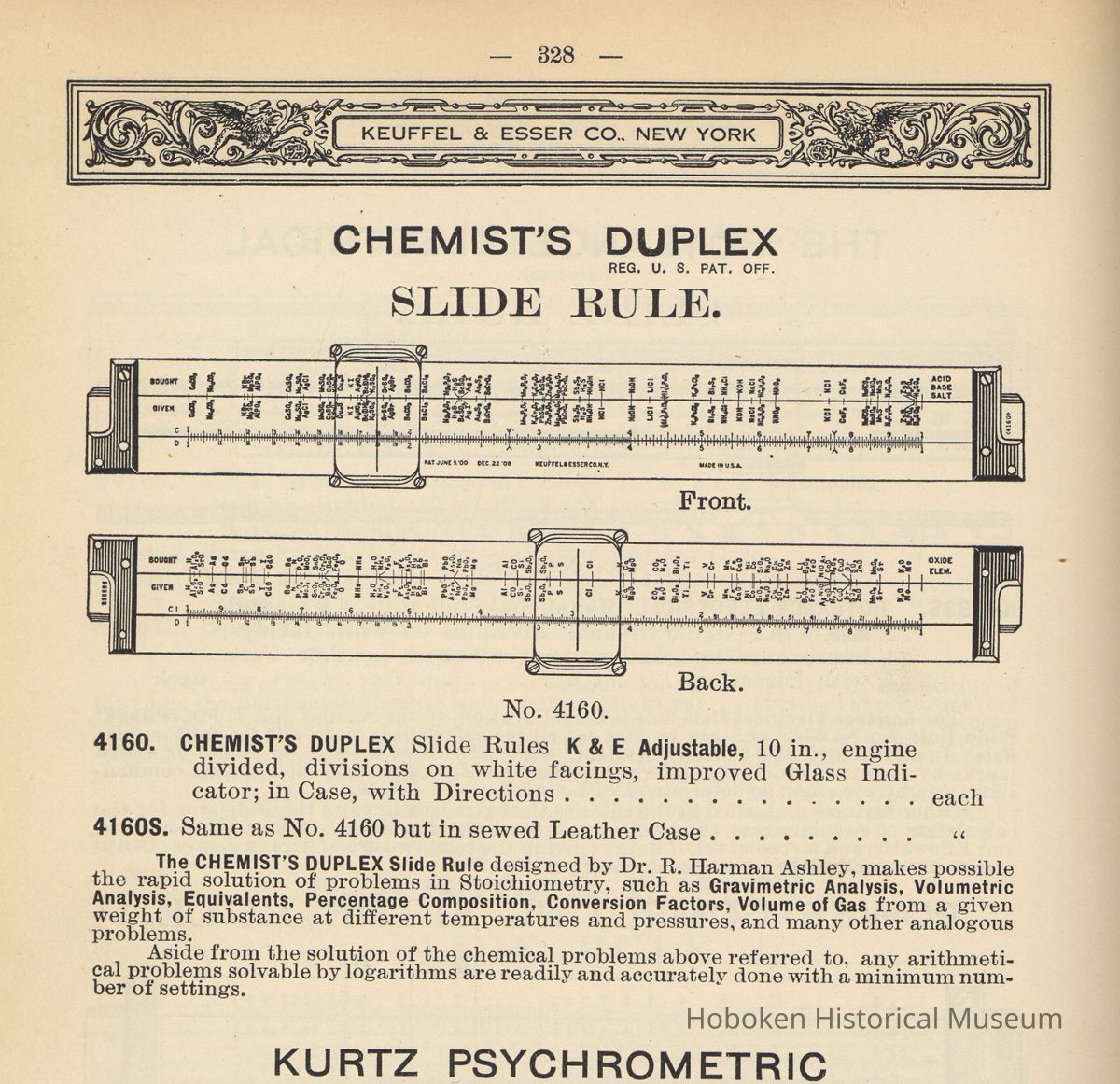
Chemist's Adjustable Duplex Slide Rule, 4160, made by Keuffel & Esser Company, New York, no date, circa 1936-1940. Mahogany with white plastic celluoid 10" scales, 10"; engine divided scales and markings in black and red; metal brackets. Overall 12-1/2" long. Metal framed glass indicator (cursor) with patent date 2,086,502 indicating manufacture no earlier than 1936. Serial number 18016. Worn with loss of some readability of scales; not cleaned. Lacking: case and manual.
This product appears in a 1939 slide rule price list for the 38th edition catalogue of 1936. It does appear in later catalogs. It is likely that the one here is from the last years that it was produced.
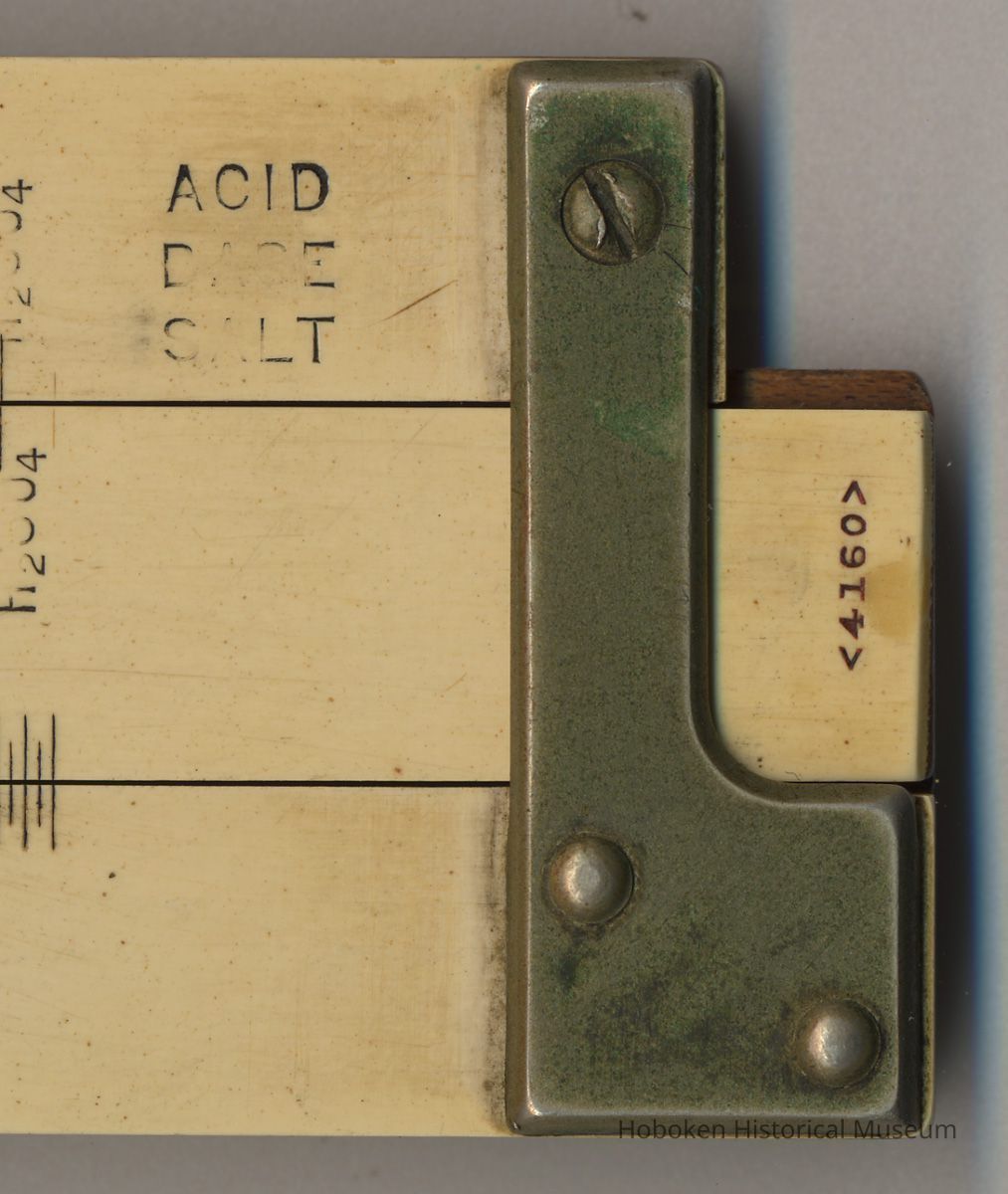
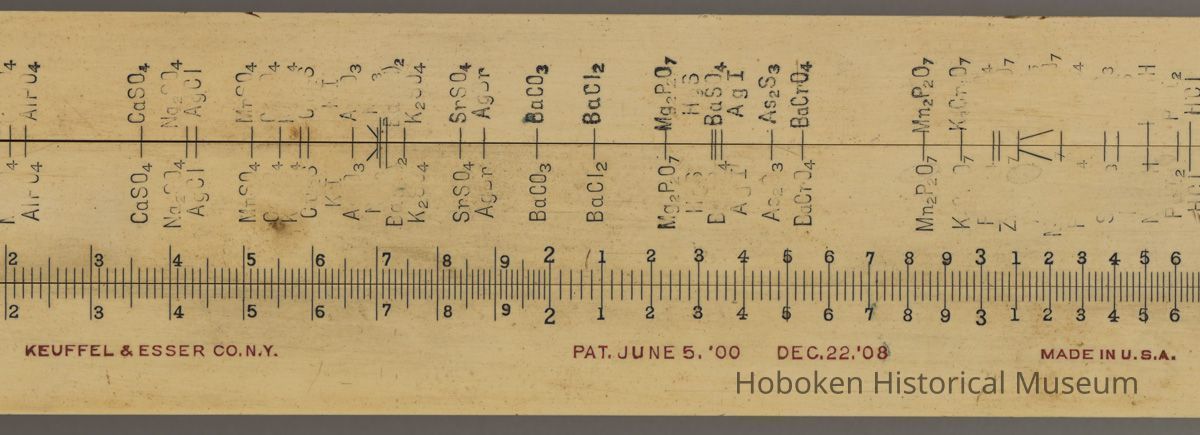
Front: Acid, Salt, Base. Model number is at right end. Also manufacturer's marks with June 5,1900 and December 22, 1908 patent dates.
Back: Oxide, Elements. Serial number is at the left end.
Used in chemistry and probably in related sciences.
Keuffel & Esser Co. main office and factories were in Hoboken in the period when this item was made.
----------
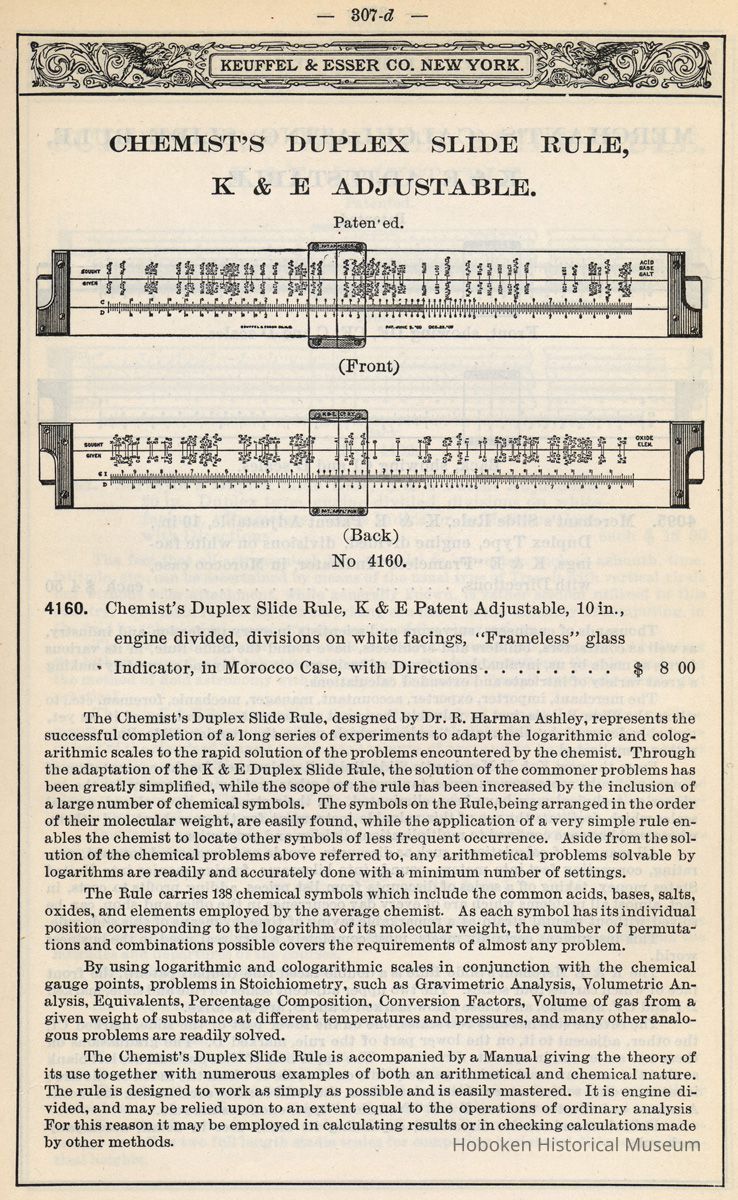
Description as found on page 307d of 35th edition general catalog, 1915.
No 4160.
The Chemist's Duplex Slide Rule, designed by Dr. R. Harman Ashley, represents the successful completion of a long series of experiments to adapt the logarithmic and cologarithmic scales to the rapid solution of the problems encountered by the chemist. Through the adaptation of the K & E Duplex Slide Rule, the solution of the commoner problems has been greatly simplified, while the scope of the rule has been increased by the inclusion of a large number of chemical symbols. The symbols on the Rule,being arranged in the order of their molecular weight, are easily found, while the application of a very simple rule enables the chemist to locate other symbols of less frequent occurrence. Aside from the solution of the chemical problems above referred to, any arithmetical problems solvable by logarithms are readily and accurately done with a minimum number of settings.
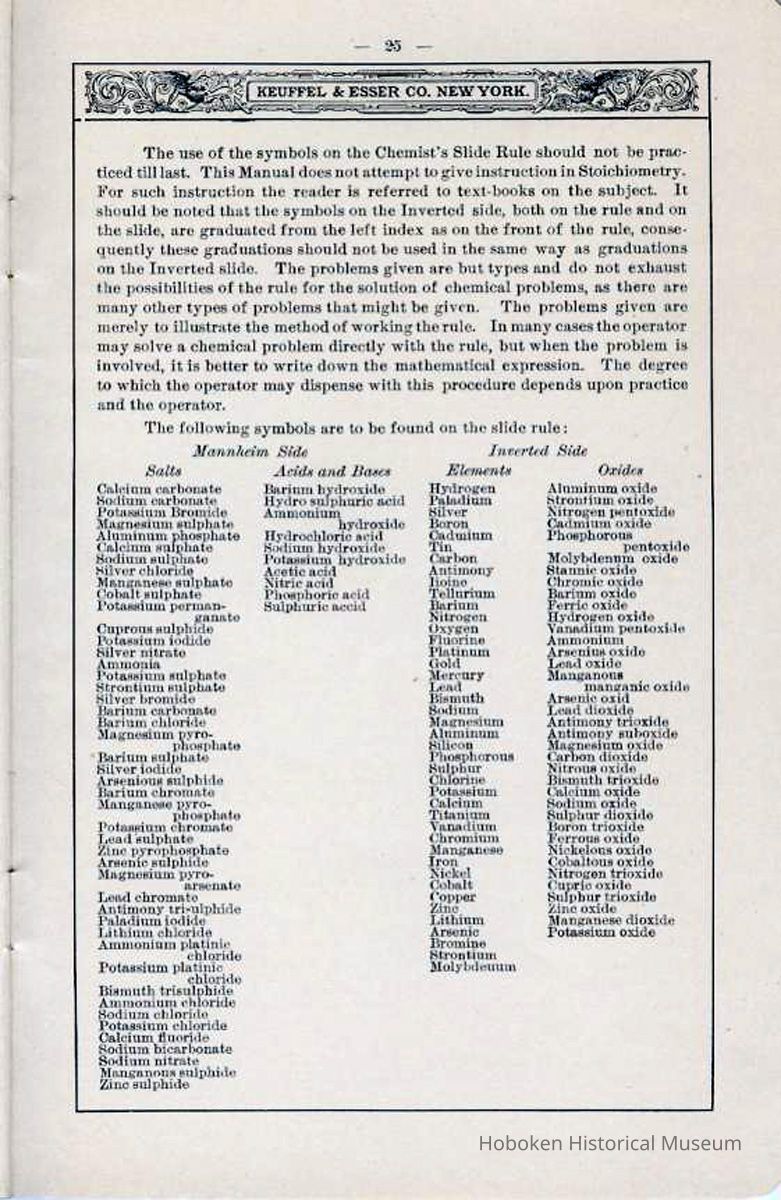
The Rule carries 138 chemical symbols which include the common acids, bases, salts, oxides, and elements employed by the average chemist. As each symbol has its individual position corresponding to the logarithm of its molecular weight, the number of permutations and combinations possible covers the requirements of almost any problem.
By using logarithmic and cologarithmic scales in conjunction with the chemical gauge points, problems in Stoichiometry, such as Gravimetric Analysis, Volumetric Analysis, Equivalents, Percentage Composition, Conversion Factors, Volume of gas from a given weight of substance at different temperatures and pressures, and many other analogous problems are readily solved.
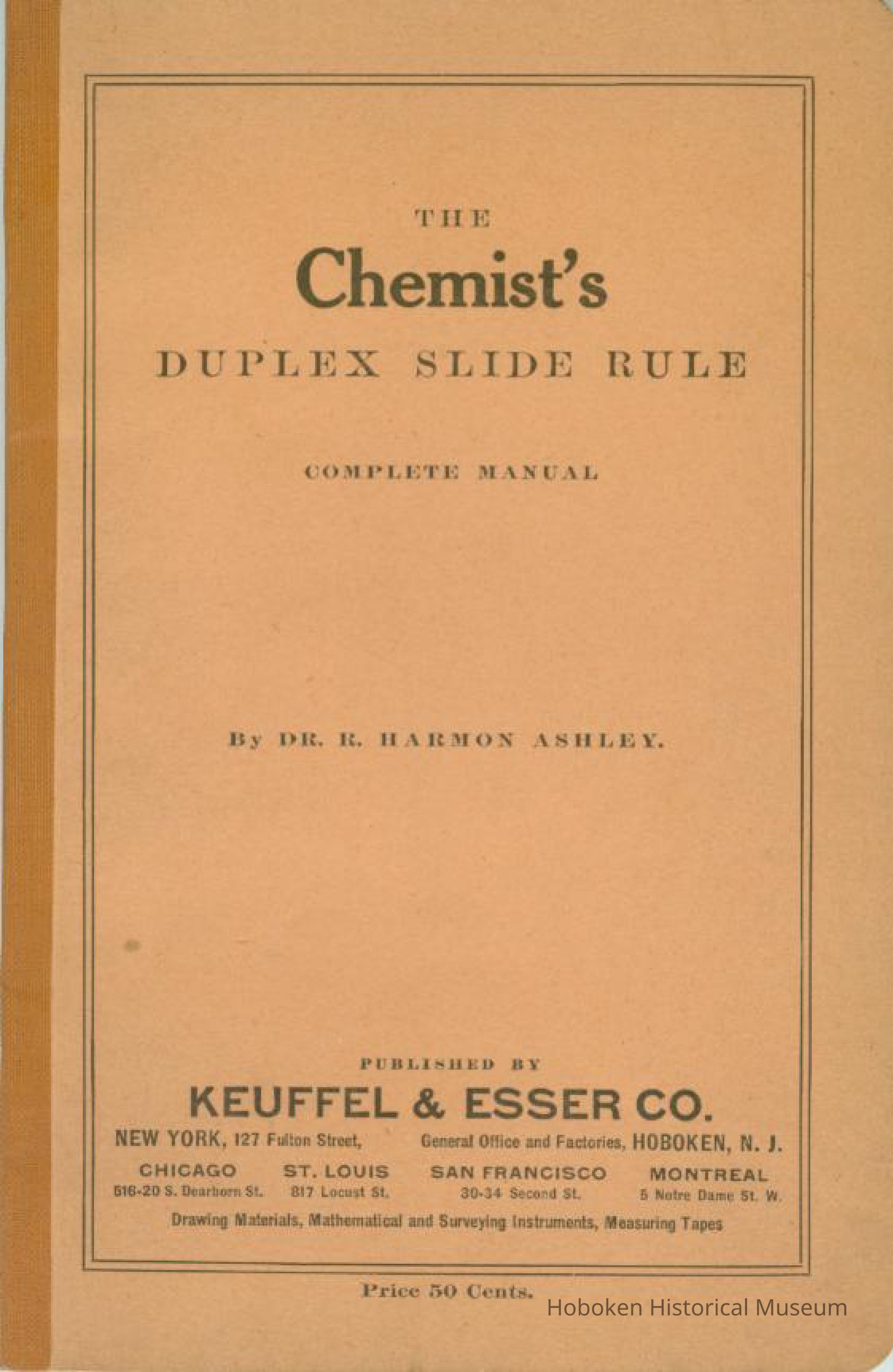
The Chemist's Duplex Slide Rule is accompanied by a Manual giving the theory of its use together with numerous examples of both an arithmetical and chemical nature. The rule is designed to work as simply as possible and is easily mastered. It is engine divided, and may be relied upon to an extent equal to the operations of ordinary analysis. For this reason it may be employed in calculating results or in checking calculations made by other methods.
----------
2009.006.0104
2009.006
Lukacs, Claire
Gift
Museum Collections. Gift of a friend of the Museum.
1936 - 1940
Date: 1936-1940
Good
Notes: PDF on file with scans of cover and all 25 pages of the 1923 copyright K&E printed manual as found on the Clark McCoy website, 2009. Status: OK Status By: dw Status Date: 2009-06-25