Archives
Raymond Smith – “En Plein Air: Seeking a Sensation”
November 11 - December 23, 2012
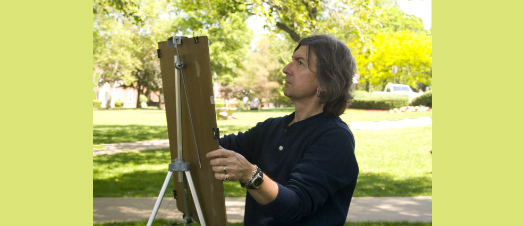
Hoboken’s physical character is known for its storied waterfront, its compact and walkable streets, and its rows of well-preserved late-Victorian homes. But not since the Elysian Fields were converted to industrial use in the early 1900s has it been known for its natural vistas.
The crush of modern urban living poses a challenge to Raymond Smith, a painter who has been seeking to capture the sensation of light and atmosphere in natural settings in the “plein air” tradition favored by the Impressionists. It’s hard to avoid the jarring elements that can ruin the mood he’s trying to render on canvas, but the artist perseveres and has developed a process that translates these fleeting sensations into oil on canvas. The results can be seen in his second show in the Museum’s Upper Gallery, En Plein Air: Seeking a Sensation, by Raymond Smith, which will be on view through Dec. 23.
Click here to see a virtual gallery of the exhibit.
The scenes in his paintings range from a sun-drenched beach filled with brightly colored kayaks in Hoboken Cove, to a moody, fog-blanketed tugboat moored to a pier, to a thoughtful young woman sitting on a patch of grass or a buoyant woman (the artist’s wife) in a bright sundress and hat strolling along the edge of the water.
To explain what inspired this series, he refers to a quote from an essay by Henri Matisse: “One starts off with an object. Sensation follows.” He says he keeps his mind open to receiving sensations or ideas and then he works on how to translate them on canvas. Each painting is the result of a careful process of making notes and sketches on site, with color swatches and measurements that he uses later to recreate on canvas the feeling he responded to in the first place.
Sometimes in working with a model, he says, “the expressions or postures before or after the sitting are what strike me the most—the unguarded moments are most revealing.” He enjoys painting outdoors, but doesn’t like the disruptions. If someone wants to talk to him while he works, he’ll put his paintbrush down and talk to them, at which point they tend to move along. But if it’s a young kid, he says, “I’ll let them take a brush and make a few strokes.”
In addition to his fine art, Smith is an art instructor and professional illustrator, who has worked for many brand-name companies. A couple of his iconic works include the 9/11 Memorial Flag composed of children’s handprints that hangs in the Board of Education meeting room, and the “Greetings from Hoboken” image reproduced on t-shirts, posters, mugs and greeting cards. For more information on Smith’s work, visit his website, www.raymondsmithart.com.
The exhibit is supported by a block grant from the State/County Partnership program for the Arts, administered by the Hudson County Division of Cultural and Heritage Affairs.
Roslyn Rose – “Hoboken from Afar”
September 15 – November 4, 2012
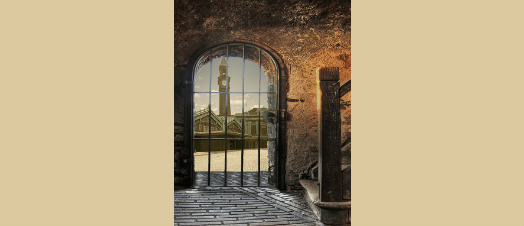
Sometimes you have to get away—far away—to see your hometown from a fresh perspective. Or, you can stop by the Hoboken Museum’s Upper Gallery this September to see Hoboken From Afar: Photomontages by Roslyn Rose.
A New Jersey native and longtime Hoboken resident, Rose credits her travels abroad for her latest series of photo montages. The foregrounds of her artworks include slides, photos, and found pictures that she collected while traveling in Europe, which are digitally superimposed upon images she’s taken of familiar Hoboken sights.
Click here to see a virtual gallery of the exhibit.
The resulting depictions, about a dozen of which will be on display from Sept. 15 through Nov. 4, convey the odd sensation of looking through foreign windows and doors onto familiar vistas of home.
“During my European travels, I always seemed to meet someone who had either visited Hoboken, had a relative living in Hoboken, or who knew of Hoboken’s history, which led to many delightful conversations about my adopted city in far away places,” she says. “By inserting my Hoboken photographs within images of foreign windows, doorways or archways, I have combined travel memories with local scenes.”
The images can evoke the mixed feelings that many of us experience while traveling—the thrill of new experiences with occasional pangs of homesickness. Rose hopes visitors to the exhibit will think about their own favorite Hoboken vistas. Meet the artist at the free opening reception for the show from 2 – 5 p.m. on Saturday, Sept. 15. She returns to give a talk about her work on Sunday, Nov. 4 at 4 pm.
An artist since early childhood, Rose was a nationally recognized etcher and printmaker before becoming intrigued with the medium of computer-manipulated montages. Although photography is now her main focus, she considers herself a fine artist using the medium to create collages. See more of her work and peruse her extensive resume of exhibitions and affiliations at roslynrose.com.
The exhibit is supported by a block grant from the State/County Partnership program for the Arts, administered by the Hudson County Division of Cultural and Heritage Affairs.
Ricardo Roig – “Hoboken in Print”
July 29 – September 9, 2012
Ricardo Roig, a young artist who moved to Hoboken in 2009 after finishing college, has long been an admirer of the Impressionist painters. Hoboken became his muse, he said, in part because its architecture reminded him of the Belle Epoque street scenes and interiors featured in their paintings.
“I find that the city’s architecture and atmosphere make a strong impression on people, and they respond to seeing Hoboken in a new way through my work,” Roig said. “That’s why I make art, to have that dialogue with people, not just for myself.”
Click here to see a virtual gallery of this exhibit.
He developed his eye for Hoboken’s historic details while waiting tables at the beautifully restored Elysian Café, where he worked while completing a teaching certificate at Kean University. Since selling all of his paintings at his first Arts & Music festival in 2009, Roig has invested a lot of energy in the city’s cultural community, participating in the Artists Studio Tour and other festivals, and placing his works in local galleries and frame stores, including Lana Santorelli Gallery and Tresorie Custom Frames. He’s visible around town with his easel, and he also donates work to local fund-raising events and actively promotes the arts at every opportunity. He’s also active online; visit his website at www.ricardoroig.com.
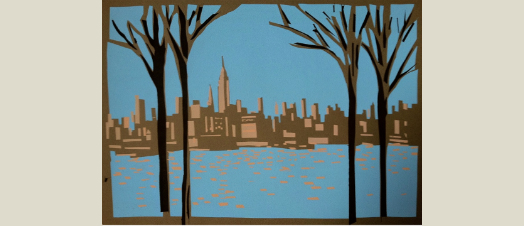
Roig now supports himself through his art and as a substitute art teacher in area schools. Though known primarily for his oil paintings, he’s recently started to produce screen prints using hand-cut paper stencils. The Museum will hang about 10 – 12 of these new works in an Upper Gallery show titled Hoboken in Print: Hand-Cut Stencil Screen Prints by Ricardo Roig, starting July 29, on view through Sept. 9. Meet the artist at the free opening reception from 2 – 5 p.m. on July 29.
He learned the printmaking technique during an elective course he took while completing his teaching certificate. Knowing that the Impressionists were heavily influenced by their encounter with Japanese woodblock prints, he wanted to understand how the process works. What he likes about the medium is the vibrant, graphic and fun energy captured in the images.
Like the Impressionists, he likes to play with lights and darks and use the color of the paper as a layer. “Cutting paper makes you aware of the process of destroying while creating,” Roig says, “and the relationship between positive and negative elements.”
It’s painstaking, Roig says, but he finds it rewarding. “First you draw, and paint your image onto paper. Using an Exacto knife, I cut shapes out of the paper, creating a stencil. Attaching this paper to a silk screen, I then squeegee my colors and ink through to acid-free archival paper. Layering these stencils upon one another, the puzzle is pieced together and the image or print is created.”
The exhibit is supported by a block grant from the State/County Partnership program for the Arts, administered by the Hudson County Division of Cultural and Heritage Affairs.
I Belong: A History of Civic and Social Clubs in Hoboken
July – December 2012
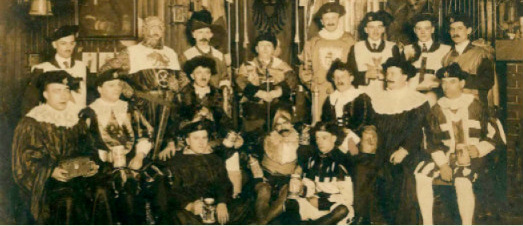
Hoboken has always been a haven for newcomers. So perhaps it’s not surprising that from as early as the 1700s, social clubs have sprung up as a way for people to connect with others around shared interests. From purely social groups like the Turtle Club—an eating and drinking society—to organizations devoted to civic and social philanthropy, along with special-interest clubs for theater, debate and sports, Hoboken has spawned a colorful array of clubs that reflect its citizens’ diverse interests and backgrounds.
I Belong: A History of Civic and Social Clubs in Hoboken traced a colorful history of a wide variety of organizations that have forged bonds among Hoboken’s residents over the years. Exhibit curators Bob Foster, Dr. Christina Ziegler-McPherson, and Eileen Lynch have unearthed more than 250 clubs, and tell their stories through displays of photographs, uniforms, medals, event programs, trophies and other artifacts from the Museum collections and other sources. A photograph of one of the clubs was blown up to life-size, so visitors could photograph themselves as a member of the club.
The show was on view for six months and included talks and lectures by noted historians such as historian, author and local resident Dr. Ziegler-McPherson and Daniel Soyer, a historian who writes about mutual aid societies and fraternal organizations.
Buildings erected by a few of these clubs are visible today around Hoboken. Some groups built impressive club headquarters, like the Benevolent and Protective Order of Elks, Lodge 74, built in 1906 at 1005 Washington St., which continues today as an active civic group, and the Independent Order of Odd Fellows, which no longer has a local chapter, but met at a building that stood at 412 – 414 Washington St., which until recently housed a Blockbuster video store at street level.
The Columbia Club at 1101 Bloomfield St. was built to impress in 1891 by some of the most prominent men in Hoboken. Designed in the once-fashionable “Richardson Romanesque” style, with rounded arches and contrasting color bands, the Columbia Club continues to impress. Its spacious, mahogany-paneled rooms for receptions and lectures reflected the group’s lofty aspiration to promote cultural and civic improvement projects, but within 20 years, the group had disbanded, and the building was taken over by a Masonic lodge for a few decades. In the 1980s, the building was rescued, restored and converted into four condominiums that retain many of the original architectural details.
Still standing on Newark St. is the clubhouse of the Hudson County Pigeon Club, built shortly after World War II (and now rented to a recording studio of the same name). Founded in 1922, HCPC once had over 70 members and sponsored the Hoboken Derby, one of the most famous races in North America. Members kept pigeon coops on rooftops, much like the one seen in the movie “On the Waterfront.” Club member Vinnie Torre still maintains his Hillside Loft on Monroe St. and shared his memories of the group’s glory days in an oral history chapbook, “The Pigeon Guys,” available at the Museum or downloadable on our website; click here to visit the oral history page.
Some former clubhouses have been replaced by modern interpretations of the original structure. The Union Club at 6th and Hudson Streets was originally built by the Deutscher Club in 1863 – 64, but the group changed names during World War I when German-Americans were closely monitored on suspicion of espionage. The building that stands there now sports a columned portico reminiscent of the original.
Another homage to a famous Hoboken-based club is the small building on Maxwell Place Park built to resemble one that belonged to the New York Yacht Club. Despite its name, the group had a clubhouse in Hoboken, and elected John Cox Stevens as its first commodore. With his brother Edwin, these sons of Hoboken founder Col. John Stevens helped design and sail the famous yacht America to Britain in 1851 to capture the cup that became the coveted trophy of the America’s Cup Yacht Race. The New York Yacht Club was just one of many boating clubs based in Hoboken, which competed fiercely in local and international races.
One of Hoboken’s earliest social groups dates to 1796, when dozens of gourmands came from all over the region to dine on turtle soup and indulge their palates in an smorgasbord of food and drink. There’s a fascinating story behind the original Turtle Club, whose reputation was such that its feasts—and accounts of prodigious drinking—were reported in The New York Times. These groups and others, including Masonic lodges, mutual-aid societies and theater clubs, are echoed in the many social clubs that make Hoboken such a welcoming place for newcomers today.
The exhibit was made possible through funding from the New Jersey Historical Commission, Applied Companies, Bijou Properties, Provident Bank, United Way of Hudson County, and John Wiley & Sons.
Puppet Heap – “Strange Neighbors”
March 18 - April 29, 2012
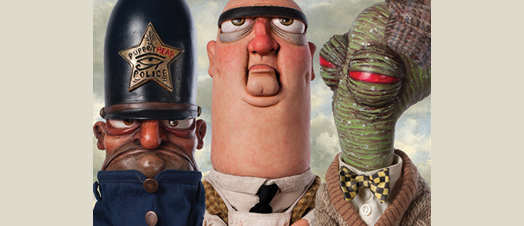
Did you know that Hoboken is home to one of the stars of the puppet-making world? The cover story from the Fall 2011 issue of The Puppetry Journal features Hoboken’s own Puppet Heap, an innovative design and fabrication studio that creates and brings to life some of the world’s most beloved characters by integrating both traditional and cutting-edge techniques to share stories with modern audiences.
Based in the Monroe Center building, “The Heap” is led by artist and entrepreneur Paul Andrejco and boasts a team of the industry’s most talented designers, performers and craftspeople. The studio began in 1992, just a few blocks away in Andrejco’s small Hoboken apartment. The company’s name was inspired by the pile of puppets in his apartment, but it has grown into an ever-expanding creative company that develops and designs characters for film, television, theater and the Web—collaborating with some of the biggest entertainment names in the world, including Sesame Workshop, The Walt Disney Company, Comedy Central and Nickelodeon.
Andrejco and the Heap also produce award-winning short films such as “Omar’s Mother,” “Ye Ballade of Ivan Petrofsky Skevar,” “I Knew an Old Lady Who Swallowed a Fly” or most recently, “Mother Hubbard Among Others.” And they’ve designed a line of retail puppets, which hit the shelves in fall 2011. Like everything Puppet Heap creates, these puppets are designed to inspire storytelling through play.
The Museum is pleased to host an Upper Gallery exhibit of the puppets, set pieces, and props built by the Heap for some of these original short films. Join us at a free opening reception on Sunday, March 18, from 2 – 5 p.m.
Through the exhibit, visitors will see some of Andrejco’s original sketches and designs for the puppets and set pieces, as well as behind-the-scenes photography, and a few production photos of the films that were filmed in their Hoboken studio. A looped video will allow visitors to see Puppet Heap’s films. The puppets are incredibly detailed and beautifully built from a variety of materials: paper tape, fabric, fur, papier-maché, silicone, latex rubber, among many other materials. The display will bring a lot of the richness of the team’s creative process to the viewer and encourage the art of storytelling through puppetry.
Andrejco has been in the business of creating puppetry in media for over 20 years. Early in his career he worked at the Jim Henson Company as a puppet maker and character designer for the Muppets as well as countless other projects during his ten-year tenure. Since then, he has been a key contributor to such ground-breaking television shows as Bear in the Big Blue House, the Book of Pooh, Bookaboo and It’s a Big Big World; his designs and ideas can be found in many productions using puppets in film, television, advertising, theater and on the Web. If you saw the new Muppet movie that opened nationwide at Thanksgiving, you’ve seen the studio’s works—Walter, the star of the movie, was designed by Andrejco.
The exhibit is supported by a block grant from the State/County Partnership program for the Arts, administered by the Hudson County Division of Cultural and Heritage Affairs.
Beth Lucas – “Ta-Da!”
May 6 – July 1, 2012

For head scenic artist Beth Lucas, the Macy’s Parade Studio’s move from Hoboken to Moonachie last year was bittersweet. While the new facility offers better lighting and working conditions, she misses being surrounded by historic details scattered throughout the architectural landscape of Hoboken. Her keen eyes pick out such decorative features as rosettes and ornate carvings as she walks along Washington Street and Central Avenue in Jersey City Heights, where she’s lived for 20 years.
Click here to see a virtual gallery of the exhibit.
In her personal artwork, she uses acrylic paints to translate these shapes in bright colors and larger-than-life images on canvas and linoleum that can hang on walls, or even serve as floor-coverings or table tops, once they’re coated in tough polyurethane.
The resulting artworks are whimsical and fun, which is not surprising, considering Lucas’ job for the last 25 years has been decorating the brightly colored, whimsical floats that entertain millions on Thanksgiving day. Come see them on Sunday, May 6, at a free opening reception from 2 – 5 p.m. for Ta-Da! Artworks by Beth Lucas in the Museum’s Upper Gallery. The show will be on view through July 1.
“My dual background in fine art and commercial art has led me to continuously develop a style that is bold with expressive color,” she says. “My imagery is taken from both popular culture and subculture. My work explores the recontextualization of ordinary objects I see, we see, in everyday life.” Flowers also figure prominently in her work, perhaps inspired by her work on Macy’s Annual Flower Show scenery.
After earning her Master’s degree in Fine Art from Rutgers in 1984, she started working at Macy’s Parade Studio, which was based in Hoboken at the former Tootsie Roll factory until last year. She loves working for Macy’s, and met her husband, Charles Walsh, there. After living in Hoboken for five years, she moved to Jersey City Heights where the couple renovated two houses and raised two daughters, Isobelle and Olivia.
The one down side to working on the Parade is never getting to celebrate Thanksgiving on the appointed day, she says. The design crew creates floats that are cleverly designed to fold up into boxes that can fit through the Lincoln Tunnel. This requires the team to start unpacking the floats at 7 p.m. on the Wednesday evening before the Parade in the staging area near the American Museum of Natural History.
They work through the night, finishing just in time for the Parade to get under way, and race down to the finish line at 37th St. to grab a quick bite and start repacking the floats as they arrive. They don’t get home until after 4 p.m., too exhausted to make or even enjoy a meal. Fortunately, the Macy’s Parade Design Studio hosts a special Thanksgiving dinner for the employees’ families on the Friday afterwards.
The exhibit is supported by a block grant from the State/County Partnership program for the Arts, administered by the Hudson County Division of Cultural and Heritage Affairs.
Laura Alexander – “Mostly Rosemary”
January 29 - March 11, 2012
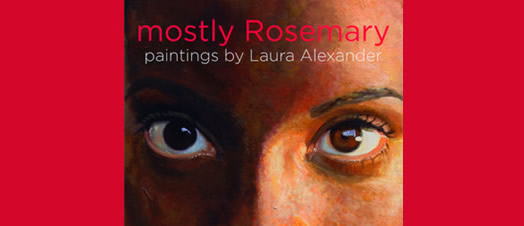
Hoboken artist Laura Alexander’s Monroe Center studio is a fixture on the annual Artists Studio Tour. In addition to her paintings, her studio walls are covered with colorful and interesting pop culture artifacts, which are fun to look at, but it’s her large portraits that arrest the visitor’s gaze and stay with you after you leave.
A series of four large portraits—with a twist—are the focus of her latest exhibit, “mostly Rosemary, Paintings by Laura Alexander” is on view in the Museum’s Upper Gallery from January 29 through March 11.
The title of the show is inspired by the model who posed for the photographs that Alexander worked from in creating these 50-inch-square portraits. “They’re ‘mostly’ her,” Alexander explains, “but we changed her cosmetically for each portrait. The concept was to portray different ethnic varieties. I attempted to do this with wigs and make-up, while Rosemary is skilled enough as a model to change her facial expressions…the pull of her smile, the squint of her eyes, etc.” The model applied her own make-up and the two spent as little as an hour to capture three different “personas.” While the results look very serious, Alexander said she and Rosemary had a lot of fun doing the photo shoots.
“The point of art making is to say something: hopefully, to create a dialogue with the viewers…within the viewers’ own thoughts,” Alexander says. “These paintings speak about the many differences we perceive in one another while we still recognize our shared humanity. Real tolerance of these differences seems to be the challenge of this century.”
A full-time artist who attended the Maine College of Art, the Vermont Studio Center in Johnson, Vt., and the New York Art Students’ League, Alexander lives in Hoboken and has had a studio at 720 Monroe since 1991, when it was still known as the Levelor Factory. She works at her art while she’s home-schooling her 11-year-old son (also an artist), and teaches art to young students on Saturdays. Art is a family affair, as her husband has a studio there as well.
This is Alexander’s second Hoboken Museum exhibit. Her work is exhibited frequently in New York and New Jersey, and occasionally internationally. She earned a fellowship in 2006 from the New Jersey State Council on the Arts and was awarded a solo exhibit in the 1998 Viridian National juried competition in New York, as well as an award from the Marie Walsh Sharpe Studio program in New York (1996).
The exhibit is supported by a block grant from the State/County Partnership program for the Arts, administered by the Hudson County Division of Cultural and Heritage Affairs.
Driving Under the Hudson: A History of the Holland and Lincoln Tunnels
January – June 2012
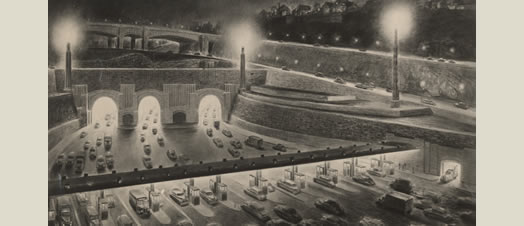
Click here to take an interactive virtual tour of the exhibit.
Through this exhibition, we celebrated the 85th anniversary of the Holland Tunnel and the 75th birthday of the Lincoln Tunnel. Love them for the access they provide to New York City, or curse them for the rush-hour traffic that ensnares Hudson County drivers, the tunnels define Hoboken’s northern and southern borders. Today we take them for granted, but when they were built, they were marvels of both engineering prowess and public works initiatives.
For hundreds of years before either tunnel was built, the Hudson River could only be crossed by boat. While railroads transported goods easily across the country, once they arrived at the Hudson River, delivering them to New York City was more complicated. A system of lighters, private ferries, barges, and car floats was employed by the railroad companies, but this was a slow, inefficient and very costly way of moving goods. Shippers were at the mercy of ever-changing river conditions, which dictated when—or whether—goods could be moved.
By the beginning of the 20th century, what the region needed most was a freight rail tunnel. Passenger access was improved in 1908 and 1910 with the construction of the Hudson & Manhattan Tubes and rail tunnel to Pennsylvania Station. But they weren’t keeping up with population growth. The story behind how the two new vehicular tunnels were planned, funded and constructed reveals a fascinating struggle between public and private sector powers against daunting physical and financial obstacles. It is also a testament to the workers—known as sandhogs—who risked their lives under highly pressurized conditions until engineers figured out how to improve worker safety. Indeed, when it was completed in 1927, the Holland Tunnel, named for its chief engineer, was called the “Eighth Wonder of the World.”
The public is invited to explore the tunnels’ back story and ongoing significance in the Museum’s online virtual gallery for the exhibition, Driving Under the Hudson: The History of the Holland and Lincoln Tunnels, which was on view at the Museum from Jan. 29 through July 1, 2012.
Waterfront reformers and political progressives wanted a freight tunnel, but that would have threatened the power of racketeers and politicians, especially Mayor Hague of Jersey City, who used the piers as a source of job patronage. It was agreed, however, that something was needed to link the eastern edge of New Jersey with Manhattan.
As America’s love affair with automobiles grew, engineers and sociologists argued for building a bridge, assuming drivers would prefer light, air and a view to a long, claustrophobic, dingy tube. But a 1913 engineering study concluded that a bridge would cost $42 million, versus $11 million for a two-tube vehicular tunnel. Ultimately, money and the lack of space to build a bridge would decide the debate in favor of a tunnel.
Two things precipitated matters. The harsh winter of 1917-1918—when the Hudson River froze over as temperatures dipped well below zero—made getting fuel and food to New York City almost impossible. The following winter, a strike by the Marine Workers’ Affiliation affected freight deliveries as well as commuter ferries. As tens of thousands of ferry travelers poured into the Hudson and Manhattan Railroad (now PATH), police were called in to deal with extreme overcrowding on the trains.
Cooperation and obstruction
In September 1919, New York and New Jersey quickly came to consensus and signed an agreement that provided for the joint construction, operation, repair, and maintenance of the tunnel, with the costs shared equally by both states. Tolls would be instituted to pay each state back within 20 years. Clifford Holland, the youngest chief tunnel engineer in the U.S., was appointed to direct and design the largest vehicular tunnel ever built. Again, the biggest challenge would prove to be Jersey City’s Mayor Frank Hague, who found many ways to hold up the project and extort money and concessions for his office and supporters.
Eventually, Holland planned a secret groundbreaking for May 31, 1922. With a small crew and a few officials, Holland clandestinely crossed into Jersey City, where he was photographed with a shovel in the ground. With the photograph in all the papers, Hague had been outmaneuvered.
Planning for the Midtown Hudson Tunnel, as the Lincoln was originally named, seemed to go much smoother, at least at first. With the technical knowledge gained from the Holland Tunnel, the construction of the Lincoln Tunnel would be the turn out to be the easiest part of the project. But the crash of 1929 and the advent of World War II delayed construction of the first two tunnel tubes for many years and by 1937 only one was completed. Each decade brought a new impediment: In the 1930s it was a lack of capital; the ’40s saw a lack of manpower and materials due to the war, and by the ’50s, a postwar building boom on both sides of the river meant complex real estate transactions had to be negotiated. Work on the second tube wasn’t completed until 1945, and the third tube delayed until 1957.
The exhibition featured original documents such as official correspondence and engineering plans, plus historic newsreel footage, and objects such as a now-defunct “catwalk car,” which was driven along specially constructed side rails to deal with vehicle emergencies. Photographs and oral histories from the original sandhogs involved in the construction of the Lincoln Tunnel will tell their history.
Curators Bob Foster and David Webster were advised by Dr. Angus Gillespie, Professor of American Studies at Rutgers University and author of Crossing Under the Hudson, The Story of the Holland and Lincoln Tunnels (Rutgers Press, 2011); and historian and engineer Robert W. Jackson, author of Highway Under the Hudson: A Story of the Holland Tunnel (New York University Press, 2011). Both authors came to the Museum to give lectures, along with architectural historian John Gomez, a member of the Museum’s History Advisory Board and a founder of the Jersey City Landmarks Conservancy, and Steven Hart, author of The Last Three Miles: Politics, Murder, and the Construction of America’s First Superhighway, which documents the construction of the Pulaski Skyway.
The exhibit is made possible through funding from the New Jersey Historical Commission, Applied Companies, Bijou Properties, T&M Contracting, United Way of Hudson County, and Wiley & Sons.
Liz Cohen – “Walkabout”
November 13 - December 23, 2011
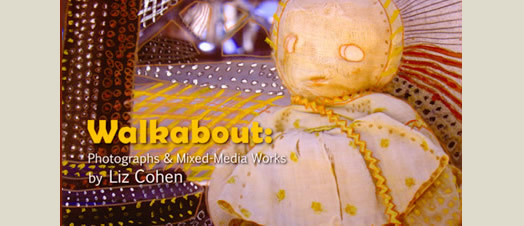
Artists’ muses can assume unexpected forms; the artist’s challenge is to be open to the muse’s inspiration. For artist Liz Cohen, a handmade doll from her childhood has emerged as a significant influence in her art. As a little girl, she had wanted one toy more than any other: a shiny new Betsy Wetsy doll. Once she had one of these dream toys of her own, however, she found herself coveting her older sister’s simple, homemade cloth doll, named Hazel. Cohen negotiated with her sister to trade dolls, and counts pulling it off as her first real accomplishment. The doll, beloved by both sisters, actually changed custody several times as they grew into adults, finally coming to stay with Cohen for good some 20 years ago.
For most of her career as an artist, Cohen worked in watercolors and oils, painting images of mythological women, elements of her dreams, and seashells. Her work is infused with motifs and techniques learned in her world travels, including seven years living in Australia and working with Aboriginal people, as well as trips to Africa and Latin America.
Then, about 15 years ago, Cohen’s husband passed away and she immersed herself in creating art to help deal with her grief. She soon found Hazel began appearing frequently in her work. “Hazel represents joy and happiness to me,” Cohen says, “I’m trying to convey the joy of a simple, well-loved object to others.”
In the resulting Hazel-inspired series, Cohen works in new and sometimes mixed media. Walking around Hoboken, for example, she would photograph Hazel in different settings. Some photographs she paints with aboriginal motifs of dots and cross-hatching, and she’s also been making fabric art, sewing new dolls of her own creation. Ten to 12 pieces from this recent work, titled Walkabout: Photographs and Mixed-Media Works by Liz Cohen, were on display in the Upper Gallery of the Museum from Nov. 13 – Dec. 23.
Lately, Cohen has invented an entire alternate world, peopled by her handmade dolls, with its own language and religion, bridging different times and cultures. Drawing on her knowledge of other cultures’ traditional beliefs and mythologies, she has created a goddess-centered culture with these dolls, using fabrics that she has collected from all over the world. The mix of fabrics gives the impression that the dolls could be artifacts from any number of civilizations. Many of these were exhibited in New York City in November, in a show titled “Mother Lore,” at the Ceres Gallery, on 27th St. Find out more on her website, www.elizabethweinercohen.com.
Cohen’s studio is a staple on the Hoboken Artists Studio Tour, and her work has been exhibited in many solo and group shows. About 10 years ago, she founded the Hob’art artists group, which is searching for a permanent home. She was an art major at Douglass College, Rutgers University, and earned a Masters in Art and teaching credentials at the University of California at Berkeley. She has taught art for more than 30 years at a private school in Summit.
Cohen returned to the Museum on Sunday, Dec. 4, at 4 p.m., to discuss her work and answer visitors’ questions. The exhibit was supported by a block grant from the State/County Partnership program for the Arts, administered by the Hudson County Division of Cultural and Heritage Affairs.
Barbara Mauriello – “Unfolding Landscapes”
September 25 - October 2, 2011
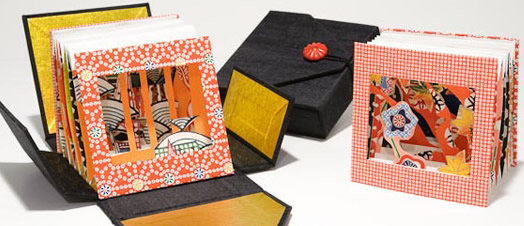
An artist with a bachelor’s degree in English and a master’s in painting, Barbara Mauriello hadn’t given much thought to how the books she loved to read were constructed until she took a class in bookbinding. She had done 10 small paintings and wanted to put them together in a book.
“I got hooked on bookbinding the first time a bowl of freshly cooked paste passed under my nose,” she recalls. “And the lovely, fat paste brushes…then a ‘bonefolder,’ the bookbinder’s essential tool, fell into my hands and that was that. I was in love: with my tools, my materials, paper, cloth, leather, thread, paint.” She made the radical decision to quit her job and, following in the tradition of centuries of craftspeople, she began an apprenticeship at the Center for Book Arts, on Bleecker and the Bowery.
Thirty years later, Mauriello is just as passionate about the art and craft of making books, if not more so. She now makes her living creating and repairing books, as well as colorful boxes that serve as containers or simply as art objects, using the same techniques. She also teaches bookbinding at the Center for Book Arts, the International Center for Photography, and the School of Visual Arts. And she has served as a consultant in book conservation to major institutions such as the Newark Public Library and the Brooklyn and New York Botanical Gardens.
By now, she’s created thousands of books and boxes by hand, for her own projects and for her clients, mostly artists and poets, who hire her to create an individual book or a small edition of up to a few hundred copies. In addition to traditional books, she makes them in unusual formats, such as accordion-style “tunnel” books, with an opening in the center of the pages that forms a tunnel when the book’s covers are pulled in opposite directions.
An exhibit of several of her books and boxes, Unfolding Landscapes: Books and Boxes by Barbara Mauriello, will open in the Museum’s Upper Gallery on Sunday, Sept. 25, with a free reception from 2 5 p.m. The show will be on view through Nov. 6. She returns to the Museum on Sunday, Oct. 2, at 4 p.m. for a talk about her craft.
Her fascination with tunnel books may be inspired in part by her decision to move to Hoboken some 20 years ago, because she commutes frequently through tunnels to New York. She loves it here, and has formed a private press with friends here who are artists with skills in calligraphy and printing. With her artist’s eye, she is drawn to rich colors and geometric shapes. She admires the work of French artists of the mid-20th century, including Henri Matisse, Joan Miro, and particularly Sonia Delaunay, who created her own books without any formal training.
Mauriello has made books from fragments of fire-damaged 18th century illustrated manuscripts and 19th century contracts written on vellum, and created books inspired by Apache playing cards, Russian constructivist costumes and good-luck charms embroidered on kimonos. Her work has been exhibited in many museums, art galleries, and libraries; one piece is being sealed in Santiago Calatrava’s New York Times time capsule.
Books as Art: Barbara Mauriello’s Unfolding Landscapes Sunday, Sept. 25, 2-5 pm: Opening reception for “Unfolding Landscapes: Books and Boxes by Barbara Mauriello.” Local artist Barbara Mauriello learned traditional techniques of bookbinding the old-fashioned way, through an apprenticeship. Now her skills are in high demand to produce limited editions of special art books or to restore antique books. Over the years, she’s expanded her craft to create innovative book shapes and decorative boxes, many of which will be on display in the Museum’s Upper Gallery through Nov. 6. She returns for a talk and demonstration on Sun., Oct. 2 at 4 pm. The opening reception and talk are free.
The Upper Gallery exhibits are made possible by a block grant from the State/County Partnership program for the Arts administered by the Hudson County Division of Cultural and Heritage Affairs.