Archives
From Another Time: Hoboken in the 1970s
January – July 2007
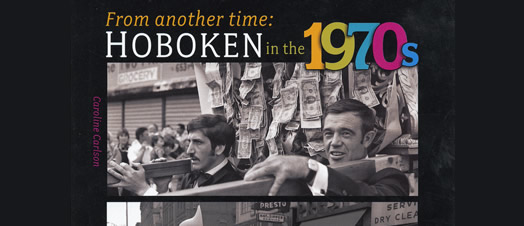
A Trip Back to the Seventies: Imagine a Hoboken before the high-rise residential towers and ubiquitous nail salons, cell phone stores, realtors and shoe boutiques. This exhibit celebrates the Museum’s latest book, From Another Time: Hoboken in the 1970s, where visitors will be transported back to Hoboken in the 1970s through a series of powerful black and white photographs taken by three highly regarded photographers. Bringing the exhibit to life will be a series of lectures by individuals who were instrumental in shaping Hoboken’s development during this pivotal decade.

The book and exhibit depict a Hoboken in limbo between its industrial heyday and its reemergence as a hotbed of residential development, documenting the people, street scenes, block parties, parades, and festivals that are an integral part of Hoboken’s essential character. Although many storefronts were vacant, many apartment buildings were dilapidated, and the padlocked waterfront was patrolled by packs of feral dogs, the people who lived here were determined to make a better life for themselves.
Before the urban-professional migration of the 1980s, Hoboken was populated by a colorful mix of born and raised Hobokenites, who proudly carried on centuries-old traditions such as saints’ festivals with feast bombs and long lines for fresh zeppole; more recent arrivals, including Puerto Ricans, who arrived just as factory jobs were leaving; and a new wave of bohemian “immigrants,” artists and musicians lured by affordable rents and spacious lofts in abandoned factories.
The book unites three distinct views of the city: Caroline Carlson’s photographs of the children of the city and their families; John Conn’s stark views of storefronts and buildings, some of which are long gone; and Benedict Fernandez’ street scenes and images of the working waterfront. The photos are accompanied by two poignant essays: one by a born-and-raised Hobokenite, Anthony DePalma, now a New York Times reporter, who witnessed the changes to his hometown, and the other by Sada Fretz, who moved her family here in the 1970s and saw the city with fresh eyes.
The 190-page book was designed by local artist and graphic designer McKevin Shaughnessy, and was partially funded by contributions from members and friends of the Museum. The exhibit, lecture series, and book were made possible through a special project grant from the New Jersey Historical Commission, a division of the Department of State.
Robert Burczy – “Poster Art”
May 2006

If you travel Hoboken by foot, you no doubt have seen those eyecatching posters on telephone poles and empty storefronts around town promoting local artist Robert Burczy. An art form of their own, these promotional posters have become a fixture of the local cityscape, which will be celebrated in an exhibit, Cascade/Proving his Mettle…The Poster Art of Robert Burczy, in the Museum’s Upper Gallery from May 7 through June 11. You are invited to the artist’s reception on Sunday, May 7, from 4 to 6 p.m. The artist will also give a talk on the last day of the exhibit at 4 p.m. Free to all.
A Hoboken resident since 1989, Robert Burczy grew up in the northwestern Pennsylvania town of Hazelton, but says he “became an artist in Hoboken.” He is self-taught, and greatly influenced by local artists he met here through the Hoboken Creative Alliance, an arts group that flourished in the 1990s.
 Burczy cites a variety of influences, including fellow artist Paul Divone, who created brightly colored wood sculptures and affixed them to telephone poles throughout the city. Burczy also acknowledges the influence of the lively music culture that thrived in Hoboken, manifesting itself in flyers tacked onto any blank surface promoting a band’s gigs, as well as the omnipresent gate-sale posters often fringed with a ruffle of pull tabs to help passersby take note of the date and details. It was out of this ephemera tradition that the “Burczy’s” were born. He prides himself on creating his own “Burczy” posters for each exhibit, most of which use clever wordplay in the name, displayed in the bold “Interstate Highway” type face, along with the opening date and location.
The exhibition will display most of the “Burczy’s” created over the past 12 years, and will include documentation on how and where they could be seen then and how some have survived over time. The exhibition and lecture are supported by a grant from the Office of Hudson County Cultural Affairs and the New Jersey Council for the Arts.
Bill Curran – “A View for All Seasons”
November 13, 2005
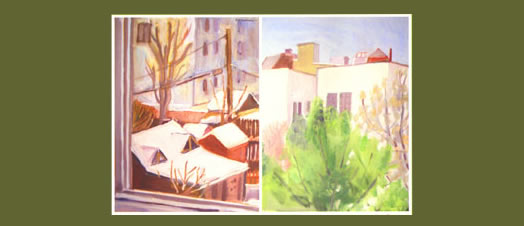
“Down all the side streets, people have wonderful hidden gardens,” artist Bill Curran told a reporter from The Hudson Dispatch in 1986. Today, the painter says, “Seeing other backyards helped me see my own.” Curran loves nature and looking out the window, so, being an artist, he married the two and began a series of paintings of his own backyard.
Outside his window, shapes and colors interact to create beautiful compositions that call out to be painted. Sometimes, Curran records the scene in one sitting. On other occasions, he may return to a subject over a series of sessions.
Please join us Sunday, November 13, 4 p.m. to 6 p.m., for an artist’s reception and opening of A View for All Seasons: Paintings by Bill Curran, in the Upper Gallery at the Museum, 1301 Hudson Street, through December 23. Over a dozen oil and acrylic paintings of backyard views observed through the seasons, and through the years, are on display.
 The paintings record fleeting changes in light and weather conditions, and lasting changes over time. This year, the red geraniums that had always accentuated the green grass of a neighbor’s yard were gone, making the scene far less interesting to the painter’s eye. Even so, the view from his window continues to inspire the artist in fresh and unexpected ways.
Bill Curran’s paintings have been exhibited throughout the metropolitan area. He has studied at The National Academy of Design and The Art Students League. Among the painters Curran counts as influences are Claude Monet, and contemporary artists Fairfield Porter, Jane Freilicher, and Wolf Kahn.
Ben Fernandez – “Shipyard”
September 2005
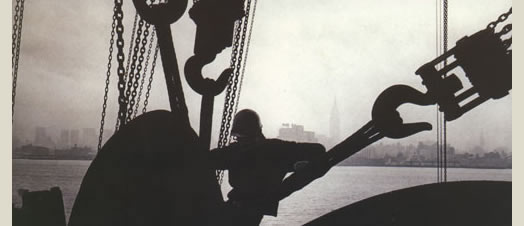
Acclaimed photographer Benedict J. Fernandez went to work at Hoboken’s Bethlehem Steel Shipyard right after high school. His father, who had gone to work at the yard in 1936 and stayed until it closed, got him the job. Ben Fernandez worked alongside Moneybags John, Willy the Beat, and Jesse James. There was an easy camaraderie among the workers, and the shipyard became a home away from home. Fernandez stayed four years at Bethlehem Shipyard working as an apprentice and, later, a full-fledged crane operator, before taking a job at the Brooklyn Navy Yard. At the time, his great avocation was photography, and on several occasions he returned to the Hoboken shipyard to photograph the men who had become his friends. In 1963, after the Brooklyn Navy Yard closed, his hobby became his profession.
The Bethlehem Shipyard photographs of Ben Fernandez pay homage to the men who worked at the yard with his father. Like Family: Photographs of Hoboken Shipyard Workers by Benedict J. Fernandez is on view in the Upper Gallery of the Hoboken Historical Museum, 1301 Hudson Street, September 18 through November 6.You are invited to attend the opening reception on Sunday, September 18, from 4 p.m. to 6 p.m.
Fernandez has been widely published and exhibited, and has received recognition for his outstanding contributions to photography, including Guggenheim and National Endowment for the Arts Fellowships. His work can be found in many permanent collections, among them the Museum of Modern Art; Boston Museum of Fine Arts; the Smithsonian Institution; Bibliotheque Nationale, Paris; Stadt Museum, Dortmund, Germany; and the International Center of Photography. Countdown to Eternity, his photographic record of Dr. Martin Luther King the year before his assassination, has been exhibited extensively in the United States and Europe. Currently, Fernandez is a senior fellow in photography at the Corcoran Gallery of Art, Washington, DC, and founder and CEO of Hoboken Almanac of Photography. The Hoboken Almanac Gallery, at 1252 Garden Street, is open by appointment.
This exhibition is made possible by a Block Grant from the State/County Partnership program for the Arts administered by the Hudson County Division of Cultural and Heritage Affairs, Tom DeGise, County Executive, and the Board of Chosen Freeholders.
Antonio DeJesus – “The Town”
March 20,2005
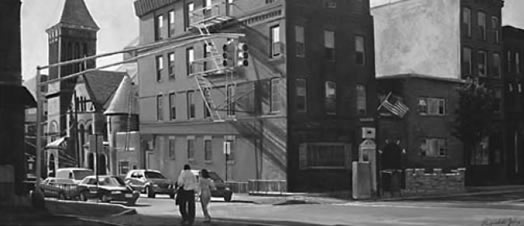
A native of the Dominican Republic, painter Antonio DeJesus moved to Hoboken only three years ago. When he first arrived, DeJesus took long walks around town and developed an appreciation of Hoboken’s architecture. His paintings of local architecture and highly realistic streetscapes are so sharply detailed that they appear at first glance to be photographs. Many are suffused with a warm, golden light, particularly his panoramic southerly view of the Erie-Lackawanna terminal, Lackawanna 2.
The second in a yearlong series of exhibitions looking at Hoboken through the eyes of artists, The Town: Paintings by Antonio DeJesus opens with a reception on Sunday, March 20, from 2 p.m. to 5 p.m. The exhibition is on view through May 7 in the Upper Gallery at the Hoboken Historical Museum, 1301 Hudson Street.
Antonio DeJesus attended Parson School of Design and has won many awards for his illustrations and murals. His work has been shown at Parsons Gallery, New York City, and Centro Cultural Fermosselle, Dominican Republic.