Archives
Up and Down the River: A History of the Hudson, 1609–2009
March – December 2009
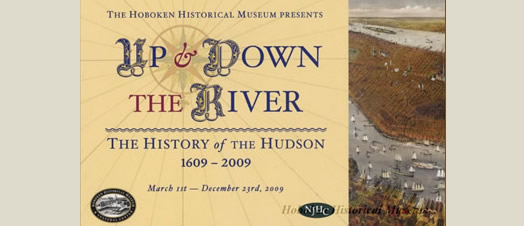
A hundred years ago, New York City threw a two-weeklong public celebration of a double anniversary: the tricentennial of Henry Hudson’s voyage up the river and the centennial (plus two) of Robert Fulton’s first successful steamboat crossing in 1807. One of the largest public anniversaries in the country’s history, offices and factories closed and the number of commuter trains doubled to handle the crowds for the banquets, parades, historical floats, theatrical performances, lectures, fireworks and an airplane flight by Wilbur Wright around the Statue of Liberty. Authentic recreations of Hudson’s ship the Half Moon and Fulton’s steamboat the Clermont participated in a U.S. Naval parade up the Hudson.
Up and Down the River: A History of the Hudson 1609 – 2009 joins many celebrations along both sides of the river during this historic quadricentennial year. The Museum’s exhibit, made possible through a special project grant from the New Jersey Historical Commission, extends through the end of the year to accommodate a full agenda of talks, events, educational programs and art celebrating our city’s relationship with the river that shaped its fortunes.
The exhibition and lecture series will trace the important roles the river has played in the life of the Mile Square City: Providing food and commerce to the area’s first inhabitants, the Lenape Indians; Connecting 19th century New Yorkers and sailing enthusiasts to the Hoboken shoreline during its incarnation as a resort called “Elysian Fields” and home of the cup-winning yacht America; bringing to its piers the grand passenger ships from Europe and later a bustling cargo trade, as depicted in the film On the Waterfront; inspiring generations of students and professors at the Stevens Institute of Technology to contribute to the legacy of groundbreaking maritime research; and providing recreational activities along miles of New Jersey waterfront walkway, thanks to the advocacy of citizen activists.
Though Robert Fulton gets credit for inventing the first steam-driven ferry, Hoboken founder Colonel John Stevens and his son Robert, both prolific inventors, were tinkering at the same time with a steam engine and a screw propeller on a ferryboat. In 1811 Stevens launched the first steam-powered commercial ferry service to cross the Hudson. Fulton’s designs and a biography of the inventor and others who were instrumental in helping him develop and refine his steam engine will covered.
For the exhibition, the Museum commissioned an original mural of the outline of Hoboken’s waterfront along the entire length of the main wall, painted by local artist Ray Guzman. Scale models of vessels from the Hudson River are on display, including New York Central Tug #18 by John Marinovich, and excerpts from Hudson’s first mate’s journal describe the first encounters between the Europeans and native inhabitants. A portion of the exhibit features memorabilia from the 1909 Hudson-Fulton celebration. Items on display come from the Museum’s own collections, as well as from the private collections of a Hudson County-based model shipmaker, the South Street Seaport Museum, Stevens Institute of Technology and the Bayonne Historical Society.
Heaven, Hell or Hoboken: A City Transformed by World War I
September 2008 – January 2009
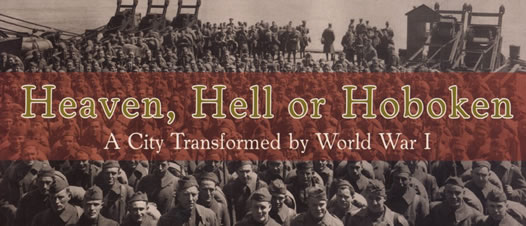
The designation as a port of embarkation meant national fame for Hoboken – General John J. Pershing’s promise to the troops that they’d be in “Heaven, Hell or Hoboken” by Christmas of 1917 became a national rallying cry for a swift end to the war, which actually dragged on for another year. But it also meant economic hardship for the small city after the federal government seized Hoboken’s piers and the German shipping lines that were major employers, closed most of its bars and beer gardens, and displaced or interned hundreds of German nationals who were not yet naturalized U.S. citizens as “enemy aliens.”
Between June 1917 and November 1918, some 1.5 – 2 million soldiers passed through Hoboken, but most were fed and housed by the U.S. military, while local businesses saw the local population decline and the city saw its revenues drop sharply. At the time, German citizens and Americans of German descent made up about 25 percent of Hoboken’s population, far outnumbering the next largest immigrant groups, Irish and Italians.
The exhibit tells the story through research and talks by Christina Ziegler-McPherson and other historians, as well as through personal letters and artifacts of soldiers and residents of Hoboken. Director Bob Foster and collections manager David Webster assembled displays from the Museum’s collections and other sources, comprising uniforms, helmets, gas masks, rifles and other gear, as well as letters and photographs from Hoboken’s soldiers, 70 of whom lost their lives on the European battlefields. The exhibition includes Hoboken’s draft registration book, on loan from the City Clerk’s office. Also on view – government-sponsored posters and advertisements by prominent artists and illustrators exhorting Americans to contribute to the war effort, through volunteering, war bonds, and general morale-boosting.
Ziegler-McPherson explores the federal government’s struggle to build the infrastructure necessary to conduct the war, using a combination of persuasion, exhortation and coercion to drum up volunteers both to fight and to muster supplies and logistics for the effort. Most of the local draft boards, for example, were staffed by volunteers, as were the medical experts who examined the new recruits, she says. The government hired so-called dollar-a-year men, professionals who donated their time and expertise to the war effort. The Red Cross mobilized volunteers to help gather medical supplies. Sometimes, volunteerism went too far, however, according to Ziegler-McPherson, as large networks of self-appointed vigilantes developed, such as the “American Protective League,” which numbered some 10,000 members nationally, who opened mail and spied on neighbors in the name of helping the government identify possible German operatives.
Greetings from Hoboken: A Postcard History
January - August 2008
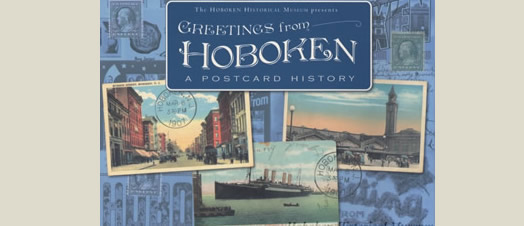
Corresponding with the greatest growth spurt in Hoboken’s history, 1898 – 1930, a simple change in postage from 2 cents to 1 transformed the medium of souvenir postcards into a national craze. Known among collectors as the “Golden Age of Postcards,” the first half of that era, up to roughly the beginning of World War I, gave rise to a flourishing of creativity and communications in an age when mail was delivered twice a day in many urban areas. By 1913, according to Postal Service estimates, some 900 million postcards had been mailed.
Hoboken’s population grew by more than two-thirds over the same period, from 43,000 in 1890 to more than 70,000 by 1910, and many of the city’s public buildings – City Hall, schools, social clubs – and much of the housing stock dates to that era. Fortunately for history buffs, the mania for picture postcards and the spirit of boosterism that pervaded this boomtown resulted in a rich visual documentary record of pre-World War I Hoboken.
Much like today, however, social observers grew alarmed at the rapid rise in popularity of tersely worded correspondence via postcards, voicing concern that it would mean the demise of letter-writing and literacy. John Walker Harrington wrote an essay for the March 1906 edition of American Magazine entitled, “Postal Carditis and some Allied Manias,” in which he bemoaned the fact that the “pasteboard souvenir industry has fattened upon epistolary sloth and collecting manias.”
Hoboken’s history as an immigration gateway contributed to the detailed record we have of the period in the many picture postcards that newcomers would send to their families back home, or on to family and friends in their adopted land. Hoboken was a hub for the postcard trade, with German ships bringing the finest-quality postcards from German printers. One store, Brook’s, at 1118 Washington St., advertised itself as a “headquarters for souvenir postcards.”
Nearly 400 of these brightly colored images are on display in Greetings from Hoboken: A Postcard History, an exhibition of postcards from the Museum’s own collections that presents a lively portrait of a booming young city, proud of its fine homes, new businesses and thriving shipping industry. The Museum’s extensive collection derives primarily from donations and acquisitions from the collections of Director Robert Foster, Trustee Paul Neshamkin, and historian and Museum founder Jim Hans. Accompanying many of the displays are relevant artifacts from Hoboken businesses and landmarks.
The displays are divided into several themes, among them the use of postcards to share news events, with postcards of the famous 1900 pier fire and the engineering marvel of “the Tubes” when the Path system opened in 1908. Others include “view cards,” depicting the city’s amenities and new buildings, and there’s even a selection of homemade postcards used to announce family milestones. Nationwide, the start of WWI put a damper on the postcard craze and left the German printing industry in a shambles. However, as an embarkation point for U.S. troops, Hoboken’s postcard trade continued to flourish, with images of servicemen enjoying the “Hut” – a YMCA-sponsored hangout after federal law closed all taverns within a half-mile of the waterfront.
The exhibit was made possible through a special project grant from the New Jersey Historical Commission, a division of the Department of State, as well as the generous support of our corporate donors, including Applied Companies, John Wiley & Sons, Lobato Floors, Otis Elevator, QualityPro Painters, Union Stone Cleaning & Restoration and Hufnagel Landscaping & Design.
Hoboken Tunes: Our Musical Heritage
July - December 2007
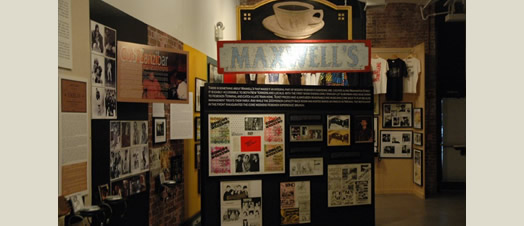
Frank Sinatra may have put Hoboken on the world map, but his is not the only musical career this town has fostered. Stephen Foster lived here when he wrote I Dream of Jeanie with the Light Brown Hair. A few years after Sinatra, and just a few doors down from his childhood home, another crooner, Jimmy Roselli rose to fame singing standards and traditional Neapolitan songs. The musical Hair was written here, and the number of bands who made the leap to national fame after playing at Maxwell’s in the 1980s and ’90s is too large to count.
From its founding in the mid-1800s through today, Hoboken has been a haven for musicians, and music has played an important role in the cultural life of the city, according to Joel Lewis, a music writer and historian who lives here and who researched and wrote the narrative for A Musical History of Hoboken. “Music is the most portable cultural artifact – unlike works of art and even literature, music is easily passed on from generation to generation, and it serves to bind people together in a community,” Lewis says. Lewis notes that it’s not surprising that Hoboken plays a larger role in the national music scene than others of its size. Hoboken’s advantages include its history as a seaport, its heritage as an immigration center, its proximity to New York City, last but not least, its affordability.
Hoboken has played host to many diverse musical communities in its 150-plus years, including German social clubs, Irish music bands, Italian vaudeville, salsa clubs and Club Zanzibar, which was a frequent after-hours stop for jazz and R&B performers after their gigs at the Apollo Theater in Harlem. Music thrived and evolved here among the many immigrant communities.
The exhibit traces the role of music in the cultural life of Hoboken, as well as the contributions Hoboken’s musicians have made to the national music scene. Naturally, center stage is given to favorite son Frank Sinatra, whose career might not have taken off as quickly if he hadn’t grown up so close to “New York, New York.” His big break was performing on Major Bowen’s Amateur Hour radio show in New York in 1935 with his fellow singers in the Hoboken Four.
But like many musicians and singers before and after him, Sinatra’s success was partly rooted in Hoboken’s proximity to New York City, where the popular music industry was centered before much of it shifted to Hollywood in the 1930s and ’40s. Before high-fidelity recording technology, most music played on radio or in theaters was performed live, Lewis says, and most popular music in the first half of this century was published, performed and broadcast from New York City.
Until very recently, Hoboken was an affordable place for struggling music-makers. In the 1960s, a pair of struggling actors, James Rado and Gerome Ragni, holed up in a Hoboken apartment to write the book and lyrics for the musical Hair, which revolutionized the Broadway musical with rock-and-roll spirit. Also in the ’60s, a band called the Insect Trust put out a record titled, Hoboken Saturday Night, and influenced the growing “underground” music scene.
In 1978, a popular restaurant for workers at the Maxwell House plant was transformed in the evenings into a neighborhood spot for bands to try out their new sounds in front of a hip, young audience. Hoboken’s infrastructure as a factory town also supported the musical industry. Guild guitars, cherished by top rock and folk guitarists, were made here in the 1950s. The International Music Corporation distributed hybrid instruments such as the ukelin (a cross between a ukulele and violin) in the 1920s and ’30s, from offices at 14th and Bloomfield St.
The exhibit offers listening stations for visitors to sample music of all kinds that have roots in Hoboken. Fans of Frank Sinatra a chance to see some rare memorabilia, including a microphone he once used, and fans of the 1980s music scene can relive the glory days of independent music through posters, album covers and a few reunion concerts. The exhibit pays homage to artists who have performed at the city’s Arts & Music Festivals over the years.
Lewis has written about music for The Wire, Time Out, The Forward and Moment and is currently a staff writer at NJPAC, interviewing musicians ranging from Ornette Coleman to Moondog. He says he’s “old enough to remember doo-wop quartets harmonizing under the awning of Seid’s Pharmacy in West New York.” A poet Lewis is widely published and anthologized, with a new book Learning From New Jersey, due out in the fall.
From Another Time: Hoboken in the 1970s
January – July 2007
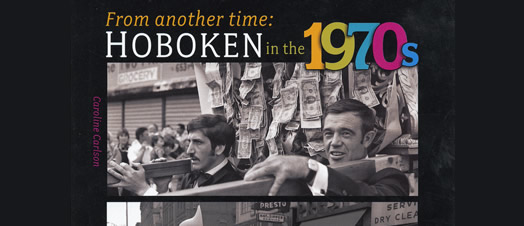
A Trip Back to the Seventies: Imagine a Hoboken before the high-rise residential towers and ubiquitous nail salons, cell phone stores, realtors and shoe boutiques. This exhibit celebrates the Museum’s latest book, From Another Time: Hoboken in the 1970s, where visitors will be transported back to Hoboken in the 1970s through a series of powerful black and white photographs taken by three highly regarded photographers. Bringing the exhibit to life will be a series of lectures by individuals who were instrumental in shaping Hoboken’s development during this pivotal decade.

The book and exhibit depict a Hoboken in limbo between its industrial heyday and its reemergence as a hotbed of residential development, documenting the people, street scenes, block parties, parades, and festivals that are an integral part of Hoboken’s essential character. Although many storefronts were vacant, many apartment buildings were dilapidated, and the padlocked waterfront was patrolled by packs of feral dogs, the people who lived here were determined to make a better life for themselves.
Before the urban-professional migration of the 1980s, Hoboken was populated by a colorful mix of born and raised Hobokenites, who proudly carried on centuries-old traditions such as saints’ festivals with feast bombs and long lines for fresh zeppole; more recent arrivals, including Puerto Ricans, who arrived just as factory jobs were leaving; and a new wave of bohemian “immigrants,” artists and musicians lured by affordable rents and spacious lofts in abandoned factories.
The book unites three distinct views of the city: Caroline Carlson’s photographs of the children of the city and their families; John Conn’s stark views of storefronts and buildings, some of which are long gone; and Benedict Fernandez’ street scenes and images of the working waterfront. The photos are accompanied by two poignant essays: one by a born-and-raised Hobokenite, Anthony DePalma, now a New York Times reporter, who witnessed the changes to his hometown, and the other by Sada Fretz, who moved her family here in the 1970s and saw the city with fresh eyes.
The 190-page book was designed by local artist and graphic designer McKevin Shaughnessy, and was partially funded by contributions from members and friends of the Museum. The exhibit, lecture series, and book were made possible through a special project grant from the New Jersey Historical Commission, a division of the Department of State.
Robert Burczy – “Poster Art”
May 2006
If you travel Hoboken by foot, you no doubt have seen those eyecatching posters on telephone poles and empty storefronts around town promoting local artist Robert Burczy. An art form of their own, these promotional posters have become a fixture of the local cityscape, which will be celebrated in an exhibit, Cascade/Proving his Mettle…The Poster Art of Robert Burczy, in the Museum’s Upper Gallery from May 7 through June 11. You are invited to the artist’s reception on Sunday, May 7, from 4 to 6 p.m. The artist will also give a talk on the last day of the exhibit at 4 p.m. Free to all.
A Hoboken resident since 1989, Robert Burczy grew up in the northwestern Pennsylvania town of Hazelton, but says he “became an artist in Hoboken.” He is self-taught, and greatly influenced by local artists he met here through the Hoboken Creative Alliance, an arts group that flourished in the 1990s.
 Burczy cites a variety of influences, including fellow artist Paul Divone, who created brightly colored wood sculptures and affixed them to telephone poles throughout the city. Burczy also acknowledges the influence of the lively music culture that thrived in Hoboken, manifesting itself in flyers tacked onto any blank surface promoting a band’s gigs, as well as the omnipresent gate-sale posters often fringed with a ruffle of pull tabs to help passersby take note of the date and details. It was out of this ephemera tradition that the “Burczy’s” were born. He prides himself on creating his own “Burczy” posters for each exhibit, most of which use clever wordplay in the name, displayed in the bold “Interstate Highway” type face, along with the opening date and location.
The exhibition will display most of the “Burczy’s” created over the past 12 years, and will include documentation on how and where they could be seen then and how some have survived over time. The exhibition and lecture are supported by a grant from the Office of Hudson County Cultural Affairs and the New Jersey Council for the Arts.
Bill Curran – “A View for All Seasons”
November 13, 2005
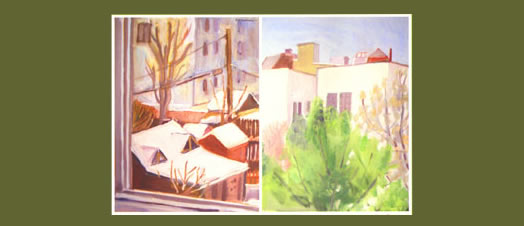
“Down all the side streets, people have wonderful hidden gardens,” artist Bill Curran told a reporter from The Hudson Dispatch in 1986. Today, the painter says, “Seeing other backyards helped me see my own.” Curran loves nature and looking out the window, so, being an artist, he married the two and began a series of paintings of his own backyard.
Outside his window, shapes and colors interact to create beautiful compositions that call out to be painted. Sometimes, Curran records the scene in one sitting. On other occasions, he may return to a subject over a series of sessions.
Please join us Sunday, November 13, 4 p.m. to 6 p.m., for an artist’s reception and opening of A View for All Seasons: Paintings by Bill Curran, in the Upper Gallery at the Museum, 1301 Hudson Street, through December 23. Over a dozen oil and acrylic paintings of backyard views observed through the seasons, and through the years, are on display.
 The paintings record fleeting changes in light and weather conditions, and lasting changes over time. This year, the red geraniums that had always accentuated the green grass of a neighbor’s yard were gone, making the scene far less interesting to the painter’s eye. Even so, the view from his window continues to inspire the artist in fresh and unexpected ways.
Bill Curran’s paintings have been exhibited throughout the metropolitan area. He has studied at The National Academy of Design and The Art Students League. Among the painters Curran counts as influences are Claude Monet, and contemporary artists Fairfield Porter, Jane Freilicher, and Wolf Kahn.
Ben Fernandez – “Shipyard”
September 2005
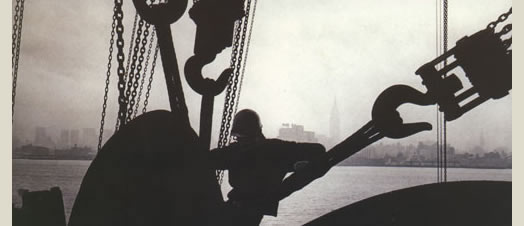
Acclaimed photographer Benedict J. Fernandez went to work at Hoboken’s Bethlehem Steel Shipyard right after high school. His father, who had gone to work at the yard in 1936 and stayed until it closed, got him the job. Ben Fernandez worked alongside Moneybags John, Willy the Beat, and Jesse James. There was an easy camaraderie among the workers, and the shipyard became a home away from home. Fernandez stayed four years at Bethlehem Shipyard working as an apprentice and, later, a full-fledged crane operator, before taking a job at the Brooklyn Navy Yard. At the time, his great avocation was photography, and on several occasions he returned to the Hoboken shipyard to photograph the men who had become his friends. In 1963, after the Brooklyn Navy Yard closed, his hobby became his profession.
The Bethlehem Shipyard photographs of Ben Fernandez pay homage to the men who worked at the yard with his father. Like Family: Photographs of Hoboken Shipyard Workers by Benedict J. Fernandez is on view in the Upper Gallery of the Hoboken Historical Museum, 1301 Hudson Street, September 18 through November 6.You are invited to attend the opening reception on Sunday, September 18, from 4 p.m. to 6 p.m.
Fernandez has been widely published and exhibited, and has received recognition for his outstanding contributions to photography, including Guggenheim and National Endowment for the Arts Fellowships. His work can be found in many permanent collections, among them the Museum of Modern Art; Boston Museum of Fine Arts; the Smithsonian Institution; Bibliotheque Nationale, Paris; Stadt Museum, Dortmund, Germany; and the International Center of Photography. Countdown to Eternity, his photographic record of Dr. Martin Luther King the year before his assassination, has been exhibited extensively in the United States and Europe. Currently, Fernandez is a senior fellow in photography at the Corcoran Gallery of Art, Washington, DC, and founder and CEO of Hoboken Almanac of Photography. The Hoboken Almanac Gallery, at 1252 Garden Street, is open by appointment.
This exhibition is made possible by a Block Grant from the State/County Partnership program for the Arts administered by the Hudson County Division of Cultural and Heritage Affairs, Tom DeGise, County Executive, and the Board of Chosen Freeholders.
Antonio DeJesus – “The Town”
March 20,2005
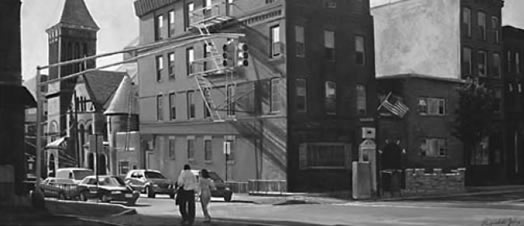
A native of the Dominican Republic, painter Antonio DeJesus moved to Hoboken only three years ago. When he first arrived, DeJesus took long walks around town and developed an appreciation of Hoboken’s architecture. His paintings of local architecture and highly realistic streetscapes are so sharply detailed that they appear at first glance to be photographs. Many are suffused with a warm, golden light, particularly his panoramic southerly view of the Erie-Lackawanna terminal, Lackawanna 2.
The second in a yearlong series of exhibitions looking at Hoboken through the eyes of artists, The Town: Paintings by Antonio DeJesus opens with a reception on Sunday, March 20, from 2 p.m. to 5 p.m. The exhibition is on view through May 7 in the Upper Gallery at the Hoboken Historical Museum, 1301 Hudson Street.
Antonio DeJesus attended Parson School of Design and has won many awards for his illustrations and murals. His work has been shown at Parsons Gallery, New York City, and Centro Cultural Fermosselle, Dominican Republic.