Category Archives: Upper Gallery
Issa Sow – “Hoboken, from Old to New”
January 27 - March 10, 2019
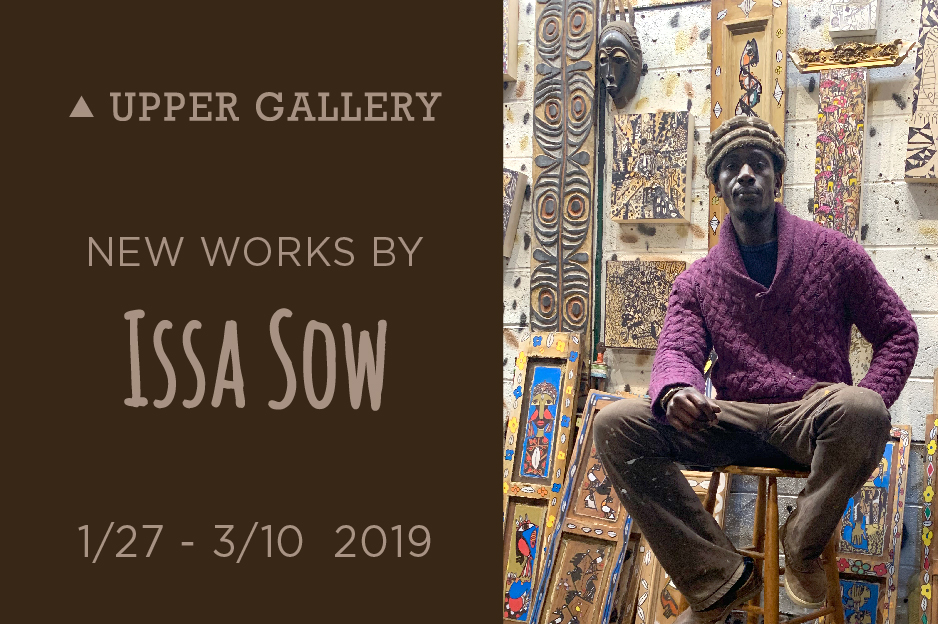
Issa Sow is a Hoboken artist in the truest sense of the word. Before moving to Hoboken from France about 7 years ago, he had never created art. He had always been an avid collector of traditional and contemporary art from his native Senegal and other countries. But he had never tried making art on his own until, he says, he was “reborn” here in Hoboken. He has learned from experience that moving to a new culture is an opportunity to change your perspective and undergo a transformation.
Sow is an autodidact — a self-taught artist who discovered his talent for creating artwork in acrylic paint, drawings and mixed media. Inspired by real life, each piece has a different personality and its own fingerprint. His artwork is constantly evolving, as he experiments with new concepts. He signs his art “Issa=2,” which represents the binary aspect of all things in life.
Issa Sow’s latest series will be on display in the Hoboken Historical Museum’s Upper Gallery, from Jan. 27 through Mar. 10, 2019. Titled “Hoboken: Old to New,” the exhibit consists of about two dozen works created from found objects from around Hoboken. Old objects like a cupboard door is repurposed as a canvas, decorated in bright colors with Sharpie oil pens.
A motif that appears throughout much of his work is the cowrie shell, which represents good fortune and the connection between animals and humans. The shells have served as currency in the distant past, and as a protection against the evil eye. To Sow, the shells also represent the harmony between earth and humanity. The shell symbolizes our connection with the earth.
He hopes the exhibit inspires visitors to think twice about the life cycle of manmade creations and our tendency to discard items after a single use. The byproduct of mass production is that our accumulated waste threatens our habitat here on earth.
“Humankind has the power to create items that can cause both progress and also destruction,” he says. “We need to be mindful about finding a balance that enables growth and progress without destroying the world we live in simultaneously. If everyone in Hoboken reused one item they were going to throw out instead of purchasing something new the impact could be significant.”
Sow is also the founder and curator of Issyra Gallery, a unique addition to the Hoboken art scene, located in the former Neumann Leathers factory building. The gallery represents work from local and international artists, as well as handpicked traditional and contemporary artwork from Africa, creating a beautiful mélange of amazing pieces. Many of Sow’s own works are mixed in, too.
He credits Hurricane Sandy for his rebirth as an artist. The gallery had originally opened in the Jefferson Trust building, right before the storm’s record flooding displaced him. The storm gave him a chance to rethink how to operate the gallery. He likes the energy at Neumann Leathers: “You can feel the old souls there.” He collaborates with other artists, musicians and poets to host a variety of cultural events there.
This exhibit is supported by a block grant from the State/County Partnership program for the Arts, administered by the Hudson County Division of Cultural and Heritage Affairs.
Jim Fallon – “Heaven, Hell or Hoboken”
November 11 - December 23, 2018
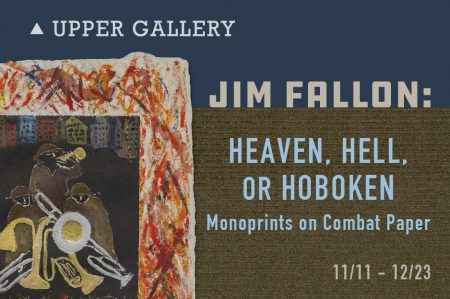
The Hoboken Historical Museum is pleased to commemorate the centennial of Armistice Day, the end of World War I, with the opening reception for a WWI-inspired art exhibit by veteran Jim Fallon: “Heaven, Hell or Hoboken: Monoprints on Combat Paper.” The reception is Sunday, Nov. 11, 6 – 8 pm, and the show is on view in the Upper Gallery through December 23.
The exhibit comprises 15 works of art, most inspired by the 100th anniversary of America’s participation in World War I, 1917 – 1918. The name of Fallon’s show is inspired by General Pershing’s famous rallying cry to the troops, “Heaven, Hell or Hoboken,” near the close of the war, as Hoboken served as the main port of embarkation and return.
Many pieces in Fallon’s Armistice Day series were produced for the Frontline Arts Center in Branchburg, NJ, and also shown in an exhibition in Jersey City Hall last year to commemorate the anniversary of America’s involvement in the Great War. Several pieces incorporate images he researches online, such as zeppelins, the Lusitania, and battle scenes from a century ago, as well as from his own service in Vietnam.
One piece, “Harlem Hellfighters WWI,” a linocut with acrylic on combat paper, combines Fallon’s deep love of jazz music with an homage to the famous 369th regiment that served in World War I as a segregated unit of mostly black and Puerto Rican soldiers from Harlem. These soldiers not only distinguished themselves in battle, but also during and after the war, when musicians from the unit introduced American jazz to Europe. Many returned to Paris after the war to escape the police harassment that made it difficult for them to perform in New York, spawning an enduring fan base for jazz in Europe.
The themes of jazz music, nature and military service recur throughout Fallon’s art. Retired from a career in the hospitality industry as owner of the New York jazz club, the Half Note, and eventually as head bartender for the Century Plaza Hotel in Beverly Hills, the Hoboken native and his wife returned to the Mile Square City several years ago to look after their aging parents.
Fallon came to the practice of art late in life, about five years ago, after joining in an art class offered by the Disabled American Veterans group. He was serving as a veterans service officer, helping other disabled vets gain access to programs like art therapy at the Veterans Center in Secaucus.
“At first, I thought I couldn’t draw more than stick figures,” he says, but with the help of his fellow veterans, he quickly developed skills with multiple media, from drawing to painting to paper making. He learned the craft of making paper from shredded veterans’ uniforms at the Frontline Arts Printmaking Center of New Jersey, in Branchburg. Called “combat paper,” the end result is a textured paper that serves as the backdrop for his art. He’s part of a veterans’ group that invites other veterans to join in the process of converting their old uniforms into paper, which also fosters therapeutic conversations among the veterans from different wars who gather weekly to share the craft.
In 1968 at age 28, Fallon had served as a medic in Vietnam in a field hospital unit comprising Army Reservists from New York. The group didn’t think their unit would be called up and fought the deployment in court, all the way to the Supreme Court. The government prevailed, and the unit was assigned, perhaps as a punishment, to staff a POW hospital. He soon realized that many of the enemy’s army were just like them, kids, some conscripted at gunpoint. Not all were hardened Vietcong combatants.
His Army Medical Unit also provided assistance to a remote village orphanage, delivering provisions of food, toys and medical supplies. The children were always excited to see the truck with the big red cross. The experience stayed with him, resurfacing years later in a work he titled, “Orphan Opus ’68,” which is included in the Upper Gallery show. The piece received the 1st place award in the October 2015 National Veterans Creative Arts Festival in Durham, N.C.
Exposure to Agent Orange also marked him, as it did over 400,000 other Vietnam veterans, although it took 20 years in his case to show up as bone cancer. He lost the humerus bone in his right arm, replaced by a titanium bone. Through therapy, he regained use of the lower part of his arm, but can’t lift heavy objects. It doesn’t prevent him from making art, which he spends several hours a day on now, in his Hoboken home.
Fallon has deep roots in Hoboken, though he was raised in Jersey City, after his family moved to the Heights neighborhood shortly after he was born in Hoboken. His great grandfather, after serving the Union Army in the Civil War, came to Hoboken and settled, working at a leather factory. His father was a Hoboken fireman during the Great Depression, but after an injury on the job, he found work as so many others did on the Hoboken piers. He was a dock checker in a longshoremen crew and recalled when the film “On the Waterfront” was being shot on the pier next to his, taking a lot of men off the job.
The exhibit is supported by a block grant from the State/County Partnership program for the Arts, administered by the Hudson County Division of Cultural and Heritage Affairs.
Gary Spector – “Hoboken Halloween”
September 23 - November 4, 2018
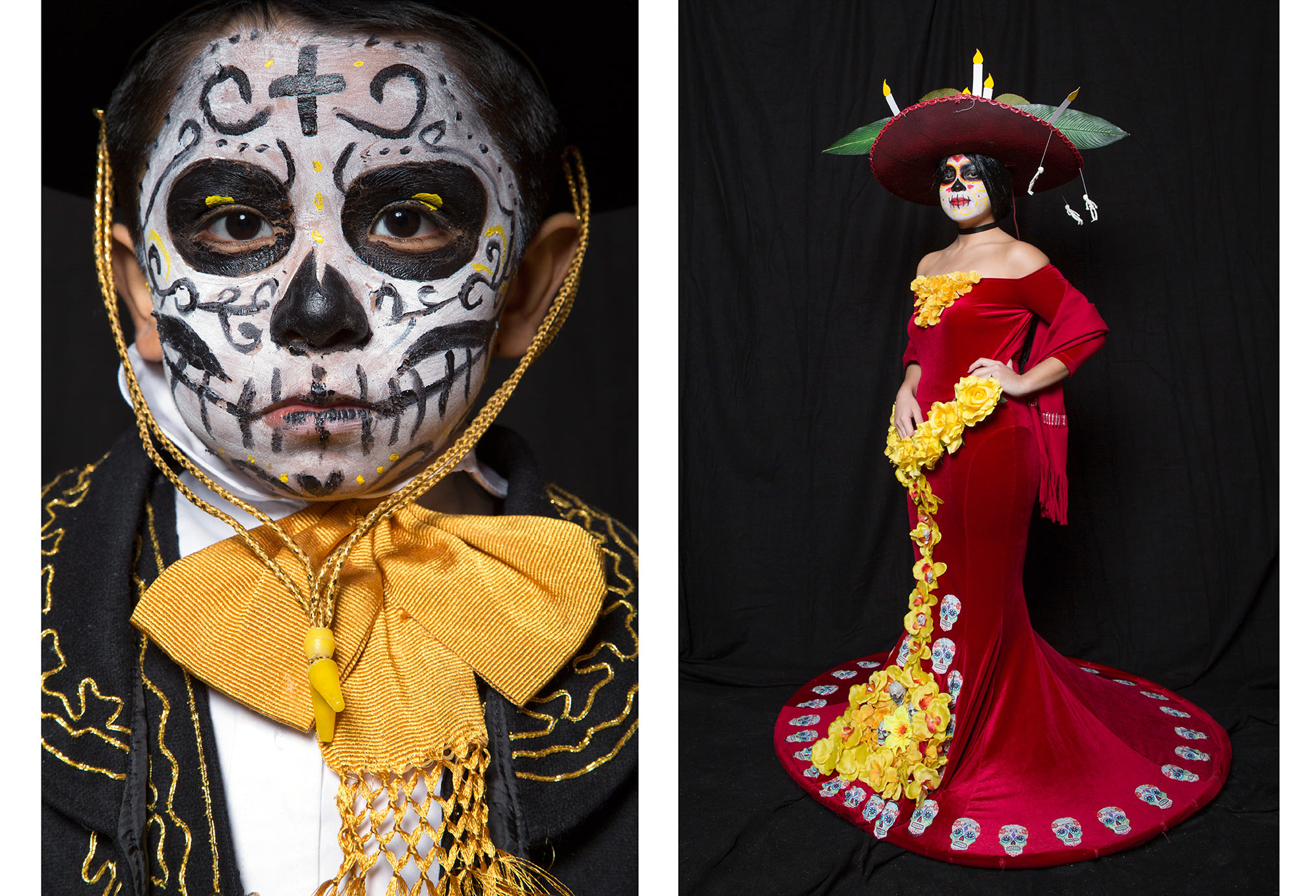
The Hoboken Museum is pleased to present our latest Upper Gallery art exhibit: “Hoboken Halloween: Portraits by Gary Spector (2011-2017).” Spector started the project on Halloween in 2011, when he set up a drape and some lights for a temporary photo studio in front of his Hoboken home. As trick-or-treaters walked by, he asked if he could take their portrait.
Over the years, Spector has photographed hundreds of people, and it’s become a Hoboken tradition, with lines extending around the block! A professional photographer by day, he offered all the Hoboken Halloween subjects a complimentary copy of their portrait.
The show is on view through Nov. 4.
David White – “Bootleggers Under Glass”
August 5 – September 16, 2018
David White moved to Hoboken when it was thick with vestiges of its gritty, mid-20th century “On the Waterfront” period. He moved here after college in 1983, already an accomplished street photographer, having grown up in Manhattan with a love of the medium. He had honed his skills on assignments in high school and at Ohio University, and began working as an apprentice to professional photographers in Manhattan.
When he landed in Hoboken, he fell in love with the city’s old factory buildings and historic vibe. He loved prowling through the streets, shooting the graffiti-covered Levelor and Maxwell House factories and the crumbling waterfront. He married and raised a family here, while building a successful commercial studio business, shooting celebrities and models for major corporate and magazine clients from his 5,000-square-foot studio near Union Square in Manhattan.
Although his work concentrates on creating perfect images for commercial clients, White has always been drawn to artistic capabilities of photography, having been raised by two artists,
a commercial illustrator for a father and an art director and sculptor mother, who met while plying their skills for Bloomingdales.
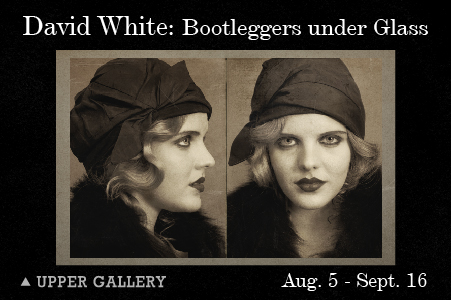
An opportunity to shoot a campaign for a liquor company named Prohibition Distillery in 2016 sparked his creative imagination. At a tasting for the company’s Bootlegger 21 Vodka at the W Hotel in Hoboken, he pitched one of the company’s principals, Brian Facquet, on a campaign to recreate the glass-plate process look of vintage mugshots from the 1920s using modern digital technology. The result is a series now on display in the Hoboken Museum’s Upper Gallery, “Bootleggers Under Glass,” on view through September 16.
“Under glass” is one of many 1920s-era euphemisms for being in jail, says White. He was fascinated by the look of wet plate collodion process of photography from the time, with the unintended imperfections that come from the laborious process. The technique meant that the photographer coated glass plates with chemicals, loaded them in a camera for the shot and processed it in a dark room right away. It didn’t give the subjects — whether for portraiture or police file photos — many chances at striking the perfect pose. The result was a realistic portrayal of the subject’s state of mind. It also resulted in an almost painterly feel and texture, with imperfections that couldn’t be digitally erased back in the day.
White, who now works almost exclusively with digital equipment, enjoyed the challenge of adding these imperfections, tonal qualities and textures to mimic the look of authentic 1920s mugshots. He also had to coax his models for the Bootleggers series into the right frame of mind to portray hard-bitten booze smugglers caught by the law. Having a case of the Bootlegger 21 vodka on hand helped, he says. Several of his subjects are avid fans of the Jazz Age, and brought their own vintage clothes and accessories to the photo shoot.
“The project was the perfect marriage of commercial and personal work,” White says. “Each image probably represents two days’ worth of work on the computer to achieve the desired effect — longer than the actual wet plate process in a dark room, but without the dangerous chemicals.”
White has enjoyed a few exhibits of his work over the years, with this series having been part of a Jazz Age-themed exhibit at Raoul’s French restaurant in New York. Hobokenites might have seen his work on display over the years in some of the local coffee shops frequented by the artists here, including Mola, Frozen Monkey, Park Pastries, and others. He still enjoys spending time with his fellow Hoboken artists at Bwé café.
Laura Alexander – “Reunion”
June 2 – July 29, 2018
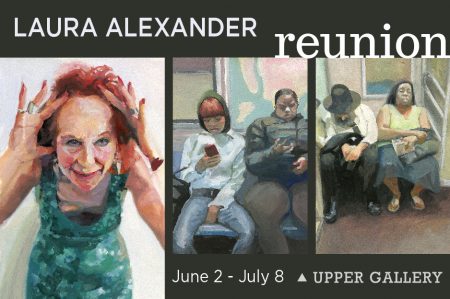
Laura Alexander is best known for her large-scale, vividly colored oil portraits. Visitors to the Hoboken Museum in 2012 might remember the striking, four-foot-tall portraits in her “Mostly Rosemary” exhibit. She also had a solo exhibit titled “Portraits” in 2005, featuring a charismatic redhead named Olivia, among others.
“Olivia used to live in a shelter in Hoboken, from 2004 through 2006,” Alexander says. “I would find her, usually at Barnes and Noble, and bring her to my studio for a photo shoot. We did this for about two years or so, and I painted 13 large oil paintings as a result of these photo shoots.”
Eventually the artist lost track of Olivia, but as a birthday gift this year, she says, “I painted a tiny portrait of Olivia. I had 450 photographs. Sifting through these photos, I was drawn back in.” It took a few attempts, but she tracked Olivia to a safe housing residence in New York, where she was invited to a visit. “I brought soup and my camera.”
“I love painting Olivia. Especially her lipstick,” Alexander explains. “She is beautiful and childlike, while cunning and clever. And tragic.” She hopes she captured these qualities in a short video about Olivia that will be on display alongside about 39 examples of her latest work – smaller in format, and in gouache instead of oils – in an exhibit appropriately titled “Reunion.” The exhibit opened Saturday, June 2, with a free reception from 2 – 5 pm, and has been extended until July 29.
For the past 28 years, Alexander has maintained a studio at 720 Monroe Street, the former Levelor factory building. But in 2013, after earning her second fellowship grant from New Jersey State Council on the Arts, she rented a spacious studio at Mana Contemporary, in Jersey City. There, she had plenty of room to work on super-sized canvases, often using herself as a model to represent different aspects of the feminine guise.
Her work is exhibited frequently in New York and New Jersey, and internationally in Japan and Austria. Notable exhibits include the Newark Museum, Morris Museum, Aljira Gallery, Visual Arts Center of New Jersey, the Institute of Contemporary Art (Portland, Maine) and George Segal Gallery. To learn more about her work, visit her website: www.lauraalexander.net.
After four years at Mana, Alexander brought everything back to Monroe Street. Suddenly, size mattered. “My 450-sq.-ft. studio was already filled with paintings and the additional 15 monster-sized paintings made the space a bit smaller,” she admits.
So she turned to a new medium and new format. “The idea of painting 7” x 10” gouaches at my kitchen table became even more appealing. Gouache is a tricky medium. I use it like oil instead of thinning it like watercolor. It dries darker and the colors become muted easily. This new process gave me a new palette…moody colors instead of my bright, intensely colored oil paintings.”
The switch to gouache dates to 2016, when Alexander flew to the island of St. Bart’s with a friend and needed art supplies she could carry easily, small tubes of paint and a small pad. “The beach scenes soon gave way to the subway series because I began house/dog sitting in New York for a friend who traveled for long periods of time. I would sneak photos with my phone and then paint them from my phone screen.”
Working in gouache from these surreptitious cellphone pictures, Alexander produced several of the 39 paintings in her new exhibit, in addition to new portraits of Olivia. “I got pretty good at it…scoping out the passengers before I took a seat in order to get the most interesting people. Sometimes, I got caught snapping photos and one of these became a painting in the show.”
The exhibit is supported by a block grant from the State/County Partnership program for the Arts, administered by the Hudson County Division of Cultural and Heritage Affairs.
Tom Zuk – “Rear Window”
April 15 – May 27, 2018
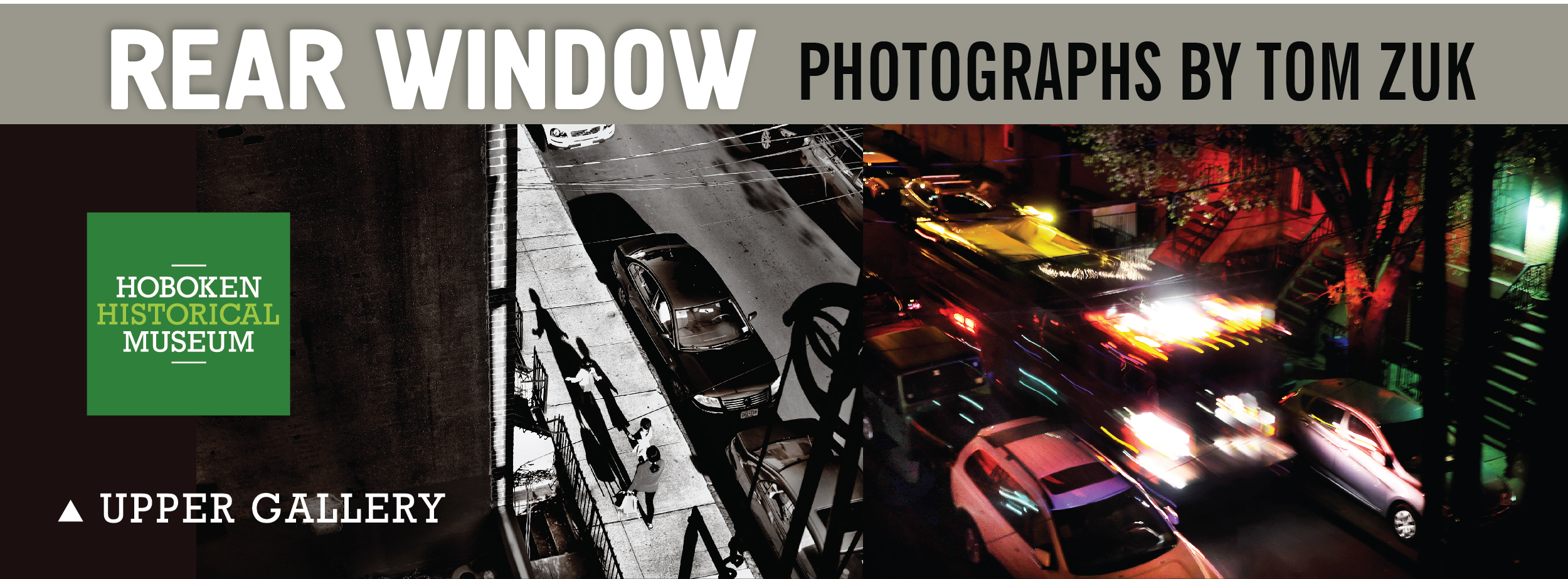
Tom Zuk has made photographic art from the rough materials of the urban cityscape outside his Hoboken apartment window. A wall of crumbling masonry, a clothesline with pulley, a patio, a street corner, a church with steeple, hi-rise apartment, just the sky filling the window from edge to edge: Each scene is interpreted by a photographer steeped in all aspects of the medium, from the studied attention to light and shadow in shooting a still life or landscape to the split-second instincts of a street photographer. Working within the self-imposed constraints of shooting from his apartment, Zuk didn’t set out with a particular objective, but he describes the resulting series as “a hybrid of the Romantic and Existential, recording the particular species of mankind’s solitude unique to dense, old cities.”
The image used in the poster, for example, was inspired by the effect of the city at night, “painted with artificial lights that haphazardly––beautifully, to my eye––mix color temperatures, and serve up a chiaroscuro dreamscape that I find compelling.” The photograph is just one in a very varied tableau of Zuk’s corner of Hoboken. See the rest in the exhibit, “Rear Window: Photographs by Tom Zuk,” which opens Sunday, April 15, with an opening reception from 2 – 5 pm, and an artist’s talk at 4 pm.
His first love was painting and drawing, but he wasn’t satisfied with his efforts. As did Man Ray and Irving Penn, photographers who started out as painters only to find that they’re more adept with a camera than with a brush, Zuk turned to photography as an alternative means of visual expression. He trained himself by walking the streets of New York, shooting and learning from his mistakes. He apprenticed with established photographers and took photos for his own portfolio, spending hundreds of hours in darkrooms mastering black and white photography. He works in the digital medium today, but credits his early experience in the darkroom for his ability to pull off a striking black and white photograph even with digital tools.
“Of all the work I did as a commercial photographer, the least remunerative but most gratifying assignments were editorial jobs and travel features, many of the latter for a New York newspaper,” Zuk says. “I liked being on the loose in a foreign country, meeting strangers, struggling to communicate, and coming home with good film. The rewards were directly proportional to the risks.”
He adds, “Another, quieter current in my work is still lifes. I enjoy taking an unusual household object––a bouquet of dead flowers, for instance, or an espresso pot or toy car––arranging it in front of the camera, and seeing if I can extract an unsettling mood from the composition.”
Zuk admits that “Hoboken isn’t Yosemite or the Grand Canyon,” but he enjoyed the challenge of capturing strong images in this variation on street photography. “The views don’t surrender themselves easily.”
Zuk has seen the city change a lot in the 35 years since he and his wife moved here. He spent his early years in Buffalo, NY. “It was a working-class city when I lived there, and often came to mind when my wife and I moved to Hoboken,” he says. “But change is the only constant, and Hoboken is no longer blue collar. I have to catch myself when drifting into nostalgia because I’m suspicious of its potential for dishonesty,” he concludes.
Explore more of Zuk’s work on Instagram. The exhibit will remain on view through May 27.
The exhibit is supported by a block grant from the State/County Partnership program for the Arts, administered by the Hudson County Division of Cultural and Heritage Affairs.
Marcella Conti – “Hoboken Sensations”
February 25 – April 8, 2018

Even though Hoboken is very close to the Big Apple, the city has its own personality and charm. There’s a sense of familiarity, a warm environment where foreigners are welcomed to be themselves and keep their traditions alive. Small, family-owned businesses are an important part of Hoboken’s character, and are the main focus of the Museum’s latest art exhibit: “Hoboken Sensations: The photographs of Marcella Conti.”
Marcella Conti is a Brazilian photographer who has found in photography a true passion for capturing places and families. In 2016 she attended the International Center of Photography, where she studied documentary and visual journalism. There she finished the project, “Hoboken Sensations,” which was part of the exhibition, “Another kind of paradise,” at ICP, in New York City in 2016.
Conti found that the city of Hoboken has a feeling of coziness, warmth and tradition. Small family shops didn’t give way to large chains, as in most big cities. Stores founded by settling immigrants are kept alive in the families for generations and so are their memories and traditions. Their walls are covered with old photographs and memories from grandparents, and their business models, routines, and customs remain mostly the same. They continue to fight to survive a gentrification that makes cities impersonal in the modern world.
“When we move to a new place, especially a country with a different culture, we change our personality too,” Conti says. “After a while we don’t belong anymore to our birth place or to the new one. I wanted to show that the old can still live with the modern.
“This feeling of not belonging brings a certain loss of identity,” she added. “Living and working in such a big and cosmopolitan place like New York City can be comforting because many residents are immigrants too, but it can also make us feel like we’re missing something that defines who we are. Pieces of our culture, history, and memories that makes us unique are usually left behind.”
The exhibit opens Sunday, Feb. 25, with a free reception from 2 – 5 pm, and remain on view through Apr. 8.
The exhibit is supported by a block grant from the State/County Partnership program for the Arts, administered by the Hudson County Division of Cultural and Heritage Affairs.
Erik L. Burro – “Legacy of Remembrance”
January 7 – February 18, 2018

As the commemoration of the centennial of America’s involvement in World War I continues into 2018, a new photography exhibit in the Museum’s Upper Gallery documents one man’s quest to bring attention to the wealth of fine statuary and other monuments erected by New Jersey’s towns and cities.
“Legacy of Remembrance: Photographs by Erik L. Burro,” presents a series of large format black-and-white photographs of over two dozen WWI monuments around New Jersey, plus a few from neighboring states. Burro is a historian and photographer who has many years’ experience with historic character portrayals and historic site multimedia productions, mostly since the 1976 bicentennial celebrations.
This WWI series has been a passion project he’s pursued on his travels around the state in the past two years, ever since he became intrigued with a WWI monument in his adopted hometown of Burlington, NJ. After researching its history, he started noticing more of these largely forgotten monuments, leading him to document as many of them as possible, in tribute to the 1917-1918 centennial of America’s involvement in the Great War.
The exhibit opens Sunday, Jan. 7, with a free reception from 2 – 5 pm, and a talk by Burro starting at 4 pm. The photos will remain on view through Feb. 18.
The exhibit is supported by a block grant from the State/County Partnership program for the Arts, administered by the Hudson County Division of Cultural and Heritage Affairs.
Anna Pinto – “30 Years of Snow”
November 18 – December 31, 2017

A hand-crafted card is a gift in itself, in an age when computer-generated “hand-writing” typefaces attempt to mimic the personal touch without quite pulling off the illusion. Hoboken-based lettering artist Anna Pinto has produced snow-themed calligraphic holiday cards for more than 30 years.
“My holiday cards are an opportunity to create something completely for my own pleasure, that I can also share with family, friends and clients,” she adds. Her cards often combine hand-lettering with photographs or drawings, and occasionally hand-coloring or stencils and individual tiny collages.
“After a series of cards based on lines from Dylan Thomas’ “A Child’s Christmas in Wales,” I decided if I just used winter and/or snow as a theme, I wouldn’t have to worry if I was late with my cards as long as they got out before the first day of spring!” The theme continued to resurface as a theme in her cards, as she keeps an eye out for references to snow in her reading throughout the year.
An exhibit of her work, “Thirty Years of Snow: Calligraphy by Anna Pinto,“ will be on display at the Hoboken Museum from Nov. 18 – Dec. 31, featuring her printed cards, along with original pieces using some of the same quotations used in the cards. The exhibit also will include examples of preliminary work and writing for a few of the cards, to give visitors an idea of how they were done. In some cases, the size of the lettering has been reduced dramatically for the final card — so having the original writing will demystify the cards a bit. Her card formats vary quite a bit, often with unusual folds that allow her to include a greeting without printing on both sides. Join the artist for a talk and Q&A about her work on Saturday, Dec. 9, at 4 pm at the Museum.
Pinto cobbled together a lettering education by taking many workshops and classes over the years. “Calligraphy really is drawing: You’re controlling line very precisely,” she says. “I also enjoy watercolor and collage. But I always loved literature as well, so calligraphy seemed like an ideal way to combine both interests.”
Now, she’s an established freelance calligrapher, doing a variety of lettering work, from invitations, envelopes and placecards for social events; citations for educational institutions and corporations; to hand-lettered poems and quotations for individual commissions. She also teaches calligraphy for the Society of Scribes (societyofscribes.org) and other organizations.
Aside from her cards and commissioned lettering projects, some of her most fascinating projects have been film props, ranging from medieval calligraphy for pages of a huge book of spells used in Disney’s “The Sorcerer’s Apprentice” and lettering on a map for the “The Smurfs,” to writing entries for a 1920s ship manifest for “The Immigrant,” an illuminated spread from Dante’s Inferno for “True Story,” and 1950s-style handwriting for a notebook in “The Marvelous Mrs. Maisel.” She notes, “I enjoy the research into the topic as much as the work itself, because it takes me into worlds I might not enter otherwise.”
Pinto moved to Hoboken in 1980 with her husband, Pieter Sommen, to find a more peaceful and affordable place of their own after sharing a large apartment with friends on Bleecker Street in Greenwich Village. “Our block had become a kind of tourist circus, but Hoboken felt so familiar, and reminded us of what we loved about the Village: the human scale of the buildings, the coal oven bakeries, delis making their own mozzarella, café con leche at the bodegas, people growing fig trees in their backyards,” she recalls.
“Hoboken has certainly changed dramatically,” she adds, “but we still love it here. My experience of snowy days in Hoboken certainly inspires my choice of quotes. I love the hush that expands as the snow falls and the normally noisy Willow Avenue traffic outside my studio window stops. And I love the graphic geometry in the backyard view from my kitchen, as snow settles on the angles of fire escapes and roof tops and the branches of trees.”
Her work has been exhibited in the show “The Revival of Calligraphy” at the Grolier Club in NYC, as well as in an exhibit along side work by her parents and sister in the “Families/Cities Shift” show at the Susan Teller Gallery in NYC in 2013. The exhibit at the Hoboken Museum will include both originals and printed cards available for purchase. For a glimpse of her work, visit www.annapintocalligraphy.com.
The exhibit is supported by a block grant from the State/County Partnership program for the Arts, administered by the Hudson County Division of Cultural and Heritage Affairs.
Frank Hanavan – “Hoboken”
September 24 - November 12, 2017
A plein air painter’s life isn’t easy, especially in an urban setting. Imagine lugging around close to 20 pounds of art supplies, including an easel and bulky canvases, perched on a bike or squeezed into public transit, just to capture a scene in the right light. For more than 25 years, that’s been the modus operandi of Frank Hanavan, whose acrylic paintings of Hoboken and New York City streetscapes, parks and waterfront adorn the walls of dozens of Hoboken homes.
A couple of years ago, to lighten his load on his “days off,” Hanavan began carrying a small watercolor set and a pad of watercolor papers, just to do some light sketches. He hadn’t worked with the medium since taking classes at the Art Institute of Chicago, University of Buffalo, and Chautauqua. He discovered it took a few tries to get the hang of it. At first, he applied the watercolor pigments thickly, resembling the opacity of acrylics. But the more he painted with them, the lighter his touch became, bringing more and more light into his paintings.
“I’ve always taken the watercolor less seriously,” he admits, adding, “I view the medium as being more carefree, and it’s my favorite thing about it.”
That insight may be the secret to why this series of watercolors of Hoboken is so delightful. “Perhaps because I don’t take it as seriously, or put it on a pedestal, I can experiment more with it,” he says. “And when I go back to using acrylics, I find the watercolor experience gives me a fresh look at the acrylic, a perspective I could not have gained otherwise.”
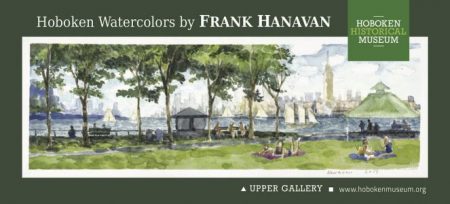
Using a smaller format than his acrylics, the artist infuses light and air into these 43 scenes of the city’s waterfront walkway and parks, train terminal, and street views. Fans of his work will recognize some of his perennial favorite Hoboken scenes, such as sidewalk cafes and the cherry trees in bloom along 9th Street, and some new ones.
Even with the entire city of New York at his disposal, Hanavan is drawn to Hoboken. “It’s small enough to feel like a microcosm,” he says. “It’s close, yet it’s a different place, it’s distinct from Manhattan or Jersey City and it pretty much looks good no matter where you plop yourself down.” And as a self-taught sailor and fan of all things nautical – he creates historically accurate ship models as a hobby – he likes that the Mile Square City is right on the Hudson.
Hanavan grew up in the Buffalo, NY, suburb of Kenmore, and moved to New York City in 1990, where he began painting scenes of everyday city life. Winter, spring, summer and fall, regardless of the weather, rain, snow or shine, he is constantly out painting the city he loves from life, without editorializing or romanticizing the subjects. He often says his real subject matter is the quality of light falling on the subject, not the physical subject itself.
The exhibit, Hanavan’s third exhibit at the Hoboken Museum this decade, opens Sunday, Sept. 24, and remains on view through Sunday, Nov. 12. And on selected Saturdays, Oct. 7th and 14th, and Nov. 11th, Hanavan will share his talents in three art classes, from 2 – 4 pm, with anyone who wants to learn how to handle watercolor paints. Each class costs $25, $15 for kids, and materials are included. See the Museum’s events calendar page for sign-up links.
The exhibit is supported by a block grant from the State/County Partnership program for the Arts, administered by the Hudson County Division of Cultural and Heritage Affairs.