
Category Archives: Upper Gallery
Artists on the Move – “In Transition”
August 6 - September 17, 2017
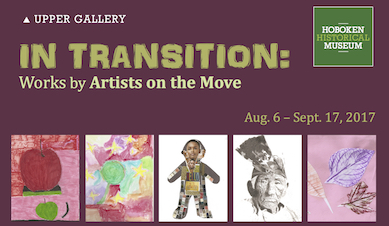
Art teacher Liz Cohen has been teaching weekly classes at the Hoboken Shelter and St. Matthew’s lunch program, as a volunteer. After retiring from 40 years of teaching in a private school, she enjoys working with Hoboken’s transitional population, helping them explore their own talents by exposing them to the techniques and styles of a diverse group of artists, including Keith Haring, Jim Dine, Hans Hofman, Kara Walker, Faith Ringgold, Georgia O’Keeffe, Romare Beardon, Stuart Davis, Jackson Pollack, Jasper Johns, Basquiat, Helen Frankenthaler and Yayoi Kusama.
The result is a stunningly diverse exhibition of nearly 150 works of art that reveal the unique perspectives and individual talents of these local artists. On view from August 6 through September 17, the exhibition should give visitors a new respect for members of our community who are often underappreciated, according to Cohen. She says some of the artists are creating artwork for the first time, while others show natural talent equal to some of America’s best-known self-taught “outsider” artists.
One of the artists once asked Cohen why she enjoys hanging out with homeless people, and after two years, she says she has come to see the art classes as a powerful tool for helping people communicate. “I really enjoy talking to the students,” she adds. “Each is unique; as unschooled talents, their work is fresh and uninhibited, unselfconscious, and naïve.”
She hopes viewers will come to see these artists more clearly as individuals through their work. “They’ve created a life for themselves,” she observes. “Hoboken provides a good amount of support, with the food pantry, the Hoboken Shelter, and St. Matthew’s lunchtime ministry, they have formed a community, sharing ideas and problems with each other.”
The exhibit is supported by a block grant from the State/County Partnership program for the Arts, administered by the Hudson County Division of Cultural and Heritage Affairs.
William Magruder – “The Walls of Hoboken”
May 28 - July 2, 2017
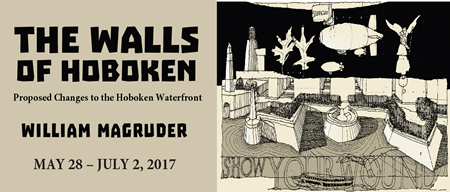
An architectural illustrator by profession, William Magruder has an irrepressible artistic imagination that expresses itself in fantasy-infused drawings, reminiscent of one of his favorite artists, Windsor McKay.
A recent series was inspired by Hoboken’s inundation during Superstorm Sandy. Magruder and his wife had lived here since 2002, and his adopted city’s defenselessness during the storm surge sent Magruder’s imagination on a journey to the fortified cities and villages he had seen on his travels through Europe. Among his favorites is Lucca, Italy, whose thick, sloped, brick-and-stone walls were built by 16th century residents for protection against mortar shells.
The walls were built to last and give the impression of impregnability, he recalls, but they are also topped with promenades so the people could enjoy the surrounding landscape during peaceful times. “They’re a delight, a magical combination of landscape and architecture,” he says. “They’re a wonderful asset to the city, drawing tourists and residents alike.”
These walls become particularly intriguing when they’re adjacent to water, Magruder adds, like those in Antibes, on the Côte d’Azur of France. That’s what inspired him to imagine such fortifications surrounding Hoboken, keeping the water at bay, yet allowing people to enjoy the views from the walkway on top. He began the series by drawing in pen and ink, with no preconceptions of how they would turn out, because he prefers creating art spontaneously. He then developed some illustrations into full-color renderings using 3D computer modeling.
His “The Walls of Hoboken” drawings are a fantasy exercise, he admits, “not a design solution.” For one thing, in the 16th century, most of the labor was conscripted! But with Margruder’s award-winning technical expertise, his illustrations of solid walls seem as capable of protecting a city as any Frank Lloyd Wright renderings.
Magruder has published the illustrations in a book, and a number of them will be displayed in the Hoboken Museum’s Upper Gallery from May 28 through July 2. For a preview, and to see other work by the artist, visit www.williammagruder.com.
Magruder and his wife no longer live in Hoboken; they have recently relocated to Italy, choosing Milan for its central location and ease of life without a car. He continues to practice his art and do some teaching.
The exhibit is supported by a block grant from the State/County Partnership program for the Arts, administered by the Hudson County Division of Cultural and Heritage Affairs.
Robert Nardolillo – “The Essence of Hoboken”
April 15 - May 21, 2017
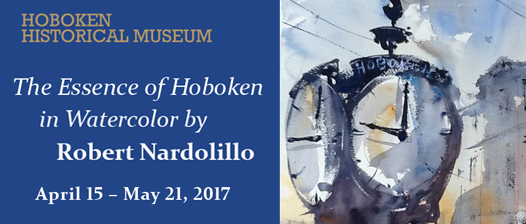
Join us for a free opening reception for our latest Upper Gallery art exhibition: “The Essence of Hoboken: Watercolors by Robert Nardolillo.” These dynamic and moody watercolor paintings by the Brooklyn-born artist who now lives in the suburbs, express the urban energy of the Mile Square City. He discovered the city’s unique beauty when his daughters moved to Hoboken after college. Meet the artist at the opening reception for his works on Saturday, Apr. 15 from 2 – 5 pm. His works will remain on view through Sunday, May 21. For a preview of his work, visit the artist’s website.
The exhibit is supported by a block grant from the State/County Partnership program for the Arts, administered by the Hudson County Division of Cultural and Heritage Affairs.
Jean-Paul Picard – “Hoboken Sweeps”
March 4 - April 9, 2017
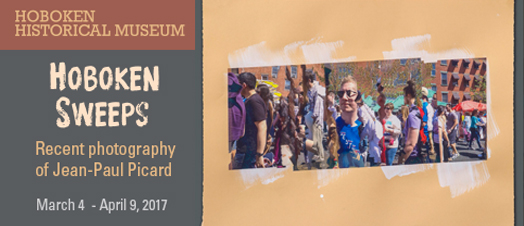
The versatile artist Jean-Paul Picard specializes in web design and digital photography. He teaches courses in these technical skills in evening classes at the Hudson County Schools of Technology. But he started out as a graphic designer and photographer back in the days when you used an actual T-square to draw a rule, and mixed chemicals in a darkroom to print a photo.
With a penchant for trying new things, Picard started experimenting with using multiple images in single work to create a story line, after seeing a Richard Avedon exhibit in 2013. Avedon had created monumental, panoramic photographs of people standing in a row by combining several exposures together. Inspired by this and by his affinity for art by cubist painters like Picasso and Braque, Picard started combining a series of separate exposures he had taken at another art exhibit.
Then, he struck on the idea of using the panorama mode on a digital camera, but rather than moving the camera in a smooth line, he learned he could create more interesting effects by sweeping the camera in different ways and at different speeds. Like the cubists, this he uses this technique to show more sides of an object than a traditional single-perspective image offers.
At first, he printed these “sweeps” from his digital printer on white paper, but because of the images’ shapes, there was too much white space on the final artwork for his taste. So he experimented with printing on different types of fine-art paper, first preparing the paper with a digital ground – a field of special white paint applied to the paper to help set the inks and make the image pop.
He devised this approach on his own, inspired by a technique that dates from the earliest days of photography, when photographers applied a silver gelatin halide solution by brush to paper before developing their images. The silver gelatin images usually had rough-edged borders, unseen behind the matte or frame of the final product. But that rough edge appealed to Picard, who incorporates it into his original works of art.
Although the images originate in a digital camera, each of the works on display in the Museum’s upper gallery is a unique edition, or monoprint, containing the serendipitous elements of the artist’s hand. In addition to the Hoboken Sweeps series, Picard is working on similar series with the themes of nature, travel, portraiture, New York City and Québec, where he has family roots. More examples of his work, including his 2009 “Visage Hoboken” portraits that were displayed in his first Museum exhibit, can be seen at www.jean-paulpicard.com.
The exhibit is supported by a block grant from the State/County Partnership program for the Arts, administered by the Hudson County Division of Cultural and Heritage Affairs.
Elliot Appel – “Mile Square Colors”
November 6 - December 30, 2016
Elliot Appel has always been interested in capturing the myriad interesting architectural details embedded in the urban landscape. On weekends, and in the margins of his workweek in Midtown Manhattan, he prowls the city’s more colorful neighborhoods, camera in hand, looking for eye-catching subjects. He’s drawn to antiquated doorways and signs, interesting street performers, or an arresting reflection in a window.
“I try to capture the details of everyday life that people may not notice, or take for granted, as they rush from place to place,” Appel says. “I’ve always been a city person. It intensified when all these old structures were being torn down and replaced by new buildings without detail.”
Born and raised in New York’s Washington Heights neighborhood, he began drawing as a child and kept on sketching through high school and college. Largely self-taught as an artist, he honed his painting technique and subject matter on trips to Europe in his early twenties, visiting museums in Paris, Geneva, Florence, Milan, Venice, Rome and Athens.
During his travels, he would often pause to sketch scenes in the public squares, capturing the unique character of each space from interesting angles. After he sold one of his acrylic paintings based on a photo of a cathedral, he began working in a more photorealistic style that has come to define his art, with urban life as his most frequent subject.
After moving to Bayonne, he began to explore neighborhoods across Hudson County filled with the same late 19th and early 20th century architectural detail that captivated two of his favorite American painters, Edward Hopper and John Sloan. Many of Appel’s scenes recall Hopper’s crisp, light-flooded canvases of modern, realistic street scenes. He interprets these scenes in vibrant colors, with unusual perspectives, as well as an eye for detail, resulting in a singular view of life in the big city. In general, his paintings take about two to three weeks to complete, depending on the amount of detail involved.
“Practice makes perfect,” he adds. “I like to work without a lot of sketching; I block it out on the canvas and launch into filling in the details, working in acrylics because they allow you to paint quickly.” He usually paints at night, with a daylight simulator lamp, with the full sunlight spectrum, and on weekends, when he’s not out searching for new subject matter. He says he’s looking forward to retiring and having more time to paint.
The artist will exhibit about 15 Hoboken-themed paintings, ranging in size from 16” x 20” to 24” x 36”, in a show titled, “Mile Square Colors: Paintings by Elliot Appel.” The show opens at the Hoboken Historical Museum on Sunday, November 6, with a free reception from 1 – 4 pm, and remains on view through Dec. 30. See more of his work at elliotpaints.com. His work is frequently on view at galleries in New York and New Jersey, as well as street fairs and online shows.
The exhibit is supported by a block grant from the State/County Partnership program for the Arts, administered by the Hudson County Division of Cultural and Heritage Affairs.
Donna O’Grady – “Hoboken Scenes”
September 18 – October 18, 2016
While most of us are busy documenting our travels and daily lives with cameras that fit in our pockets, Donna O’Grady carts along a full pochade box, a traditional painter’s supply case with attachable tripod easel, to capture scenes from her travels and her favorite places in her adopted hometown of Hoboken.
She takes her pochade case everywhere: To many of Hoboken’s sidewalk cafes, on business trips around the world as a financial software product manager, on frequent artist workshops in Italy, and even on a boat, where she lived for two years sailing around the Caribbean. She paints to preserve her memories of these places, or sometimes to barter for the catch of the day, painting portraits of fishing boats and their crews in exchange for a hearty meal of fresh scallops.
Like the Impressionists, she paints in oils on location, en plein air, and uses an Old Masters’ technique called underpainting, roughing out the major elements of a composition in dark and light monochromes before applying colors and details. This helps infuse a painting with light and depth, giving them a deeper dimension and a realistic atmosphere. (See examples on her blog, www.donnaogrady.com/blog)
O’Grady has been painting all her life – she can’t remember when she didn’t paint, from her early years in Jersey City and high school years in North Haledon, to her early adult years in Ringwood, NJ. Along the way, she has taken classes at the Art Students League and the School of Visual Arts, both in Manhattan. She likes studying with different teachers to learn different techniques and styles, and has taken to listening to podcasts by artists, too.
Her parents, who had worked so hard to be able to move the family out to the suburbs, couldn’t believe it when she chose to move to Hoboken about 14 years ago, but she says she felt an irresistible pull to the Mile Square City.
“I love Hoboken’s architecture, day or night, there’s so much detail,” she raves. “I love the factories, cafés, the train terminal, the waterfront—there’s so much life on the streets of the city.” Her artist’s eye is drawn to interesting details wherever she goes. She quickly sets up her easel and captures the local architecture, landscape and portraits of the people she meets. She even enjoys chatting with strangers while she works.
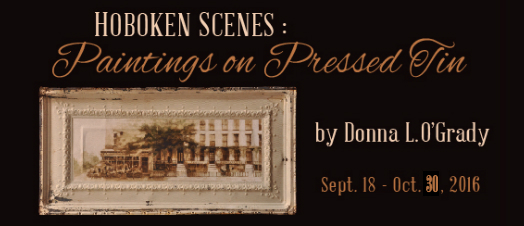
Hoboken’s architecture has inserted itself even more directly into her paintings lately, as she has begun painting on salvaged antique ceiling tiles made of pressed tin, once ubiquitous in older Hoboken homes and businesses. “My neighbor had bought some at a street fair and she gave me the idea to paint in the flat center area — a perfect painting surface with a built-in frame,” O’Grady says. “Now, I find them at craft fairs and order vintage tiles online – the older the better, with cracked and peeling paint.”
She’s chosen about 12 new works mostly on these tiles for her latest exhibit, “Hoboken Scenes: Paintings on Pressed Tin,” on view from September 18 – October 18 in the Hoboken Historical Museum’s Upper Gallery. O’Grady is an active member of the local hob’art artists gallery, and exhibits her work in shows in Jersey City and Ocean Grove, NJ.
The exhibit is supported by a block grant from the State/County Partnership program for the Arts, administered by the Hudson County Division of Cultural and Heritage Affairs.
Bill Curran – “Extraordinary Hoboken”
April 9 - May 29, 2016
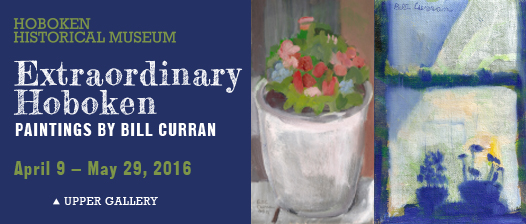
When most of us pass a flowerpot in full bloom on a stoop or a cat sunning lazily in a window, we might make a mental note of these moments of unexpected beauty, but they are soon forgotten, buried under a pile of errands and obligations. It takes a special eye to see these fleeting moments of pure color and light as inspiration for great art.
Artist Bill Curran has that kind of eye. He finds subjects for his lushly colorful paintings in his everyday walks through Hoboken, or views from his own window. The less “artfully” arranged the better. Taking a cue from his favorite painter, Fairfield Porter, Curran prefers to happen upon a scene worth painting, rather than intentionally arranging objects.
To explain his penchant for painting flowers, Hoboken stoops, cats, windows, boats and more, he cites a phrase that Porter used to describe the French painter Edouard Vuillard: “It seems to be ordinary, what [he’s] doing, but the extraordinary is everywhere.” When Curran sees something he likes, he will paint it quickly, en plein air, to capture the fleeting moment of pure color and light, sometimes making a sketch on site and finishing the canvas quickly back at his studio. “The feeling of adding lush paint to a rough canvas is incomparable,” he adds.
On Saturday, April 9, with an opening reception from 2 – 5 pm, the Museum is pleased to present Curran’s third Upper Gallery exhibit, “Extraordinary Hoboken,” comprising 64 small-format oil paintings of a stunning variety of subjects, painted between 1999 and 2016. Regular visitors to the Museum will know Curran as the unfailingly nice Museum Associate who greets guests and keeps operations humming at the Museum and the Fire Department Museum. On view through May 29, the paintings are as delightful as the artist!
Before coming to work for the Hoboken Museum, Curran was an illustrator and art director for 16 years at Lord & Taylor in New York. He also teaches private art lessons and classes at the Bayonne Jewish Community Center. His work has been widely exhibited at venues in New York and New Jersey, including Hoboken City Hall, Hoboken Library and even in the Empire State Building, which used to captivate him from his vantage point at Lord & Taylor, and continues to draw his eye from the Hoboken waterfront.
Curran honed his technique through years of study at The Art Institute in Fort Lauderdale, as well as New York’s School of Visual Arts, the Fashion Institute of Technology, Parsons School of Design and the Art Students League. But perhaps the most profound influence was an invitation to join Fairfield Porter’s niece, Anina Porter Fuller, and 12 other artists for a painting retreat at the family’s 100-year-old estate on Great Spruce Head Island, Maine, in 2013.
Originally born in Brooklyn, NY, and raised on Long Island, Curran has lived in Hoboken for thirty-two years. View more of his work online at billcurran.net.
The exhibit is supported by a block grant from the State/County Partnership program for the Arts, administered by the Hudson County Division of Cultural and Heritage Affairs.
Alex Morales – “Watercolor Paintings”
January 10 - February 14, 2016
The Uruguayan artist Alex Morales has been making art in a wide range of media from an early age, studying and refining his skills at the Museum of Fine Arts in the state of San Jose de Mayo in his home country. He earned a living in Uruguay and Buenos Aires as a successful illustrator, graphic artist, set designer and muralist before moving to the United States about nine years ago. He settled in the New York/New Jersey area, and about three years ago met a woman named Pilar in Hoboken. They fell in love, and have since married, and along the way, he fell in love with Hoboken.
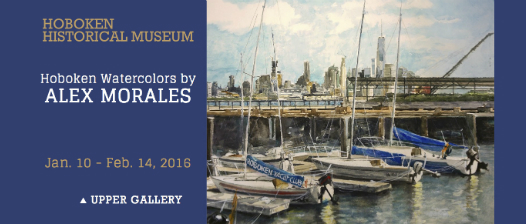
“I like Hoboken because of the people and the small-town feel,” he says. “It is a very open community, a small town that offers a blend of youth and joy with elegance and maturity. The community is very vibrant and friendly.” As an artist, he is drawn to Hoboken’s architecture, and its piers and marina, as well as the mesmerizing views of the New York City skyline across the river. He can sense that the people who live here are proud of their city, and he was inspired to give them a chance to see it through his artistic interpretation.
For his six-week exhibition in the Hoboken Museum’s Upper Gallery, Morales has assembled about 15 recent paintings executed in water-based media, some in traditional watercolor and some elaborated in ink and lemon juice. They are realist works, with elements of abstraction and meticulously detailed work with a fountain pen.
Morales earned a reputation in Uruguay as a sought-after decorator for dance clubs and pubs, and today he continues to earn commissions creating art for commercial spaces, such as the large-scale mosaic mural, “Life,” that he created recently for the Orama Restaurant in Edgewater, NJ. The massive, 1,150-square-foot mural and other artistic elements adorning the restaurant took the artist the better part of 2013 and half of 2014 to realize. This year, he plans to offer private art classes, specifically drawing and painting.
Throughout his career, he has continued to produce fine art, exhibiting his work in solo and group shows in galleries and public spaces. “My next exhibition will be of small sculptures representing the most characteristic places of Hoboken,” Morales says. “These will be replicas in yeso (plaster) of the buildings and homes showing the architecture of this town.” The first of these pieces will be on view during his exhibit at the Hoboken Historical Museum, through Sunday, February 14. Learn more at the artist’s website: http://www.ajmorales.com
The exhibit is supported by a block grant from the State/County Partnership program for the Arts, administered by the Hudson County Division of Cultural and Heritage Affairs.
Judy Schmitt – “Capturing Hoboken”
May 10 - July 5, 2015
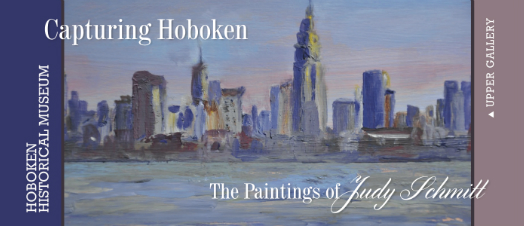
The accomplished artist Judy Schmitt may be based in Cape Cod, but since her daughter and son-in-law moved to Hoboken 15 years ago, this city has been a second home for her. Inspired by the artistic tradition of Provincetown, Mass., and many of the experienced artists who live there, Schmitt strives to capture the soul of her subjects in her paintings. She will exhibit 14 of them in the Museum’s Upper Gallery from May 10 to July 5.
Schmitt grew up in the blue collar town of Waterbury, CT, so she appreciates the hidden beauty of the many factory buildings tucked into Hoboken’s cityscape. She is enamored of the beauty and sounds of Hoboken, which she soaks in on walks through the city, or while visiting its parks with her grandchildren. She loves the way the light bounces off the brownstones, and imagines the voices of the families who grew up in them. Her goal is to portray each building’s individual character and charm, using a rich palette of Veneitan red and burnt sienna.
She starts the paintings in plein air, on the street, taking color notes for the trees, the different red-browns of the bricks and grays of the sidewalks, and finishes the canvases in her studio.
“A major influence was Edward Hopper, who lived and painted in my town,” she says, “and I learned about capturing the light, from my mentor, Steve Kennedy, a wonderful plein air artist.”
Living near the sea in New England, Schmitt is especially sensitive to Hoboken’s waterfront and its rich shipping history. She was so struck by the image of an old pier with the “Hoboken” tugboat, that she felt compelled to use a large canvas to convey the scene in all its rich detail, with the New York skyline in the background.
The exhibit is supported by a block grant from the State/County Partnership program for the Arts, administered by the Hudson County Division of Cultural and Heritage Affairs.
Walter Barco – “Litopintura”
March 22 - May 3, 2015
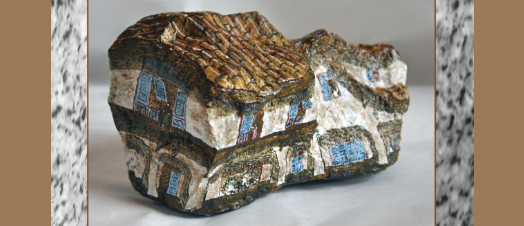
Ecuadoran artist Walter Barco creates extraordinary “rock-works” that evoke nostalgic memories of his native Guayaquil’s colonial architecture and 19th century homes, using a technique he describes as “la litopintura,” or stone-painting. With incredibly fine detail, including tiny figures in the windows of these three-dimensional paintings, he brings 12 of these miniature buildings to the Museum’s Upper Gallery for a unique exhibit from March 22 to May 3.
Working with the natural contours of the stone, Barco recreates the buildings’ walls of mud-and-straw (adobe), which are traditionally painted white, or sometimes structures made of wood and painted in pastel colors of pink, yellow, or blue. They are adorned with wooden balconies, porches, doors and windows.
This mini-village is mounted on revolving turntables so visitors can take in the full dimensionality of these amazing works of art.
The exhibit is supported by a block grant from the State/County Partnership program for the Arts, administered by the Hudson County Division of Cultural and Heritage Affairs.