Collections Item Detail
Offprint from New York Daily News, Jan. 5, 1973: "Hoboken: Snug Harbor just off midtown." By Donald Singleton.
2006.041.0021
2006.041
Purchase
Purchase
Museum Purchase.
1973 - 1973
Date(s) Created: 1973 Date(s): 1973-1973
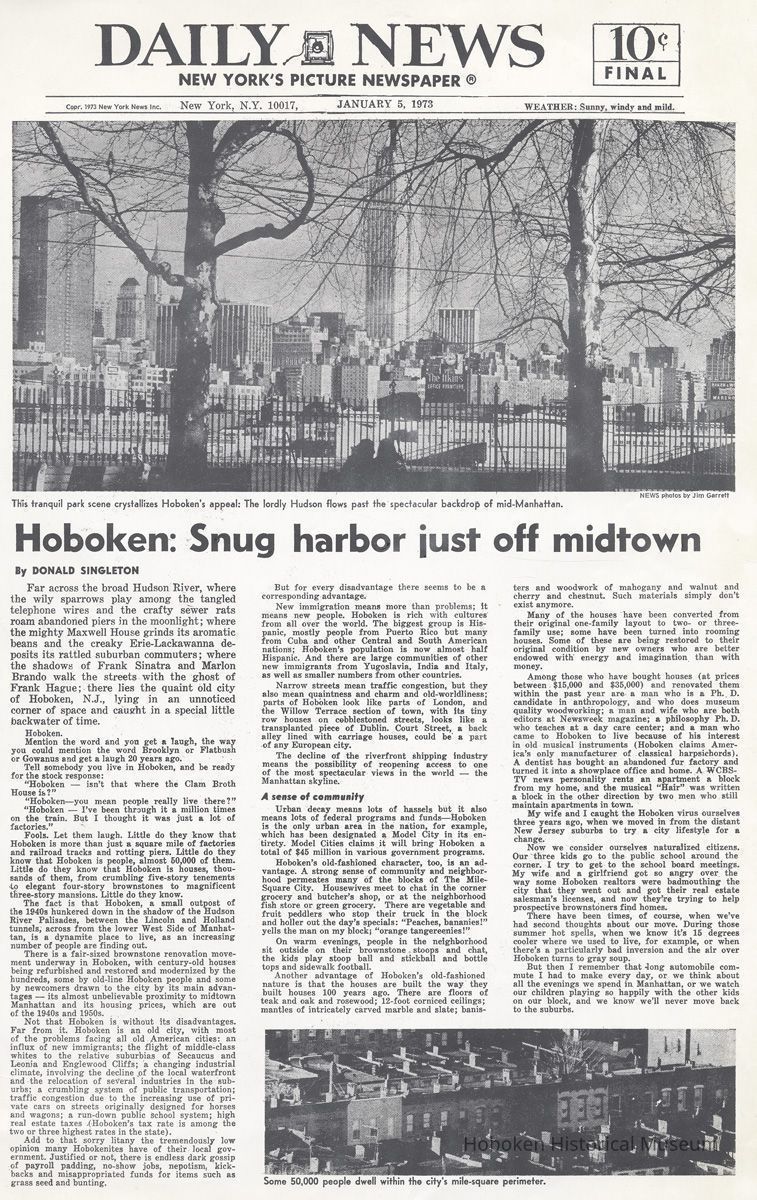
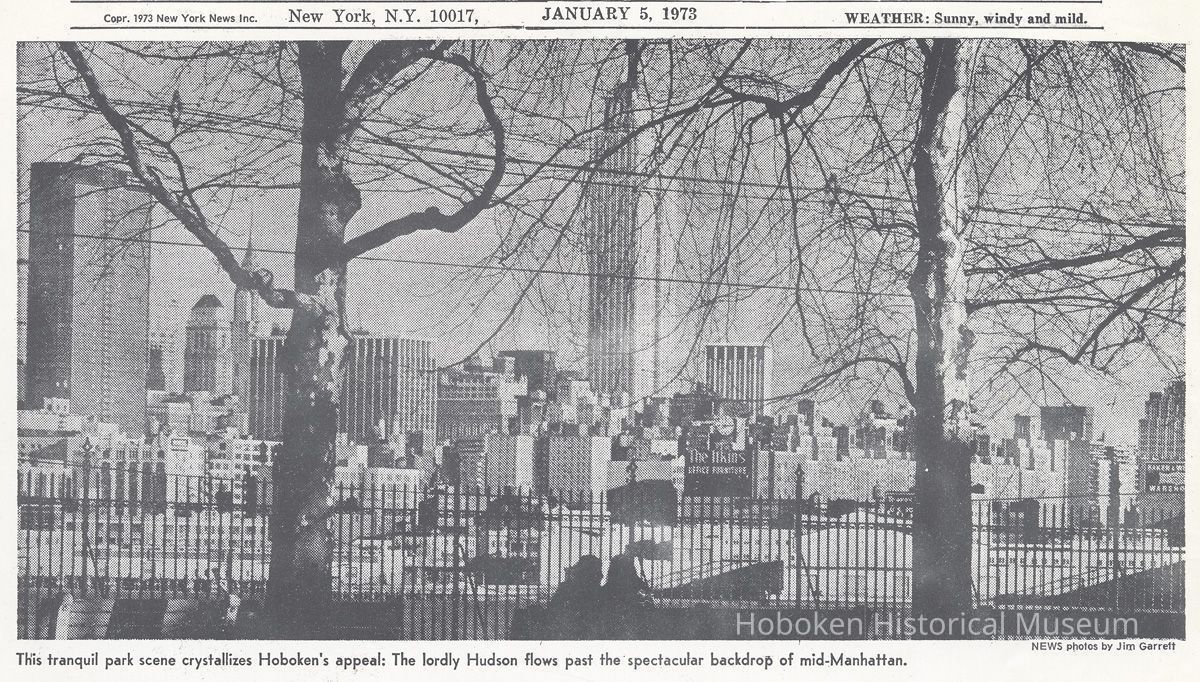
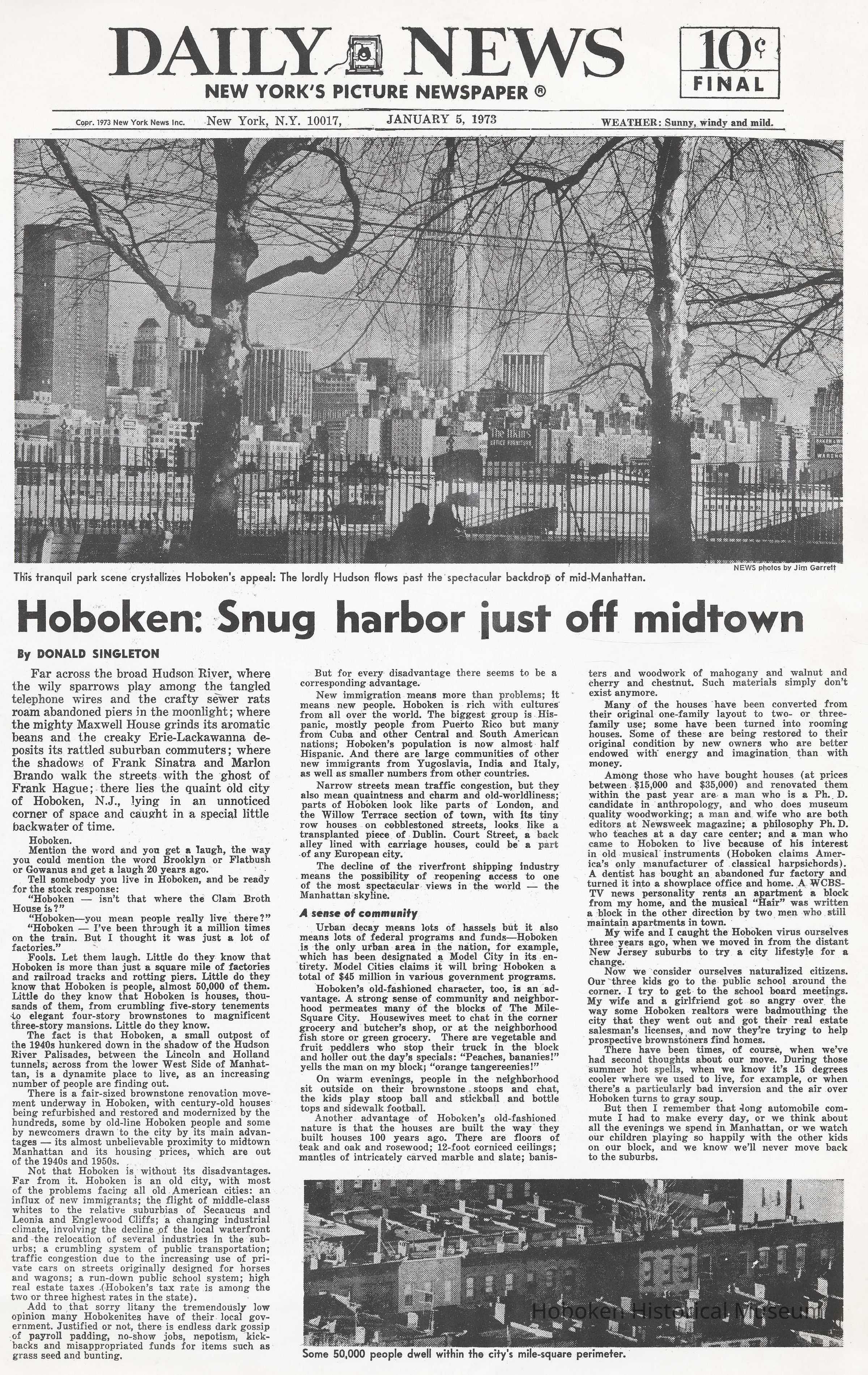
Notes: Archives 2006.041.0021 ==== DAILY NEWS NEW YORK'S PICTURE NEWSPAPER JANUARY 5, 1973 ==== [caption top photo] This tranquil park scene crystallizes Hoboken's appeal: The lordly Hudson flows past the spectacu.ar backdrop of midcManhattan. NEWS photo by Jim Garrett. ==== Hoboken: Snug harbor just off midtown By DONALD SINGLETON Far across the broad Hudson Riyer, where the wily sparrows play among the tangled telephone wires and the crafty sewer rats roam abandoned piers in the moonlight; where the mighty Maxwell House grinds its aromatic beans and the creaky Erie-Lackawanna deposits its rattled suburban commuters; where the shadow~ of Frank Sinatra and Marlon Brando walk the streets with the ghost of Frank Hague; there lies the quaint old city of Hoboken, N.J., lying in an unnoticed corner of space and caught in a special little backwater of time. Hoboken, Mention the word and you get a laugh, the way you could mention the word Brooklyn · or Flatbush or Gowanus and get a laugh 20 years ago. . . Tell somebody you live in Hoboken, and be reaoy for the stock response: "Hoboken - isn't that where the Clam Broth House is?" . "Hoboken-you mean people really live there?" "Hoboken - I've been through it a million times on the train. But I thought it was just a lot of factories." Fools. Let them laugh. Little do they know that Hoboken is more than just a square mile of factories and railroad tracks and rotting piers. Little do they know that Hoboken is people, almost 60,000 of them. Little do they know that Hoboken is houses, thousands of them, from crumbling five-story tenements to elegant four-story brownstones to magnificent three-story mansions. Little do they know. The fact is that Hoboken,a small outpost of the 1940s hunkered down in the shadow of the Hudson River Palisades, between the Lincoln and Holland tunnels; across from the lower West Side of Manhattan, is a dynamite place to live, as an increasing number of people are finding out. There is a fair-sized brownstone renovation movement underway in Hoboken, with century-old houses being refurbished and restored and modernized by the hundreds, some by old-line Hoboken people and some by newcomers drawn ·to the city by its main advantages - its almost unbelievable proximity to midtown Manhattan and its housing prices, which are out of the 1940s and 1950s. Not that Hoboken is without its disadvantages. Far from it. Hoboken is an old city. with most of the problems facing all old American cities: an influx of new immigrants; the flight of middle-class whites to the relative suburbias of Secaucus and Leonia and Englewood Cliffs; a changing industrial climate, involving the decline of the local waterfront and the relocation of several industries in thesuburbs; a crumbling system of public transportation; traffic congestion due to the increasing use of private cars on streets originally designed for horses and wagons; a run-down public school system; high real estate taxes (Hoboken's tax rate is among the two or three highest rates in the state). Add to that sorry litany the tremendously low opinion many Hobokenites have of their local government. Justified or not, there is endless dark gossip of payroll padding, no-show jobs, nepotism,kickbacks and misappropriated funds for items such as grass seed and bunting. But for every disadvantage there seems to be a corresponding advantage. New immigration means more than problems; it means new people. Hoboken is rich with cultures from all over the world. The biggest group is Hispanic, mostly people from Puerto Rico but many from Cuba and other Central and South AmerIcan nations. Hoboken's population is now almost half Hispanic. And there are large communities of other new immigrants from Yugoslavia, India and Italy, as well as smaller numbers from other countries. Narrow streets mean traffic congestion, but they also mean quaintness and charm and old-worldliness; parts of Hoboken look like parts of London, and the Willow Terrace section of town, with its tiny row houses on cobblestoned streets, looks like a transplanted piece of Dublin . . Court Street,a back alley lined with carriage houses, could be a part of any European city. The decline of the riverfront shipping Industry means the possibility of reopening access to one of the most spectacular views in the world - the Manhattan skyline. A sense of community Urban decay means lots of hassels but it also means lots of federal programs and funds - Hoboken is the only urban area in the nation, for example, which has been designated a Model City in its entirety. Model Cities claims it will bring Hoboken a total of $45 million in various government programs. Hoboken's old-fashioned character, too, is an advantage. A strong sense of community and neighborhood permeates many of the blocks of The Mile Square City. Housewives meet to chat in the corner grocery and butcher's shop, or at the neighborhood fish store or green grocery. There are vegetable and fruitpeddlers who stop their truck in the block and holler out .. the day's specials: "Peaches, bananies!" yells the man on my block "orange tangereenies!" On warm evenings, people in the neighborhood sit outside on their brownstone stoops and chat, the kids play stoop ball and stickball and bottle tops and sidewalk football. Another advantage of Hoboken's old-fashioned . nature is that the houses are built the way they built houses 100 years ago. There are floors of teak and oak and rosewood; 12-foot corniced ceilings; mantles of intricately carved marble and slate; banisters and woodwork of mahogany and walnut and cherry and chestnut. Such materials simply don't exist anymore. Many of the houses have been converted from their original one-family layout to two- or three family use; some have been turned Into rooming houses. Some of these are beIng restored to theIr original condition by new owners who are better endowed with energy and imagination than with money. Among those who have bought houses (at prices between. $15,000 and $35,000) and renovated them within the past year are, a man who is a Ph. D. candidate in anthropology, and who does museum quality woodworking; a man and, wife who are both editors at Newsweek magazine; a philosophy Ph. D. who teaches at a day care center; and a man who came to Hoboken to live because of his interest in old musical instruments (Hoboken claims America's only manufacturer of classical harpsichords). A dentist has bought an abandoned fur factory and turned it into a showplace office and home.. A WCBSTV news personality rents an apartment a block from my home, and the musical ' "Hair" was written a block in the other direction by two men who still maintain apartments in town. . My wife and I caught the Hoboken virus ourselves three years ago, when we moved In from the dIstant New Jersey suburbs to try a city lifestyle for a change. Now we consider ourselves naturalized citizens. Our three kids go to the public school around the corner. I try to get to the school board meetings. My wife and a girlfrend got so angry over the way some Hoboken realtors were badmouthing the city that they went out and got their real estate salesman's licenses, ,and now they're trying to help prospective brownstoners find homes. There have been times, of course, when we've had second tho.ughts about our move. During those summer hot spells, when we know it's 15 degrees cooler where we used to live, for example, or when there's a particularly bad inversion and the air over Hoboken turns to gray soup. But then I remember that long automobile commute I had to make every day, or we think about all the evenings we spend in Manhattan, or we watch our children playing so happily with the other kids on our block, and we know we'll never move back to the suburbs. ==== [caption bottom photo] Some 50,000 people dwell within the city's mile-square perimeter. ==== ==== Status: OK Status By: dw Status Date: 2008-06-15