Collections Item Detail
Fundamentals First: The Story of Stevens Institute of Technology. Dr. Kenneth C. Rogers, Newcomen Society address, N.Y., June 1979.
2012.016.0005
2012.016
Martinez, Arturo & Pat
Gift
Gift of Arturo & Pat Martinez.
1979 - 1979
Date(s) Created: 1979 Date(s): 1979
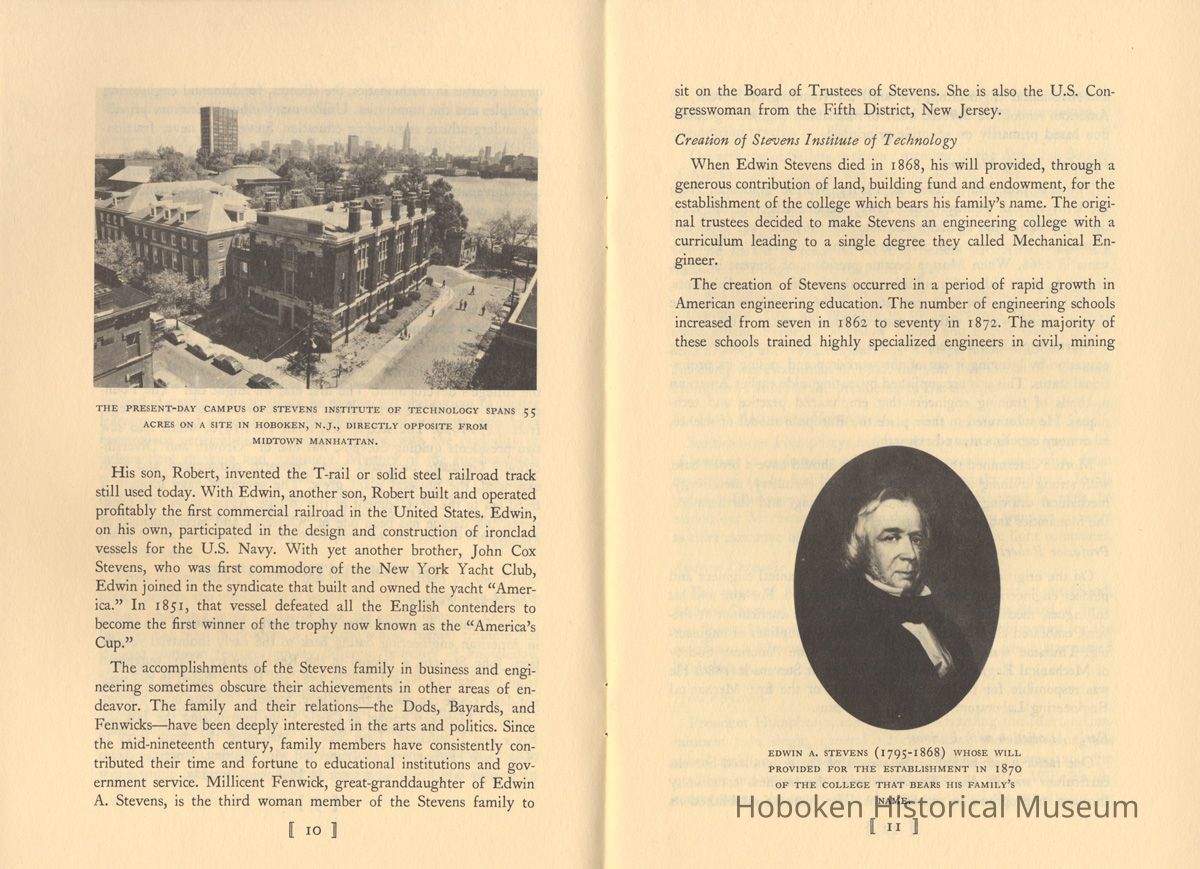
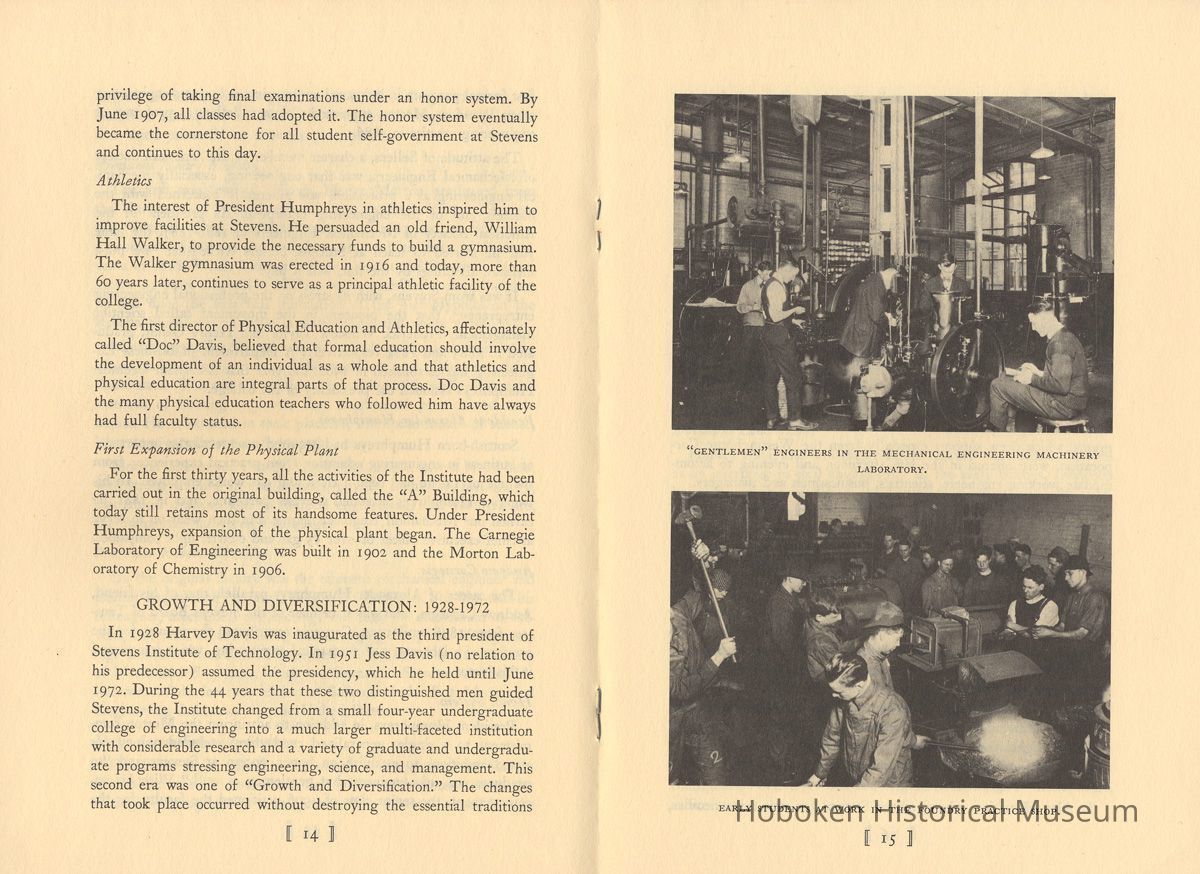
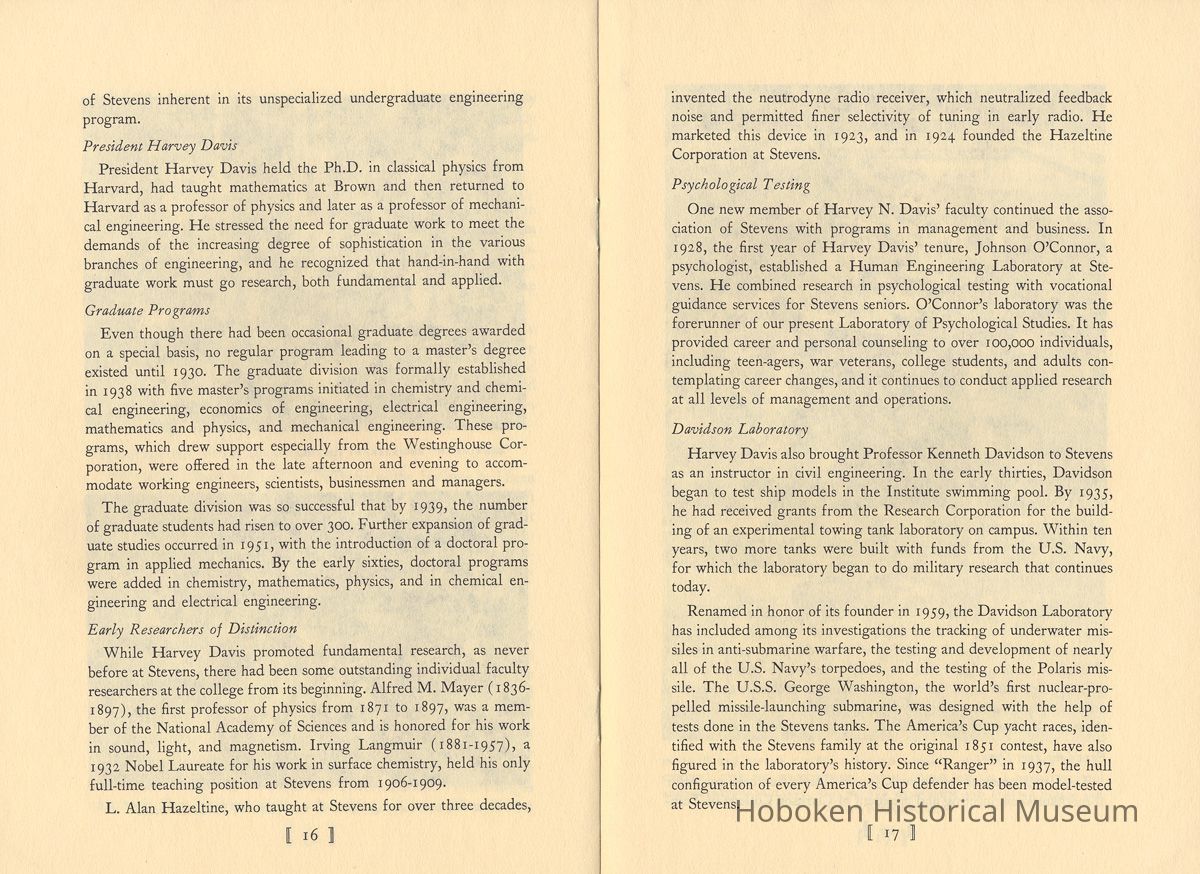
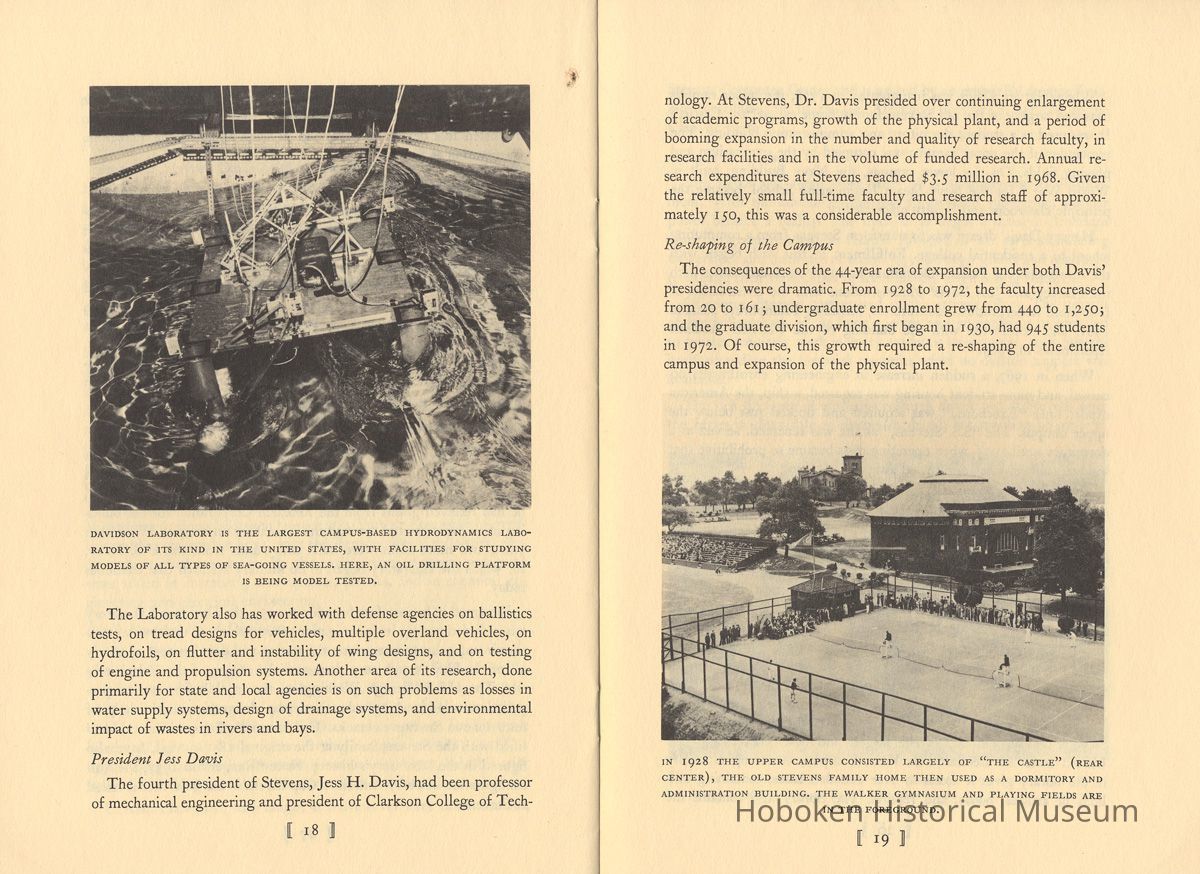
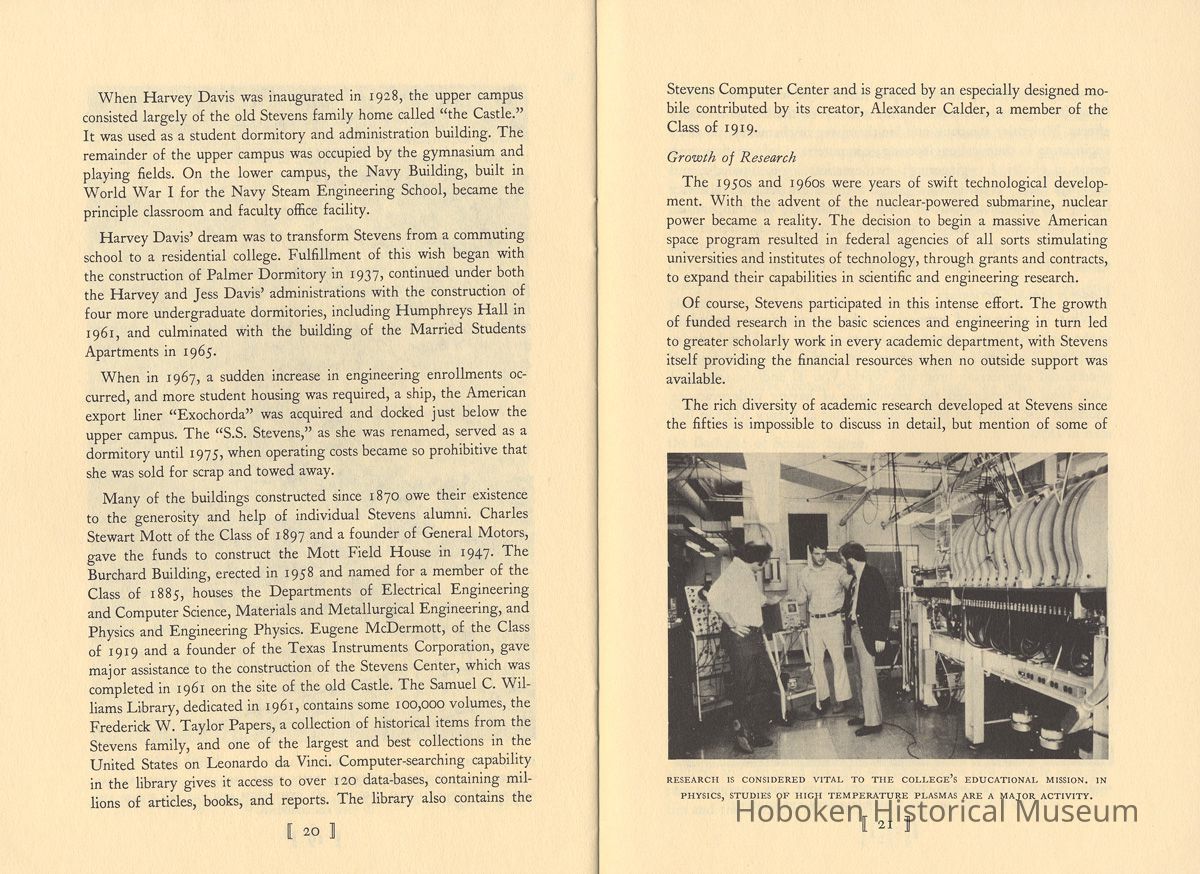
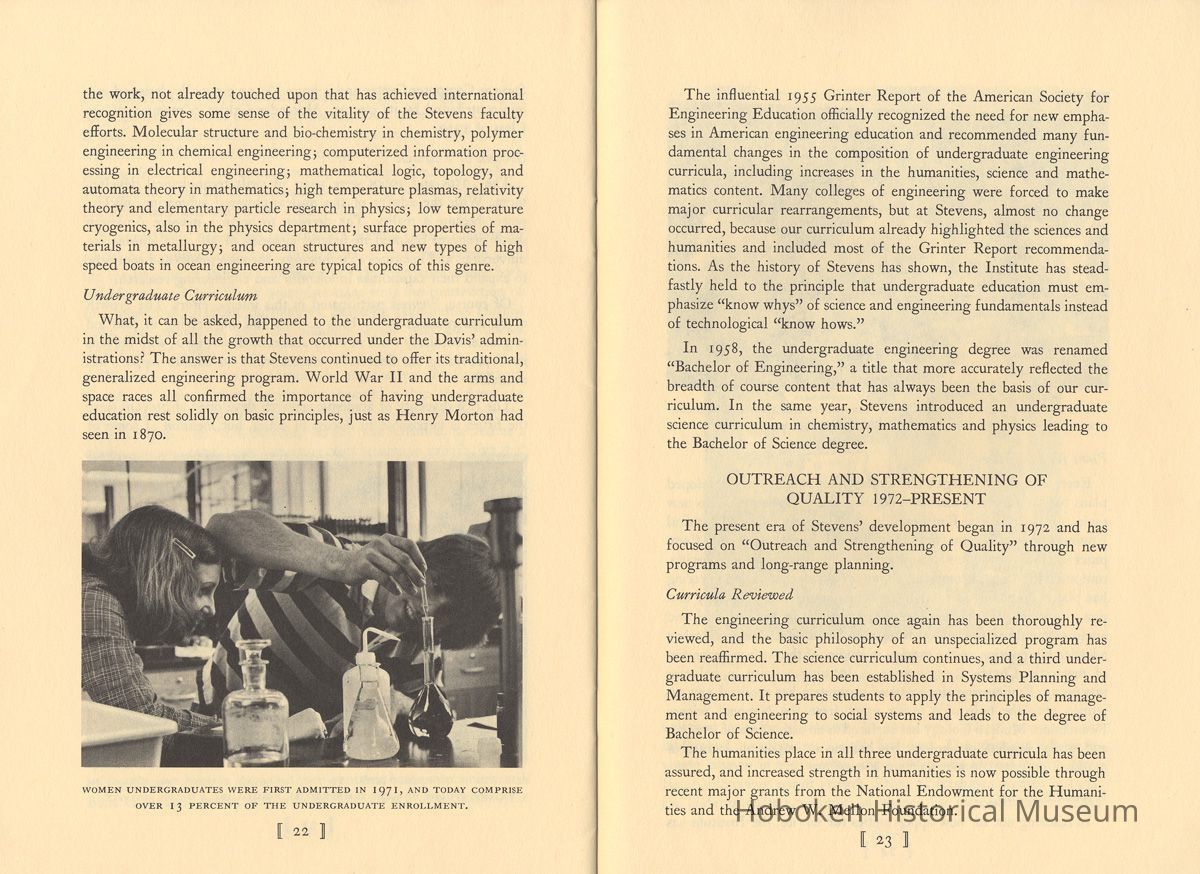
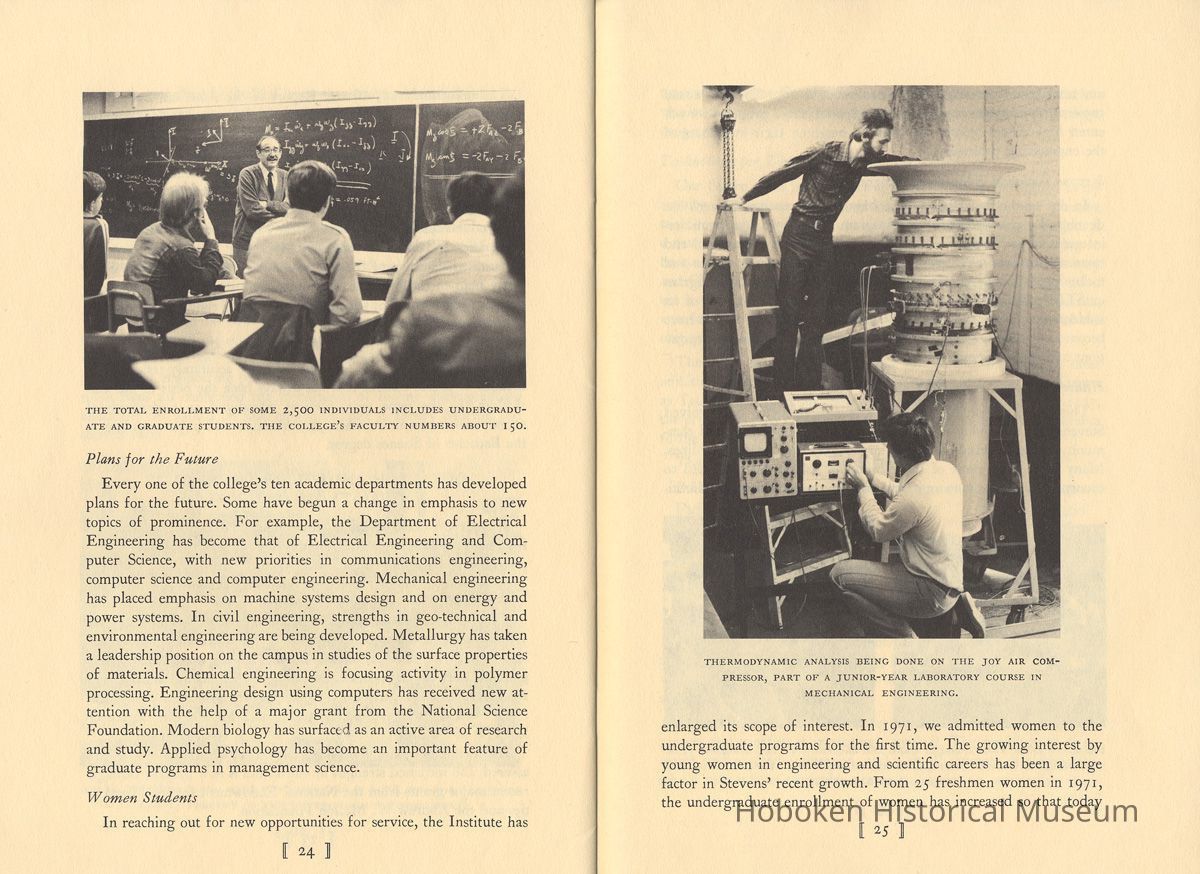
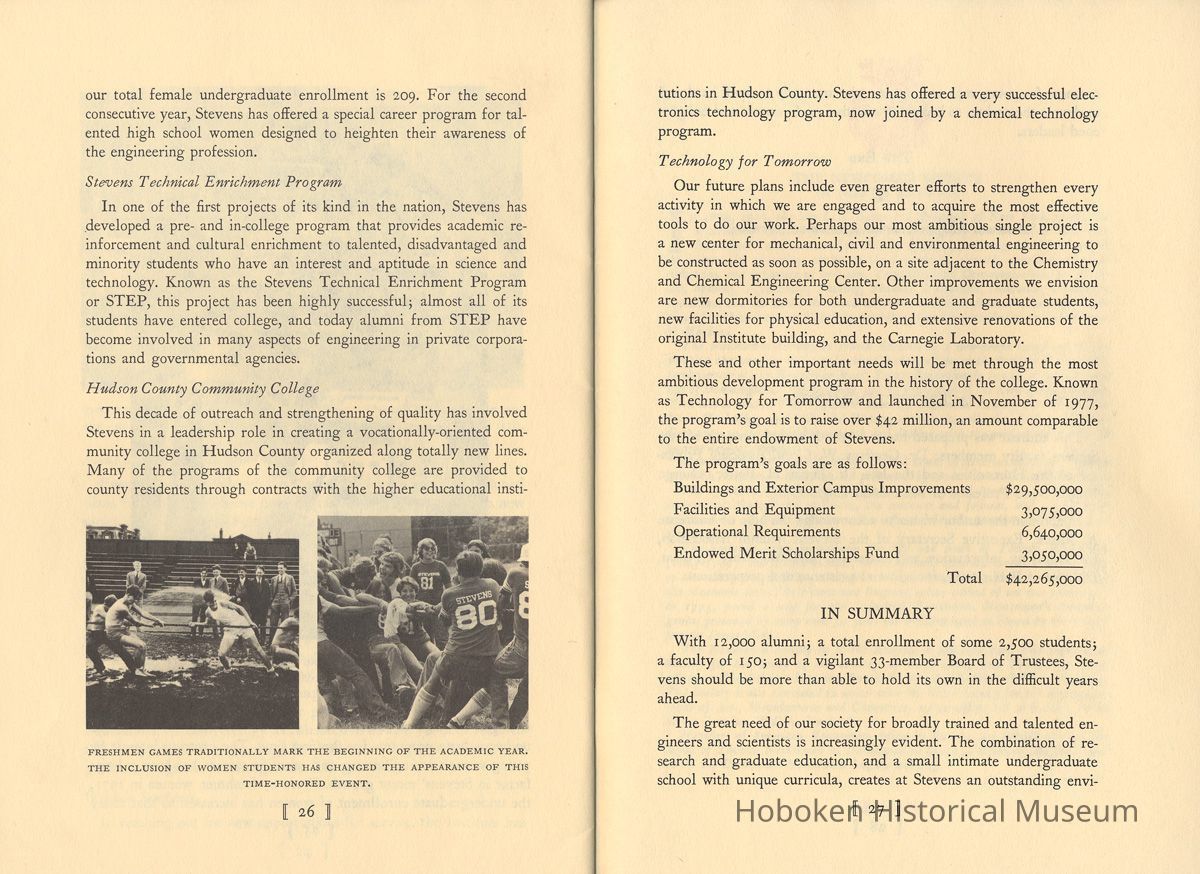
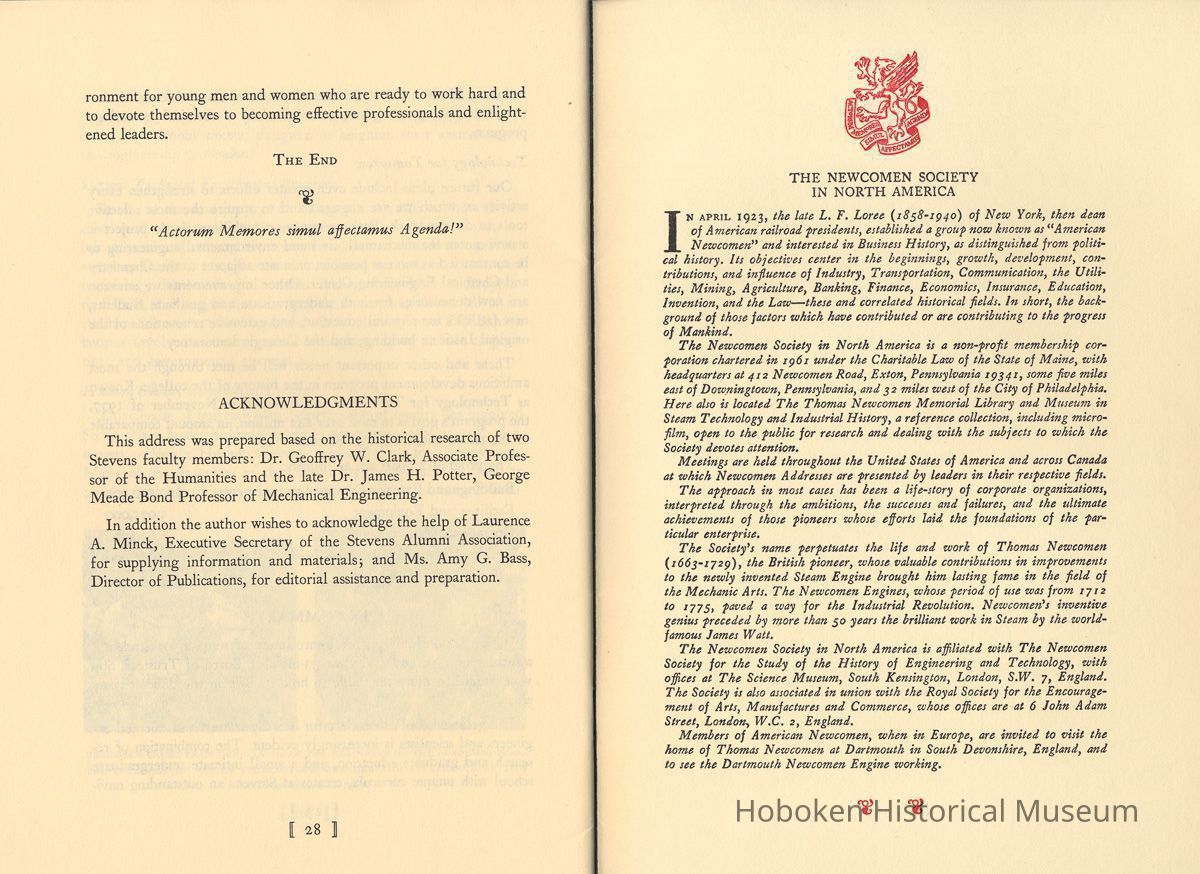
Notes: Archives 2012.016.0005 ==== Fundamentals First The Story of Stevens Institute of Technology DR. KENNETH C. ROGERS "Were American Newcomen to do naught else, our work is well done if we succeed in sharing with America a strengthened inspiration to continue the struggle towards a nobler Civilization- through wider knowledge and understanding of the hopes, ambitions, and deeds of leaders in the -past who have upheld Civilization's material progress. As we look backward, let us look forward." -CHARLES PENROSE (1886-1958) Senior Vice-President for North America The Newcomen Society for the study of the history of Engineering and Technology (1923-1957) Chairman for North America (1958) "Actorum Memores simul affectamus Agenda" This address, dealing with the history and growth of Stevens Institute of Technology, was delivered at the 1979 New York Dinner of The Newcomen Society in North America when Dr. Kenneth C. Rogers was the guest of honor and speaker on June 21, 1979. This statement, crystallizing a broad purpose of the Society, was first read at the Newcomen Meeting at New York World's Fair on August 5, 1939, when American Newcomen were guests of The British Government. "From its inception, Stevens has stressed education of the 'complete' person, the intellectually well-rounded and physi- cally fit individual who has a unified sense of how the world operates. The combination of research and graduate educa- tion, and a small intimate undergraduate school with unique curricula, creates at Stevens an outstanding environment for young men and women who are ready to work hard and to devote themselves to becoming effective professionals and enlightened leaders." - DR. KENNETH C. ROGERS Fundamentals First The Story of Stevens Institute of Technology DR. KENNETH C. ROGERS MEMBER OF THE NEWCOMEN SOCIETY PRESIDENT STEVENS INSTITUTE OF TECHNOLOGY HOBOKEN THE NEWCOMEN SOCIETY IN NORTH AMERICA NEW YORK DOWNINGTOWN PRINCETON PORTLAND 1979 Newcomen Publication Number 1109 Copyright, 1979 DR. KENNETH C. ROGERS Library of Congress Catalog Card Number 79-91593 Permission to abstract is granted provided proper credit is allowed The Newcomen Society, as a body, is not responsible for opinions expressed in the following pages First Printing: November 1979 SET UP, PRINTED AND BOUND IN THE UNITED STATES OF AMERICA FOR THE NEWCOMEN SOCIETY IN NORTH AMERICA BY PRINCETON UNIVERSITY PRESS INTRODUCTION OF DR. ROGERS AT NEW YORK ON JUNE 21, 1979, BY DR. FREDERICK L. BISSINGER, COUNSEL, PENNIE & EDWARDS, COUNSELLORS- AT-LAW; RETIRED PRESIDENT, ALLIED CHEMICAL CORPORATION; AND CHAIRMAN, BOARD OF TRUSTEES, STEVENS INSTITUTE OF TECHNOLOGY Members of The Newcomen Society: IT'S A PLEASURE to be here tonight to recognize the leadership of President Kenneth C. Rogers and to honor the Stevens Institute of Technology, the institution which I am privileged to serve as chairman of the Board of Trustees. My 16 years of service on the Board indicate only one measure of the affection I hold for Stevens, where I earned my baccalaureate degree of Mechanical Engineer in 1933. While I was an undergraduate, my course of study included an extensive program of engineering and scientific subjects as well as a substantial emphasis on the humanities. The Stevens broad-based and generalized approach to undergraduate education gave me a cer- tain breadth and flexibility in my career that graduates of most other engineering colleges might have found harder to achieve. I owe much to this special character of my studies as a Stevens undergraduate. Stevens Institute of Technology is a vigorous member of the in- dependent or private sector in American higher education. The wis- dom and generosity of the founder and of a succession of thousands of donors over the decades have made it possible for Stevens to main- tain its independence and pursue its distinct educational philosophy for over a century. In 1972 the Board of Trustees was faced with the problem of find- ing a new president of the college. In December of that year, it chose the man you are honoring here tonight, Dr. Kenneth C. Rogers, who had been head of the college's physics department and who six months earlier had been named acting provost and dean of the faculty. Dr. Rogers earned the bachelor of science degree in physics from St. Lawrence University, and the master's and doctoral degrees in physics from Columbia University. His scientific interests and research have focused on topics in plasma physics, physical electronics, high current arcs, pulsed high magnetic field technology, optical spectros- copy, high energy particle accelerators and elementary particle physics. The author of some 30 articles that have appeared in professional journals, he holds patents for a plasma accelerator and for a stabilized high current electric arc. Dr. Rogers has held research positions and visiting professorships at Cornell University, the Brookhaven National Laboratory, the City University of New York and Princeton University. In 1957, Kenneth Rogers joined the Stevens faculty as an assistant professor of physics. Seven years later he was named professor of physics and in 1968, he became head of the physics department. Under his leadership, the physics department received and effectively administered a $670,000 grant from the National Science Founda- tion to strengthen and expand programs offered by the department. Shortly after he became president of Stevens, Dr. Rogers was asked to comment on the future of private colleges and particularly the future of Stevens. At that time he said: "When I think of Stevens' future, I like to think of a kind of lean and tough institution-no frills, but everything done with skill and confidence. . . . "I'd like to see each of us at Stevens feel convinced that if we do something, we do it very well, no matter what it is. . . . "What I see is a certain intellectual sharpness, a keenness, an edge-no nonsense, no sham-a kind of lean and athletic intel- lectual roughness. That is how I see the Stevens' style." Let's see how well he applied what he characterized as the "Stevens style" in guiding the college during the past seven years. When he became president, Stevens was having operating deficits of more than $1 million per year; today, they are substantially at a break even. Enrollments were down; today, they are at a peak both at the undergraduate and graduate levels. The administration of the college has been strengthened and streamlined. Objectives for future goals of the college have been formulated. Programs for mutual cooperation between the private sector and Stevens have been put into operation. [ 6 ] All in all, Kenneth Rogers has engineered the transition from being the head of the physics department to being a strong administrator and effective fund raiser with consummate skill. Fund raising is par- ticularly important since private, independent colleges can only remain private and independent by adequate support from the private sector. Dr. Rogers has given the school new vitality and purpose so that we as Trustees feel we are in a sound position to ask for continued private support. Notwithstanding his many activities on behalf of Stevens, Dr. Rogers manages to fulfill commitments beyond the Stevens campus. He is a director of the First Jersey National Bank, the Public Service Electric and Gas Company and the New Jersey State Chamber of Commerce. A past president of the Association of Independent En- gineering Colleges, he is now a trustee of the Independent College Fund of New Jersey. Dr. Rogers is also a fellow of the Royal Society of Arts. It is with a great deal of pleasure that I introduce to you the fifth president of Stevens - DR. KENNETH C. ROGERS. My fellow members of Newcomen: THANK YOU, Dr. Bissinger, for your most kind introduction, to which I feel compelled to make an addendum. Were it not for your own counsel and guidance and indeed the sup- port of all of Stevens' devoted trustees, our programs of the last few years would have been all but impossible to accomplish. I thank you, and also express my gratitude to the Newcomen Society, and its dis- tinguished president, Charles Penrose, for honoring Stevens Institute of Technology this evening. The Educational Philosophy of Stevens Sixty years after the founding of Stevens, the most eminent sci- entist of this century was asked to give his views on higher education. He remarked that, even for technical schools, the demands of life are much too great for colleges to emphasize specialized knowledge. Instead of graduating specialists, he maintained, institutions of higher learning should strive for the development of students who have harmonious personalities and general ability, with the capability of independent thinking and judgment. Mastery of the fundamentals of a subject, and learning to think and work independently, are much more fruitful than the acquisition of detailed knowledge. Of course, Albert Einstein was that scientist, and his thoughts correspond pre- cisely to the basic educational philosophy that has guided Stevens for over 100 years. From its inception, Stevens has stressed education of the "com- plete" person, the intellectually well-rounded and physically fit indi- vidual who has a unified sense of how the world operates. Our phi- losophy has been to produce a graduate whose formal training has stressed common features among different branches of knowledge, and who will leave Stevens with a comprehensive view of a broad field and how its respective parts meld together. Our greatest em- phasis has been on general concepts and a long-range perspective within each of the college's three undergraduate curricula. The original curriculum at the founding of the Institute in 1870 was a single integrated engineering program, based on a core of re- [ 8 ] quired courses in mathematics, the sciences, fundamental engineering principles and the humanities. Unlike many other institutions provid- ing undergraduate engineering education, Stevens has never fraction- alized its curriculum into different specialities of engineering. A statement made about Stevens in 1903 by Edgar Marburg of the University of Pennsylvania aptly describes the educational phi- losophy even to this day: "She has not allowed herself to be beguiled by the educational fads and follies of the time, nor to be swerved from her straight course by any popular developments-more apparent than real -for shortcut or highly specialized courses. She has wisely held that the increasing necessity of specialization in after-life served but to emphasize the need of broad and thorough train- ing in the fundamentals." In relating the history of Stevens, I will talk about three eras in the college's development. The first era, we might call "The Foun- dations," covered the terms of the first two presidents of the college, from 1870-1928. The second era, from 1928-1970, which also saw two presidents guiding Stevens, was one of "Growth and Diversifi- cation." Graduate programs began, research commenced and then expanded, the physical plant grew. The seventies have brought a third era to the development of the college. Again under two presi- dents, this decade has been one of "Outreach and Strengthening of Quality." THE FOUNDATIONS: 1870-1928 The Stevens Family The Institute is named after a family who perpetuated a tradition in American engineering dating back to the early industrial revolu- tion. John Stevens, a colonel in the Revolutionary War, purchased from the State of New Jersey in 1784 the land included in the pres- ent-day 55-acre campus of the college. Stevens Institute is on a prom- ontory in Hoboken known as Castle Point overlooking the Hudson River and Manhattan. John Stevens introduced the steam ferry to New York Harbor, and experimented with the first American steam locomotive which ran on a track in Hoboken, in 1825. [ 9 ] [top photo caption] THE PRESENT-DAY CAMPUS OF STEVENS INSTITUTE OF TECHNOLOGY SPANS 55 ACRES ON A SITE IN HOBOKEN, N.J., DIRECTLY OPPOSITE FROM MIDTOWN MANHATTAN. His son, Robert, invented the T-rail or solid steel railroad track still used today. With Edwin, another son, Robert built and operated profitably the first commercial railroad in the United States. Edwin, on his own, participated in the design and construction of ironclad vessels for the U.S. Navy. With yet another brother, John Cox Stevens, who was first commodore of the New York Yacht Club, Edwin joined in the syndicate that built and owned the yacht "America." In 1851, that vessel defeated all the English contenders to become the first winner of the trophy now known as the "America's Cup." The accomplishments of the Stevens family in business and engi- neering sometimes obscure their achievements in other areas of en- deavor. The family and their relations-the Dods, Bayards, and Fenwicks-have been deeply interested in the arts and politics. Since the mid-nineteenth century, family members have consistently con- tributed their time and fortune to educational institutions and gov- ernment service. Millicent Fenwick, great-granddaughter of Edwin A. Stevens, is the third woman member of the Stevens family to [ 10 ] sit on the Board of Trustees of Stevens. She is also the U.S. Congresswoman from the Fifth District, New Jersey. Creation of Stevens Institute of Technology When Edwin Stevens died in 1868, his will provided, through a generous contribution of land, building fund and endowment, for the establishment of the college which bears his family's name. The origi- nal trustees decided to make Stevens an engineering college with a curriculum leading to a single degree they called Mechanical En- gineer. The creation of Stevens occurred in a period of rapid growth in American engineering education. The number of engineering schools increased from seven in 1862 to seventy in 1872. The majority of these schools trained highly specialized engineers in civil, mining [bottom photo caption] EDWIN A. STEVENS ( 1795 - 1868) WHOSE WILL PROVIDED FOR THE ESTABLISHMENT IN 1870 OF THE COLLEGE THAT BEARS HIS FAMILY'S NAME. [ 11 ] and mechanical engineering, but until the founding of Stevens, no American school had devoted itself to mechanical engineering educa- tion based primarily on scientific principles. President Henry Morton The first president of Stevens, Henry Morton graduated from the University of Pennsylvania in 1857, became editor of the scien- tific "Journal of the Franklin Institute" in 1867 and was appointed a professor of physics and chemistry at the University of Pennsyl- vania in 1868. When Morton became president of Stevens in 1870, he was 34 years old, and in addition to his scientific accomplishments, he had done the first full translation of the hieroglyphics on the Rosetta Stone, was an artist in watercolors, and wrote verse. Morton's goal for Stevens was to upgrade mechanical engineering education by bringing it out of the workshop and raising its profes- sional status. This was accomplished by casting aside earlier American methods of training engineers that emphasized practice and tech- niques. He substituted in their place the European model of science, laboratory experiment, and research. Morton determined that the curriculum should have a broad base, with strong training in mathematics, physics, chemistry, metallurgy, mechanical drawing and mechanical engineering, and furthermore, the humanities and foreign languages. Professor Robert Thurston On the original faculty was the eminent mechanical engineer and pioneer engineering educator, Robert H. Thurston. For him and his colleagues, mechanical engineering, and thus the curriculum at Ste- vens, embraced all the existing and emerging disciplines of engineer- ing. Thurston was elected first president of the American Society of Mechanical Engineers, which was formed at Stevens in 1880. He was responsible for the creation at Stevens of the first Mechanical Engineering Laboratory in the United States. Early Association with Business One factor which added to the success of the generalized Stevens curriculum was its close association with the business community through its programs in management. The Institute established its [ 12 ] first formal program in industrial engineering or business engineering when President Morton appointed Coleman Sellers as professor of engineering practice in 1886. The attitude of Sellers, a charter member of the American Society of Mechanical Engineers, was that engineering, especially mechani- cal engineering as a profession, was inherently concerned with the business end of the engineering enterprise. As president of the American Society of Mechanical Engineers in 1886-1887, the same year he started to teach at Stevens, Sellers wrote that "we must measure all things by the test, will it pay?" It was from Stevens, with its stress on the professional engineering entrepreneur, that the pioneers in the movement called scientific management, Frederick Winslow Taylor and Henry Gannt, gradu- ated in 1883 and 1884 respectively. A Department of Business En- gineering was established in 1902, the year that Alexander Crombie Humphreys assumed the presidency of the college. President Alexander Humphreys Scottish-born Humphreys had acquired a sense of the importance of business in engineering education from practical experience; from the age of 14, he had been a clerk and gas works employee. In his twenties Humphreys attended Stevens part-time, and in 1881 he earned our Mechanical Engineer degree. He then went on to serve as chief executive officer of over 55 gas and electric light companies. Andrew Carnegie The career of Alexander Humphreys parallels that of his friend, Andrew Carnegie, who was a member of the Stevens Board of Trus- tees from 1896 until 1920. Carnegie contributed the monies for the erection of a laboratory of mechanical engineering, which was named in his honor. Honor System President Humphreys, in addition to advancing the Morton com- mitment to a single, generalized curriculum, included among his stated ambitions to establish an honor system at Stevens and "to graduate not only engineers but gentlemen as well." With his en- couragement, the senior class of 1906 petitioned the faculty for the [ 13 ] privilege of taking final examinations under an honor system. By June 1907, all classes had adopted it. The honor system eventually became the cornerstone for all student self-government at Stevens and continues to this day. Athletics The interest of President Humphreys in athletics inspired him to improve facilities at Stevens. He persuaded an old friend, William Hall Walker, to provide the necessary funds to build a gymnasium. The Walker gymnasium was erected in 1916 and today, more than 60 years later, continues to serve as a principal athletic facility of the college. The first director of Physical Education and Athletics, affectionately called "Doc" Davis, believed that formal education should involve the development of an individual as a whole and that athletics and physical education are integral parts of that process. Doc Davis and the many physical education teachers who followed him have always had full faculty status. First Expansion of the Physical Plant For the first thirty years, all the activities of the Institute had been carried out in the original building, called the "A" Building, which today still retains most of its handsome features. Under President Humphreys, expansion of the physical plant began. The Carnegie Laboratory of Engineering was built in 1902 and the Morton Lab- oratory of Chemistry in 1906. GROWTH AND DIVERSIFICATION: 1928-1972 In 1928 Harvey Davis was inaugurated as the third president of Stevens Institute of Technology. In 1951 Jess Davis (no relation to his predecessor) assumed the presidency, which he held until June 1972. During the 44 years that these two distinguished men guided Stevens, the Institute changed from a small four-year undergraduate college of engineering into a much larger multi-faceted institution with considerable research and a variety of graduate and undergradu- ate programs stressing engineering, science, and management. This second era was one of "Growth and Diversification." The changes that took place occurred without destroying the essential traditions [ 14 ] [top photo caption] "GENTLEMEN" ENGINEERS IN THE MECHANICAL ENGINEERING MACHINERY LABORATORY. [bottom photo caption] EARLY STUDENTS AT WORK IN THE FOUNDRY PRACTICE SHOP. [ 15 ] of Stevens inherent in its unspecialized undergraduate engineering program. President Harvey Davis President Harvey Davis held the Ph.D. in classical physics from Harvard, had taught mathematics at Brown and then returned to Harvard as a professor of physics and later as a professor of mechani- cal engineering. He stressed the need for graduate work to meet the demands of the increasing degree of sophistication in the various branches of engineering, and he recognized that hand-in-hand with graduate work must go research, both fundamental and applied. Graduate Programs Even though there had been occasional graduate degrees awarded on a special basis, no regular program leading to a master's degree existed until 1930. The graduate division was formally established in 1938 with five master's programs initiated in chemistry and chemi- cal engineering, economics of engineering, electrical engineering, mathematics and physics, and mechanical engineering. These pro- grams, which drew support especially from the Westinghouse Cor- poration, were offered in the late afternoon and evening to accom- modate working engineers, scientists, businessmen and managers. The graduate division was so successful that by 1939, the number of graduate students had risen to over 300. Further expansion of grad- uate studies occurred in 19 51, with the introduction of a doctoral pro- gram in applied mechanics. By the early sixties, doctoral programs were added in chemistry, mathematics, physics, and in chemical en- gineering and electrical engineering. Early Researchers of Distinction While Harvey Davis promoted fundamental research, as never before at Stevens, there had been some outstanding individual faculty researchers at the college from its beginning. Alfred M. Mayer (1836- 1897), the first professor of physics from 1871 to 1897, was a mem- ber of the National Academy of Sciences and is honored for his work in sound, light, and magnetism. Irving Langmuir (1881-1957), a 1932 Nobel Laureate for his work in surface chemistry, held his only full-time teaching position at Stevens from 1906-1909. L. Alan Hazeltine, who taught at Stevens for over three decades, [ 16 ] invented the neutrodyne radio receiver, which neutralized feedback noise and permitted finer selectivity of tuning in early radio. He marketed this device in 1923, and in 1924 founded the Hazeltine Corporation at Stevens. Psychological Testing One new member of Harvey N. Davis' faculty continued the asso- ciation of Stevens with programs in management and business. In 1928, the first year of Harvey Davis' tenure, Johnson O'Connor, a psychologist, established a Human Engineering Laboratory at Ste- vens. He combined research in psychological testing with vocational guidance services for Stevens seniors. O'Connor's laboratory was the forerunner of our present Laboratory of Psychological Studies. It has provided career and personal counseling to over 100,000 individuals, including teen-agers, war veterans, college students, and adults con- templating career changes, and it continues to conduct applied research at all levels of management and operations. Davidson Laboratory Harvey Davis also brought Professor Kenneth Davidson to Stevens as an instructor in civil engineering. In the early thirties, Davidson began to test ship models in the Institute swimming pool. By 1935, he had received grants from the Research Corporation for the build- ing of an experimental towing tank laboratory on campus. Within ten years, two more tanks were built with funds from the U.S. Navy, for which the laboratory began to do military research that continues today. Renamed in honor of its founder in 1959, the Davidson Laboratory has included among its investigations the tracking of underwater mis- siles in anti-submarine warfare, the testing and development of nearly all of the U.S. Navy's torpedoes, and the testing of the Polaris mis- sile. The U.S.S. George Washington, the world's first nuclear-pro- pelled missile-launching submarine, was designed with the help of tests done in the Stevens tanks. The America's Cup yacht races, iden- tified with the Stevens family at the original 1851 contest, have also figured in the laboratory's history. Since "Ranger" in 1937, the hull configuration of every America's Cup defender has been model-tested at Stevens. [ 17 ] [top photo caption] DAVIDSON LABORATORY IS THE LARGEST CAMPUS-BASED HYDRODYNAMICS LABORATORY OF ITS KIND IN THE UNITED STATES, WITH FACILITIES FOR STUDYING MODELS OF ALL TYPES OF SEA-GOING VESSELS. HERE, AN OIL DRILLING PLATFORM IS BEING MODEL TESTED. The Laboratory also has worked with defense agencies on ballistics tests, on tread designs for vehicles, multiple overland vehicles, on hydrofoils, on flutter and instability of wing designs, and on testing of engine and propulsion systems. Another area of its research, done primarily for state and local agencies is on such problems as losses in water supply systems, design of drainage systems, and environmental impact of wastes in rivers and bays. President Jess Davis The fourth president of Stevens, Jess H. Davis, had been professor of mechanical engineering and president of Clarkson College of Tech- [ 18 ] nology. At Stevens, Dr. Davis presided over continuing enlargement of academic programs, growth of the physical plant, and a period of booming expansion in the number and quality of research faculty, in research facilities and in the volume of funded research. Annual re- search expenditures at Stevens reached $3.5 million in 1968. Given the relatively small full-time faculty and research staff of approxi- mately 150, this was a considerable accomplishment. Re-shaping of the Campus The consequences of the 44-year era of expansion under both Davis' presidencies were dramatic. From 1928 to 1972, the faculty increased from 20 to 161 j undergraduate enrollment grew from 440 to 1,250; and the graduate division, which first began in 1930, had 945 students in 1972. Of course, this growth required a re-shaping of the entire campus and expansion of the physical plant. [bottom photo caption] IN 1928 THE UPPER CAMPUS CONSISTED LARGELY OF "THE CASTLE" (REAR CENTER), THE OLD STEVENS FAMILY HOME THEN USED AS A DORMITORY AND ADMINISTRATION BUILDING. THE WALKER GYMNASIUM AND PLAYING FIELDS ARE IN THE FOREGROUND. [ 19 ] When Harvey Davis was inaugurated in 1928, the upper campus consisted largely of the old Stevens family home called "the Castle." It was used as a student dormitory and administration building. The remainder of the upper campus was occupied by the gymnasium and playing fields. On the lower campus, the Navy Building, built in World War I for the Navy Steam Engineering School, became the principle classroom and faculty office facility. Harvey Davis' dream was to transform Stevens from a commuting school to a residential college. Fulfillment of this wish began with the construction of Palmer Dormitory in 1937, continued under both the Harvey and Jess Davis' administrations with the construction of four more undergraduate dormitories, including Humphreys Hall in 1961, and culminated with the building of the Married Students Apartments in 1965. When in 1967, a sudden increase in engineering enrollments oc- curred, and more student housing was required, a ship, the American export liner "Exochorda" was acquired and docked just below the upper campus. The "S.S. Stevens," as she was renamed, served as a dormitory until 1975, when operating costs became so prohibitive that she was sold for scrap and towed away. Many of the buildings constructed since 1870 owe their existence to the generosity and help of individual Stevens alumni. Charles Stewart Mott of the Class of 1897 and a founder of General Motors, gave the funds to construct the Mott Field House in 1947. The Burchard Building, erected in 1958 and named for a member of the Class of 1885, houses the Departments of Electrical Engineering and Computer Science, Materials and Metallurgical Engineering, and Physics and Engineering Physics. Eugene McDermott, of the Class of 1919 and a founder of the Texas Instruments Corporation, gave major assistance to the construction of the Stevens Center, which was completed in 1961 on the site of the old Castle. The Samuel C. Wil- liams Library, dedicated in 1961, contains some 100,000 volumes, the Frederick W. Taylor Papers, a collection of historical items from the Stevens family, and one of the largest and best collections in the United States on Leonardo da Vinci. Computer-searching capability in the library gives it access to over 120 data-bases, containing mil- lions of articles, books, and reports. The library also contains the [ 20 ] Stevens Computer C... [truncated due to length]
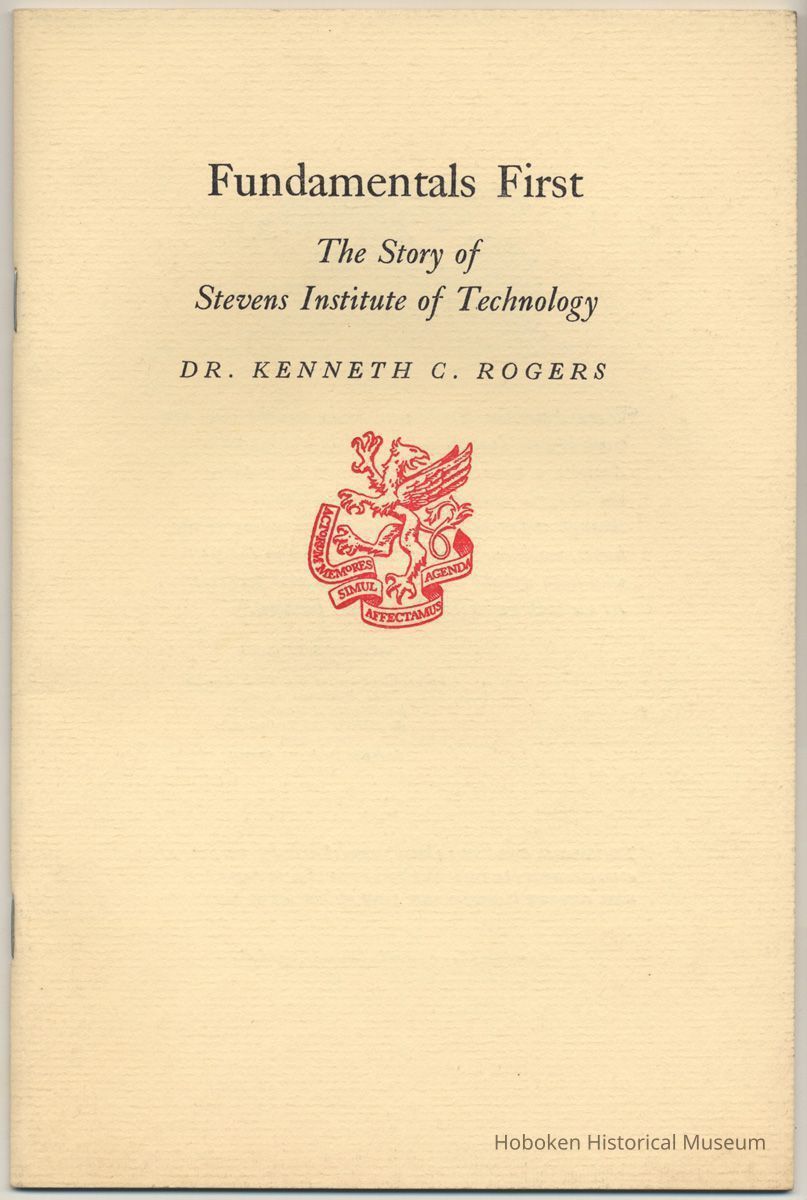
![inside front cover + pg [1]](https://d8e7jbdw4fu0e.cloudfront.net/11047/3dbf2220-fb5d-11ed-a641-b3912f9925a9-wx0aNoE.lg@2x.jpg)
![pp [2-3] Title](https://d8e7jbdw4fu0e.cloudfront.net/11047/3ef0c450-fb5d-11ed-a641-b3912f9925a9-wx0aNoE.lg@2x.jpg)
![pp [4]-5 Introduction of Dr. Rogers](https://d8e7jbdw4fu0e.cloudfront.net/11047/40223f70-fb5d-11ed-a641-b3912f9925a9-wx0aNoE.lg@2x.jpg)