Collections Item Detail
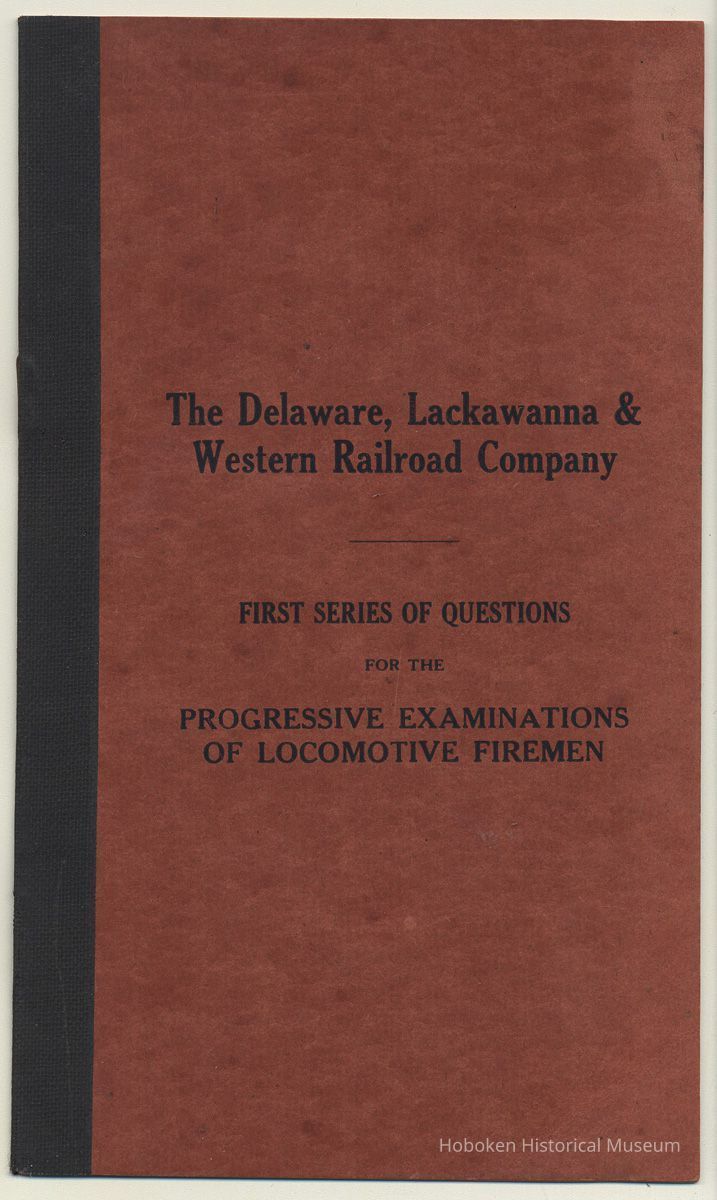
Manual: D. L. & W. R.R. Co. First Series of Questions for the Progressive Examinations of Locomotive Firemen. N.p, n.d., ca. 1910-1930.
2013.005.0009
2013.005
Lukacs, Claire
Gift
Museum Collections. Gift of a Friend of the Museum.
1910 - 1930
Date(s) Created: 1910-1930 ca Date(s): 1910-1930
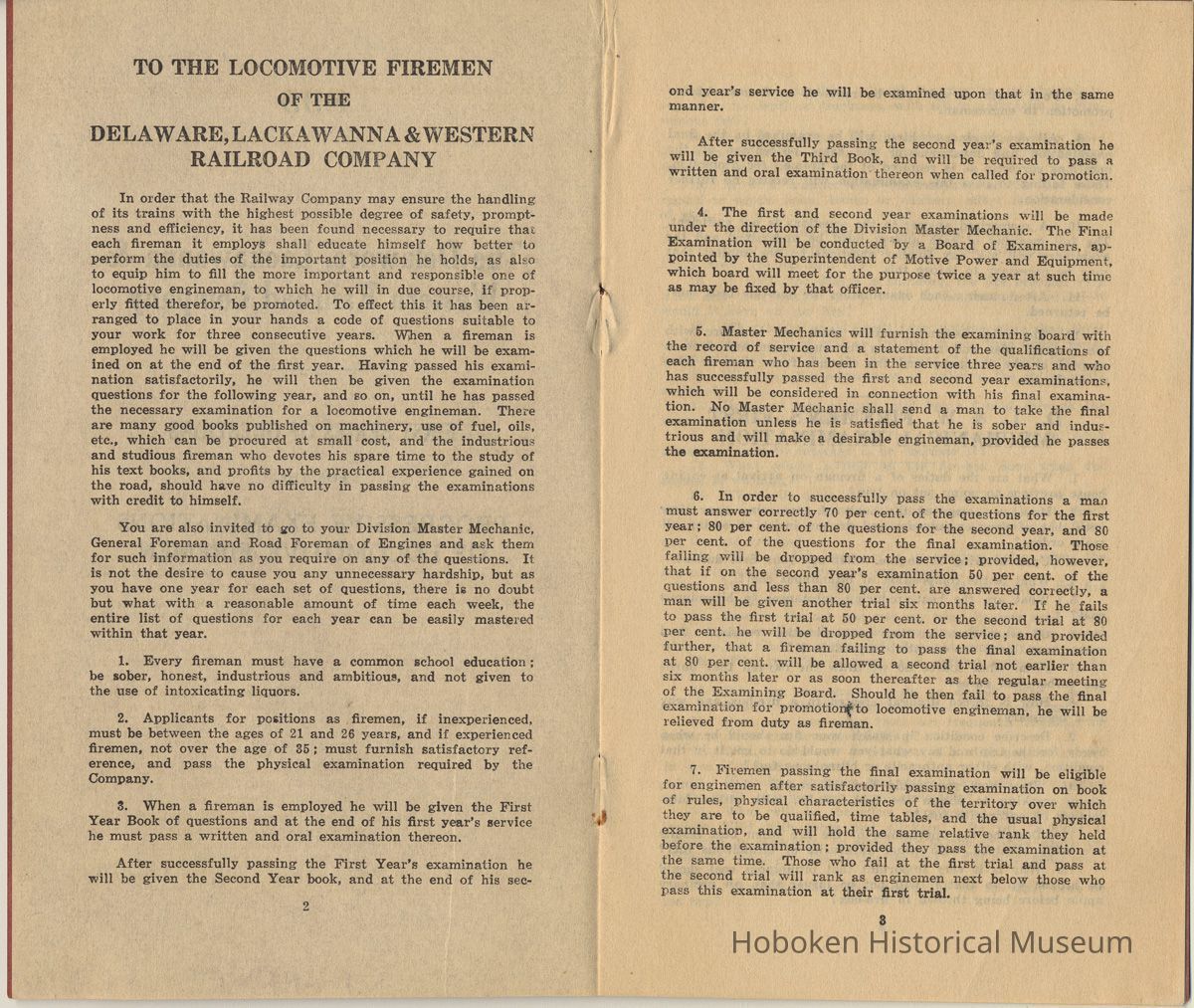
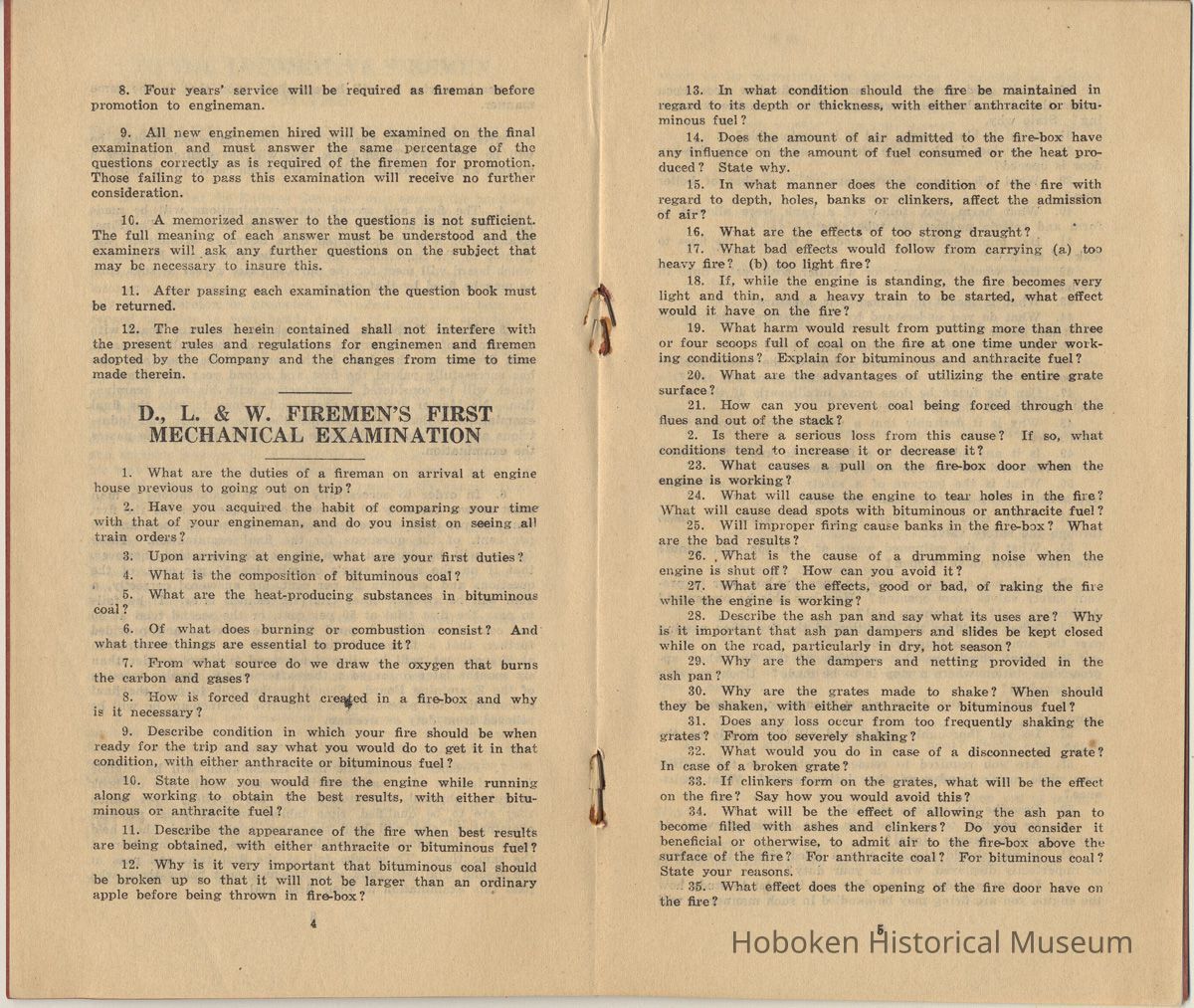
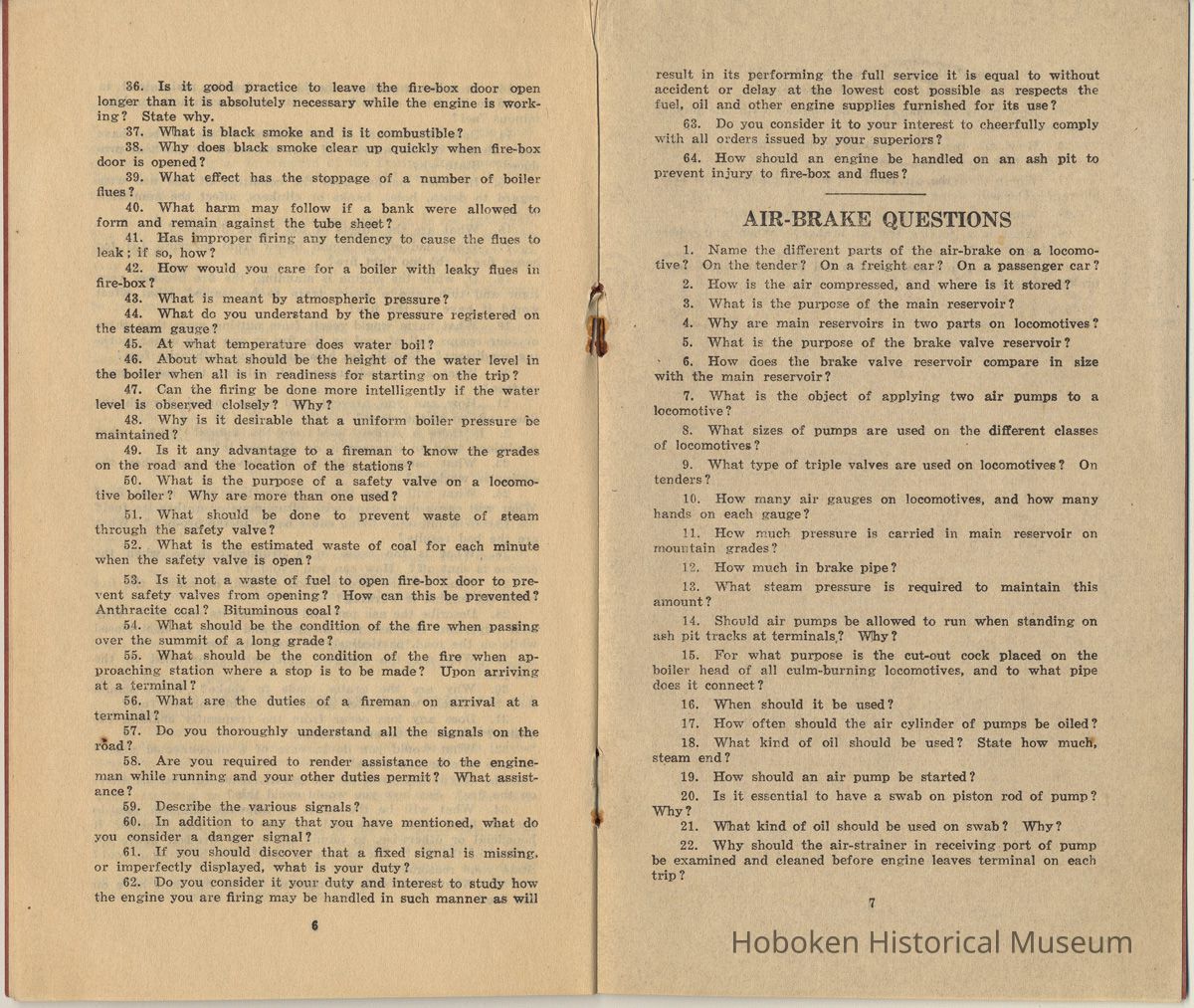
Notes: 2013.005.0009 The Delaware, Lackawanna & Western Railroad Company. First Series of Questions for the Progressive Examination of Locomotive Firemen. ==== TO THE LOCOMOTIVE FIREMEN OF THE DELAWARE, LACKAWANNA & WESTERN RAILROAD COMPANY In order that the Railway Company may ensure the handling of its trains with the highest possible degree of safety, promptness and efficiency, it has been found necessary to require thai; each fireman it employs shall educate himself how better to perform the duties of the important position he holds, as also to equip him to fill the more important and responsible one of locomotive engineman, to which he will in due course, if properly fitted therefor, be promoted. To effect this it has been arranged to place in your hands a code of questions suitable to your work for three consecutive years. When a fireman is employed he will be given the questions which he will be examined on at the end of the first year. Having passed his examination satisfactorily, he will then be given the examination questions for the following year, and so on, until he has passed the necessary examination for a locomotive engineman. There are many good books published on machinery, use of fuel, oils, etc., which can be procured at small cost, and the industrious and studious fireman who devotes his spare time to the study of his text books, and profits by the practical experience gained on the road, should have no difficulty in passing the examinations with credit to himself. You are also invited to go to your Division Master Mechanic, General Foreman and Road Foreman of Engines and ask them for such information as you require on any of the questions. It is not the desire to cause you any unnecessary hardship, but as you have one year for each set of questions, there is no doubt but what with a reasonable amount of time each week, the entire list of questions for each year can be easily mastered within that year. 1. Every fireman must have a common school education; be sober, honest, industrious and ambitious, and not given to the use of intoxicating liquors. 2. Applicants for positions as firemen, if inexperienced, must be between the ages of 21 and 26 years, and if experienced firemen, not over the age of 35 ; must furnish satisfactory reference, and pass the physical examination required by the Company. 3. When a fireman is employed he will be given the First Year Book of questions and at the end of his first year's service he must pass a written and oral examination thereon. After successfully passing the First Year's examination he will be given the Second Year book, and at the end of his sec- 2 ==== ond year's service he will be examined upon that in the same manner. After successfully passing the second year's examination he will be given the Third Book, and will be required to pass a written and oral examination thereon when called for promotion. 4. The first and second year examinations will be made under the direction of the Division Master Mechanic. The Final Examination will be conducted by a Board of Examiners, appointed by the Superintendent of Motive Power and Equipment, which board will meet for the purpose twice a year at such time as may be fixed by that officer. 5. Master Mechanics will furnish the examining board with the record of service and a statement of the qualifications of each fireman who has been in the service three years and who has successfully passed the first and second year examinations, which will be considered in connection with his final examination. No Master Mechanic shall send a man to take the final examination unless he is satisfied that he is sober and industrious and will make a desirable engineman, provided he passes the examination. 6. In order to successfully pass the examinations a man must answer correctly 70 per cent, of the questions for the first year; 80 per cent, of the questions for the second year, and 80 per cent, of the questions for the final examination. Those failing will be dropped from the service; provided, however, that if on the second year's examination 50 per cent, of the questions and less than 80 per cent, are answered correctly, a man will be given another trial six months later. If he fails to pass the first trial at 50 per cent, or the second trial at 80 per cent, he will be dropped from the service; and provided further, that a fireman failing to pass the final examination at 80 per cent, will be allowed a second trial not earlier than six months later or as soon thereafter as the regular meeting of the Examining Board. Should he then fail to pass the final examination for promotioi^to locomotive engineman, he will be relieved from duty as fireman. 7. Firemen passing the final examination will be eligible for enginemen after satisfactorily passing examination on book of rules, physical characteristics of the territory over which they are to be qualified, time tables, and the usual physical examination, and will hold the same relative rank they held before the examination ; provided they pass the examination at the same time. Those who fail at the first trial and pass at the second trial will rank as enginemen next below those who pass this examination at their first trial. 3 ==== 8. Four years' service will be required as fireman before promotion to engineman. 9. All new enginemen hired will be examined on the final examination and must answer the same percentage of the questions correctly as is required of the firemen for promotion. Those failing to pass this examination will receive no further consideration. 1C. A memorized answer to the questions is not sufficient. The full meaning of each answer must be understood and the examiners will ask any further questions on the subject that may be necessary to insure this. 11. After passing each examination the question book must be returned. 12. The rules herein contained shall not interfere with the present rules and regulations for enginemen and firemen adopted by the Company and the changes from time to time made therein. D., L. & W. FIREMEN'S FIRST MECHANICAL EXAMINATION 1. What are the duties of a fireman on arrival at engine house previous to going out on trip? 2. Have you acquired the habit of comparing your time with that of your engineman, and do you insist on seeing all train orders ? 3. Upon arriving at engine, what are your first duties ? 4. What is the composition of bituminous coal ? 5. What are the heat-producing substances in bituminous coal? 6. Of what does burning or combustion consist? And what three things are essential to produce it? 7. From what source do we draw the oxygen that burns the carbon and gases? 8. How is forced draught created in a fire-box and why is it necessary? 9. Describe condition in which your fire should be when ready for the trip and say what you would do to get it in that condition, with either anthracite or bituminous fuel? 10. State how you would fire the engine while running along working to obtain the best results, with either bituminous or anthracite fuel ? 11. Describe the appearance of the fire when best results are being obtained, with either anthracite or bituminous fuel? 12. Why is it very important that bituminous coal should be broken up so that it will not be larger than an ordinary apple before being thrown in fire-box? 4 ==== 13. In what condition should the fire be maintained in regard to its depth or thickness, with either anthracite or bituminous fuel ? 14. Does the amount, of air admitted to the fire-box have any influence on the amount of fuel consumed or the heat produced ? State why. 15. In what manner does the condition of the fire with regard to depth, holes, banks or clinkers, affect the admission of air ? 16. What are the effects of too strong draught? 17. What bad effects would follow from carrying (a) too heavy fire? (b) too light fire? 18. If, while the engine is standing, the fire becomes very light and thin, and a heavy train to be started, what effect would it have on the fire? 19. What harm would result from putting more than three or four scoops full of coal on the fire at one time under working conditions? Explain for bituminous and anthracite fuel? 20. What are the advantages of utilizing the entire grate surface ? 21. How can you prevent coal being forced through the flues and out of the stack? 2. Is there a serious loss from this cause? If so, what conditions tend to increase it or decrease it? 23. What causes a pull on the fire-box door when the engine is working? 24. What will cause the engine to tear holes in the fire? What will cause dead spots with bituminous or anthracite fuel? 25. Will improper firing cause banks in the fire-box? What are the bad results? 26. , What is the cause of a drumming noise when the engine is shut off? How can you avoid it? 27. What are the effects, good or bad, of raking the fire while the engine is working? 28. Describe the ash pan and say what its uses are? Why is it important that ash pan dampers and slides be kept closed while on the road, particularly in dry, hot season ? 29. Why are the dampers and netting provided in the ash pan ? 30. Why are the grates made to shake ? When should they be shaken, with either anthracite or bituminous fuel ? 31. Does any loss occur from too frequently shaking the grates? Prom too severely shaking? 32. What would you do in case of a disconnected grate? In case of a broken grate? 33. If clinkers form on the grates, what will be the effect on the fire? Say how you would avoid this? 34. What will be the effect of allowing the ash pan to become filled with ashes and clinkers? Do you consider it beneficial or otherwise, to admit air to the fire-box above the surface of the fire ? For anthracite coal ? For bituminous coal ? State your reasons. 35. What effect does the opening of the fire door have en the fire? 5 ==== 36. Is it good practice to leave the fire-box door open longer than it is absolutely necessary while the engine is working? State why. 37. What is black smoke and is it combustible? 38. Why does black smoke clear up quickly when fire-box door is opened? 39. What effect has the stoppage of a number of boiler flues ? 40. What harm may follow if a bank were allowed to form and remain against the tube sheet? 41. Has improper firing any tendency to cause the flues to leak; if so, how ? 42. How would you care for a boiler with leaky flues in fire-box ? 43. What is meant by atmospheric pressure? 44. What do you understand by the pressure registered on the steam gauge? 45. At what temperature does water boil ? 46. About what should be the height of the water level in the boiler when all is in readiness for starting on the trip? 47. Can the firing be done more intelligently if the water level is observed clolsely? Why? 48. Why is it desirable that a uniform boiler pressure be maintained ? 49. Is it any advantage to a fireman to know the grades on the road and the location of the stations ? 50. What is the purpose of a safety valve on a locomotive boiler ? Why are more than one used ? 51. What should be done to prevent waste of steam through the safety valve? 52. What is the estimated waste of coal for each minute when the safety valve is open? 53. Is it not a waste of fuel to open fire-box door to prevent safety valves from opening? How can this be prevented? Anthracite ecal ? Bituminous coal ? 54. What should be the condition of the fire when passing over the summit of a long grade? 55. What should be the condition of the fire when approaching station where a stop is to be made? Upon arriving at a terminal ? 56. What are the duties of a fireman on arrival at a terminal ? 57. Do you thoroughly understand all the signals on the road? 58. Are you required to render assistance to the engine-man while running- and your other duties permit? What assistance? 59. Describe the various signals? 60. In addition to any that you have mentioned, what do you consider a danger signal ? 61. If you should discover that a fixed signal is missing, or imperfectly displayed, what is your duty? 62. Do you consider it your duty and interest to study how the engine you are firing may be handled in such manner as will 6 ==== result in its performing the full service it is equal to without accident or delay at the lowest cost possible as respects the fuel, oil and other engine supplies furnished for its use? 63. Do you consider it to your interest to cheerfully comply with all orders issued by your superiors? 64. How should an engine be handled on an ash pit to prevent injury to fire-box and flues ? AIR-BRAKE QUESTIONS 1. Name the different parts of the air-brake on a locomotive? On the tender? On a freight car? On a passenger car? 2. How is the air compressed, and where is it stored? 3. What is the purpose of the main reservoir? 4. Why are main reservoirs in two parts on locomotives? 5. What is the purpose of the brake valve reservoir? 6. How does the brake valve reservoir compare in size with the main reservoir? 7. What is the object of applying two air pumps to a locomotive ? 8. What sizes of pumps are used on the different classes of locomotives ? 9. What type of triple valves are used on locomotives ? On tenders ? 10. How many air gauges on locomotives, and how many hands on each gauge? 11. Hew much pressure is carried in main reservoir on mountain grades ? 12. How much in brake pipe? 13. What steam pressure is required to maintain this amount ? 14. Should air pumps be allowed to run when standing on ash pit tracks at terminals,? Wlhy? 15. For what purpose is the cut-out cock placed on the boiler head of all culm-burning locomotives, and to what pipe does it connect ? 16. When should it be used? 17. How often should the air cylinder of pumps be oiled? 18. What kind of oil should be used? State how much, steam end? 19. How should an air pump be started? 20. Is it essential to have a swab on piston rod of pump? Why? 21. What kind of oil should be used on swab? Why? 22. Why should the air-strainer in receiving port of pump be examined and cleaned before engine leaves terminal on each trip? 7 ==== 23. How should the air-strainer be cleaned? 24. How many brake valves on locomotives? 25. How many governors used on engines with one pump ? With two pumps ? 26. How are the train brakes applied from the locomotive? And how released? 27. Where does the air come from that operates the sand blower ? The bell wringer? 28. What is a terminal test of brakes on a train ? 29. What is a service test of brakes? When and where should it be made? 30. Does the pump governor control the main reservoir or brake pipe pressure? 8 [end] ==== ==== Status: OK Status By: dw Status Date: 2013-02-19
![pg [1]](https://d8e7jbdw4fu0e.cloudfront.net/11047/02d80f10-fa5d-11ed-a641-b3912f9925a9-vd29Z0v.lg@2x.jpg)