Collections Item Detail
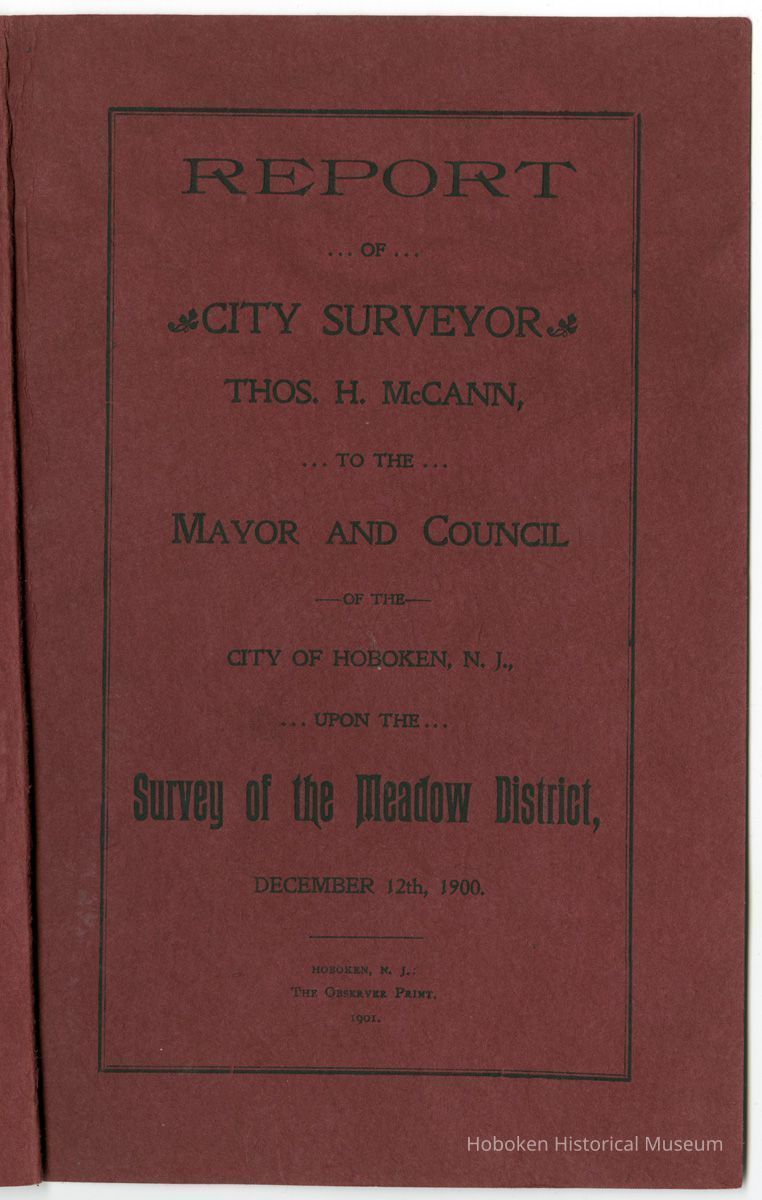
Report of City Surveyor Thos. H. McCann to the Mayor and Council of the City of Hoboken Upon the Survey of the Meadow District, December 12th, 1900.
2013.069.0001
2013.069
Maier, Estate of Robert
Gift
Gift of Estate of Robert Maier by sister, Michelle Maier.
1900 - 1901
Date(s) Created: 1900 Date(s): 1900-1901
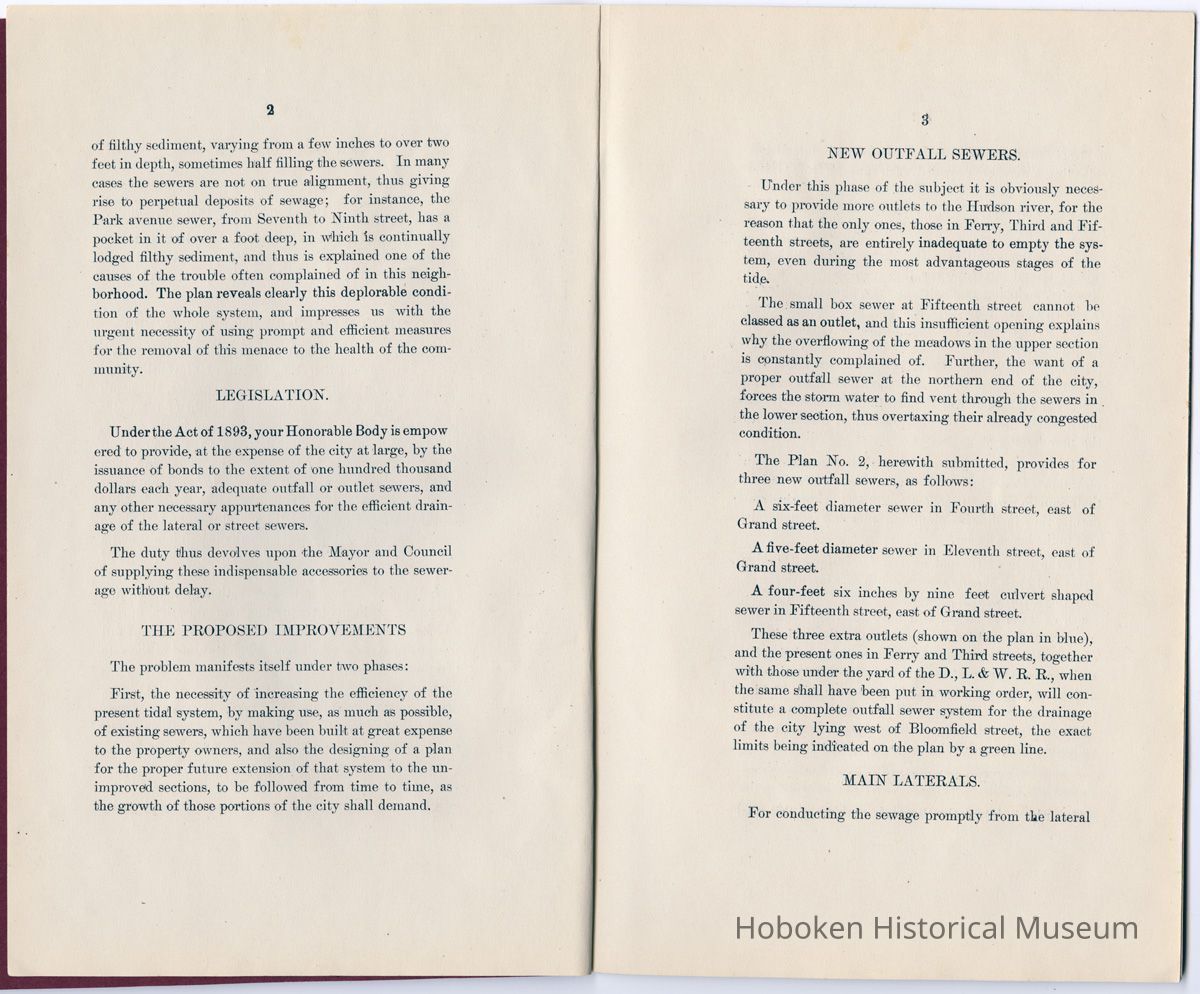
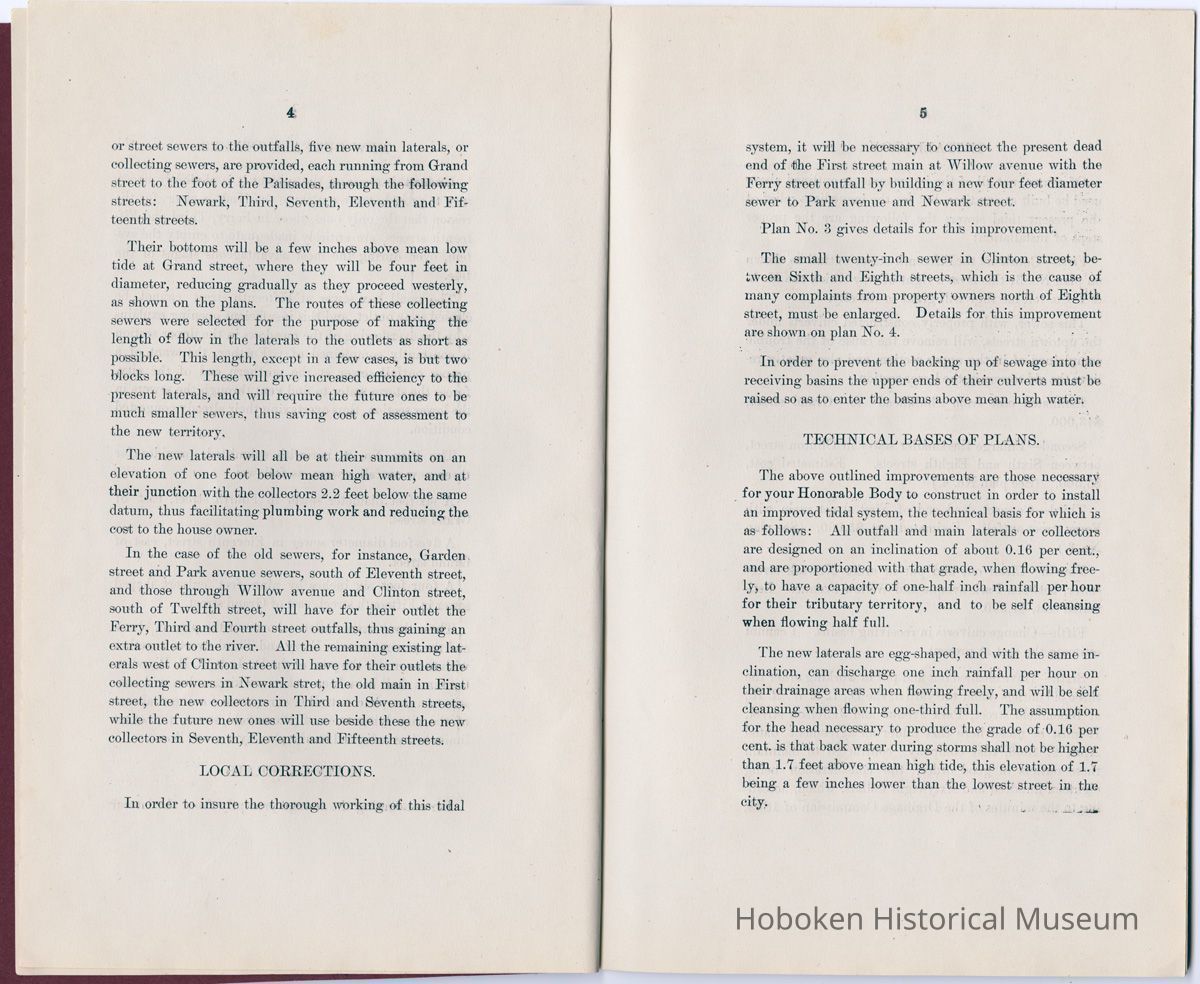
Notes: Archives 2013.069.0001 [cover title and imprint] Report of City Surveyor Thos. H. McCann to the Mayor and Council of the City of Hoboken Upon the Survey of the Meadow District, December 12th, 1900. Hoboken, N.J.: The Observer Print, 1901. ==== [page 1] Hoboken, N. J., Dec. 12, 1900. To the Honorable Council of the City of Hoboken: Gentlemen—In accordance with your resolution of October 24, 1900, I herewith submit report and plans for the sewerage of the city. CONDITION OF THE PRESENT SEWERS. Plan No. 1.—This plan gives profiles of all sewers west of Bloomfield Street, and south of Eleventh street, and shows at a glance their character, grades, the depth of sediment in them, together with height of the water as it stood, both in the Hudson river and in the sewers, at 11 a. m., November 26th last. At that hour it was extreme high water in the river, the tide being then twenty inches above the mean or average high water mark. The water in the sewers was motionless, because all the tide gates were closed; its level was one foot above mean high water, three feet over the marsh lands, and a few inches below the surface of the street at the corner of Newark street and Park avenue, which place is the lowest in the city. These water observations were taken just after a heavy storm of twenty-one hours duration, during which three inches of rain fell; the maximum rate of fall was during a certain half hour when it rained at the rate of 3/4 inch an hour. This plan, also shows that the water level at the time of observation reached to Ninth street, in the Garden street sewer, to Tenth street in Park avenue, to Eleventh street in Willow avenue, and to Twelfth street in the Clinton street sewers, while the remainder of the sewers west of Clinton street were full of sewage. As will be seen by the profiles, all the sewers contain large deposits ==== 2 of filthy sediment, varying from a few inches to over two feet in depth, sometimes half filling the sewers. In many cases the sewers are not on true alignment, thus giving rise to perpetual deposits of sewage; for instance, the Park avenue sewer, from Seventh to Ninth street, has a pocket in it of over a foot deep, in which is continually lodged filthy sediment, and thus is explained one of the causes of the trouble often complained of in this neighborhood. The plan reveals clearly this deplorable condition of the whole system, and impresses us with the urgent necessity of using prompt and efficient measures for the removal of this menace to the health of the community. LEGISLATION. Underthe Act of 1893, your Honorable Body is empowered to provide, at the expense of the city at large, by the issuance of bonds to the extent of one hundred thousand dollars each year, adequate outfall or outlet sewers, and any other necessary appurtenances for the efficient drainage of the lateral or street sewers. The duty thus devolves upon the Mayor and Council of supplying these indispensable accessories to the sewerage without delay. THE PROPOSED IMPROVEMENTS The problem manifests itself under two phases: First, the necessity of increasing the efficiency of the present tidal system, by making use, as much as possible, of existing sewers, which have been built at great expense to the property owners, and also the designing of a plan for the proper future extension of that system to the unimproved sections, to be followed from time to time, as the growth of those portions of the city shall demand. ==== 3 NEW OUTFALL SEWERS. Under this phase of the subject it is obviously necessary to provide more outlets to the Hudson river, for the reason that the only ones, those in Ferry, Third and Fifteenth streets, are entirely inadequate to empty the system, even during the most advantageous stages of the tide. The small box sewer at Fifteenth street cannot be classed as an outlet, and this insufficient opening explains why the overflowing of the meadows in the upper section is constantly complained of. Further, the want of a proper outfall sewer at the northern end of the city, forces the storm water to find vent through the sewers in the lower section, thus overtaxing their already congested condition. The Plan No. 2, herewith submitted, provides for three new outfall sewers, as follows: A six-feet diameter sewer in Fourth street, east of Grand street. A five-feet diameter sewer in Eleventh street, east of Grand street. A four-feet six inches by nine feet culvert shaped sewer in Fifteenth street, east of Grand street. These three extra outlets (shown on the plan in blue), and the present ones in Ferry and Third streets, together with those under the yard of the D., L. & W. R. R., [Delaware, Lackawanna and Western Railroad] when the same shall have been put in working order, will constitute a complete outfall sewer system for the drainage of the city lying west of Bloomfield street, the exact limits being indicated on the plan by a green line. MAIN LATERALS. For conducting the sewage promptly from the lateral ==== 4 or street sewers to the outfalls, five new main laterals, or collecting sewers, are provided, each running from Grand street to the foot of the Palisades, through the following streets: Newark, Third, Seventh, Eleventh and Fifteenth streets. Their bottoms will be a few inches above mean low tide at Grand street, where they will be four feet in diameter, reducing gradually as they proceed westerly, as shown on the plans. The routes of these collecting sewers were selected for the purpose of making the length of flow in the lateral's to the outlets as short as possible. This length, except in a few cases, is but two Mocks long. These will give increased efficiency to the present laterals, and will require the future ones to be much smaller sewers, thus saving cost of assessment to the new territory. The new laterals will all be at their summits on an elevation of one foot below mean high water, and at their junction with the collectors 2.2 feet below the same datum, thus facilitating plumbing work and reducing the cost to the house owner. In the case of the old sewers, for instance, Garden street and Park avenue sewers, south of Eleventh street, and those through Willow avenue and Clinton street, south of Twelfth street, will have for their outlet the Ferry, Third and Fourth street outfalls, thus gaining an extra outlet to the river. All the remaining existing laterals west of Clinton street will have for their outlets the collecting sewers in Newark street, the old main in First street, the new collectors in Third and Seventh streets, while the future new ones will use beside these the new collectors in Seventh, Eleventh and Fifteenth streets. LOCAL CORRECTIONS. In order to insure the thorough working of this tidal ==== 5 system, it will be necessary to connect the present dead end of the First street main at Willow avenue with the Ferry street outfall by building a new four feet diameter sewer to Park avenue and Newark street. Plan No. 3 gives details for this improvement. The small twenty-inch sewer in Clinton street, between Sixth and Eighth streets, which is the cause of many complaints from property owners north of Eighth street, must be enlarged. Details for this improvement are shown on plan No. 4. In order to prevent the backing up of sewage into the receiving basins the upper ends of their culverts must be raised so as to enter the basins above mean high water. TECHNICAL BASES OF PLANS. The above outlined improvements are those necessary for your Honorable Body to construct in order to install an improved tidal system, the technical basis for which is as follows: All outfall and main laterals or collectors are designed on an inclination of about 0.16 per cent., and are proportioned with that grade, when flowing freely) to have a capacity of one-half inch rainfall per hour for their tributary territory, and to be self cleansing when flowing half full. The new laterals are egg-shaped, and with the same inclination, can discharge one inch rainfall per hour on their drainage areas when flowing freely, and will be self cleansing when flowing one-third full. The assumption for the head necessary to produce the grade of 0.16 per cent, is that back water during storms shall not be higher than 1.7 feet above mean high tide, this elevation of 1.7 being a few inches lower than the lowest street in the ==== 6 INSTALLATON [sic - Installion]. Of course, not all of the improvements outlined above need be built at one time, but for the immediate relief of the present tidal sewers the following are the proper steps of installation: First—Construct the Fifteenth street outfall as shown on plan No. 5; this is on a right of way which the H. L. & I. Co. [Hoboken Land & Improvement Company] tell me they will grant to the city. This sewer, with properly constructed culverts under the uptown streets, will remove the cause of the trouble complained of in the upper section, and also greatly relieve the old sewers in the lower section. Estimated cost from bulkhead to Grand street, $43,000. Second—Enlarge the smaller sewer in Clinton street, between Sixth and Eighth streets. Estimated cost, $5,500. (See plan No. 4.) Third—Connect dead end of First street main with Ferry street outfall. Estimated cost, $5,000. (See plan No. 3.) Fourth—Clean out and put in order Newark street sewer, between Park avenue and Willow avenue. Estimated cost, $1,500. Fifth—Change culverts in receiving basins. I cannot estimate the cost at present. Sixth—Have cleaned out and put in working order the three old outlets under the yard of the D., L. & W. R. R., at Bloomfield street, Park avenue and Jefferson street. It must be noted here that under an agreement dated April 2, 1868, that company contracted to maintain these outlets in good order, the consideration being eighteen hundred and sixty-eight dollars, which, according to the minutes of the Drainage Commission of 1868, ==== 7 on file in the City Hall, was paid in the form of a rebate on assessments against the railroad property. Should the city decide to retain and extend the sewerage on the tidal system permanently and without the assistance of pumping, you would next construct the Fourth street outlet, from Grand street to end of the piers, estimated cost $48,000. (Details shown on plan No. 6.) This outlet could just as well be located through Fifth street, but in that case the cost would be $10,000 greater. (See plan No. 6.) The Eleventh street outfall need not be built until improvements in the upper section shall demand it, which will probably not be for some years to come. In the meantime, the Fifteenth street outfall will give ample drainage to that section. The estimated cost is $41,000. (See plan No. 7.) The construction of the collectors in Newark, Third and Seventh streets should next follow. REVIEW OF THE COMPLETED TIDAL SYSTEM With the completion of all the above mentioned accessories, a vast improvement will be attained over the bad conditions of the present sewerage, but at best, this tidal system will manifestly carry with it the inherent evils, well known to such methods of sewerage, and the usual criticisms will arise: First—That it did not prevent the filthy sewage at every recurring incoming tide from flowing over and polluting the marsh lands. Second—That it did not prevent the filling of the sewers at storms and high tides, thereby displacing the contained noxious gas, and forcing it into the houses. Third—That it did not prevent flooding, as in the case ==== 8 like that of the storm of November 25 and 26 last, when, with the gates closed to keep back the extreme high water, all the storm water was forced to flow out on the marsh lands to be retained there, as in a reservoir for days, until the receding tides permitted the sewers to empty. AUXILIARY PUMPING PLANT. What then may be done to obviate these evils in the tidal system? This brings us to the Second Phase of the Problem, and the solution lies in providing for the system above designed, an auxiliary pumping plant. This will consist of a deep collecting main sewer, running through Grand street, from Fifteenth street to a pumping-station in Newark street, near Clinton street. Its elevation at Fifteenth street will be at about mean low Water, and at the pumps, ten feet below that datum. The pumps will be in several units and of the centrifugal type, to have an ultimate capacity equal to one-quarter of an inch rainfall per hour over the entire drainage area of 640 acres; this area includes 510 acres in Hoboken, and 130 acres along the steep slope of the Palisades in Jersey City and West Hoboken, the rain from which will always continue to flow down upon our low lands, or until a storm collecting-sewer shall be constructed along the foot of the hill, connecting at its north and south ends with the Hudson river independently of your sewer system. As such improvement cannot be anticipated1 for many years to come, this area of 130 acres is therefore included in the necessary capacity of the pumps. The one-quarter inch rainfall per hour is a large and unusual amount to provide for, and greatly exceeds the capacity maintained in Newark, N. J.; Boston, Mass.; London, England; Dantzig and Berlin, in Germany, and many other cities, where pumping systems have been in successful operation many years. ==== 9 It is made necessary, however, in your ease, for the reason that about 300 acres or nearly one-half of the drainage area is improved territory, thickly populated, with well constructed streets, that lie in many places more than one foot below extreme high water mark, and often less than two feet above mean high tide. This quarter of an inch rainfall equals the greatest storm Which has visited this region during the last thirty years; it occurred in September, 1882, when it rained six inches in twenty-four hours, according to the reports of the United States Weather Department. The small area of your drainage district makes it practicable to provide this pumping capacity within economical bounds, especially considering the vast benefits to be Obtained by its instalment. It is therefore necessary that your Honorable Body should decide without delay, whether you will adopt this auxiliary pumping plant, for in that case, you could omit the expensive construction of the Fourth and Eleventh street outfalls, and apply their cost to the installation of the pumping plant. Eighth—For immediate needs, you would only build the Grand street delivery main as far north as Third street. Estimated cost........................ $40,000 With pumping station, without land........ 70,000 Total, present instalment ............. $110,000 OPERATION OF PUMPING PLANT. With this much of the auxiliary pumping plant completed, the operation of your system would be as follows: The river water will be cut off by the gates and regulators and during dry weather all the sewage from the built-up district within the drainage area will flow to the ==== 10 pumps, which will lift and discharge it by way of the Ferry street outfall into the river. Occasionally, and as often as deemed necessary, at high tide, clean river water will be admitted into the entire system, so as to fill the sewers half full, when with the gate then closed, the pump will empty them and thus flush out their contents. As many of the present meadow sewers are nearly level, this flushing will not be sufficient to remove entirely all the solid contents, hence in such case some cleaning by hand will have to be done, but they will all be free of noxious gas and whenever found necessary may be replaced from time to time by new laterals, which will be self-cleaning; the cost of replacing the old sewers with new small laterals will be low, as the present piling and timber foundations need not be renewed. When a storm occurs, as for instance, like that of November 25 and 26, last, the pumps will easily cope with the rainfall and keep the sewers flowing freely. Such a storm has only occurred twelve times in the last thirty years. In this manner the sewers will be kept clean and free from sewer gas, and the marsh lands maintained in their natural healthy state, in fact as much river water may be allowed to flow upon them as experience shall prove to be beneficial. Should a sudden cloudburst occur, as occasionally happens for a short duration of time, or should by any possible manner, the pumps fail to work, then the tide regulators would automatically go into operation and thus permit the sewerage to return for the time being to the tidal system. With the pumping plant in operation, the Fourth street and Eleventh street outfalls may not be require ==== 11 until the entire meadow district is solidly built up, for the Fifteenth, Third and Ferry streets and railroad yard outlets will answer as storm overflow sewers. COST OF OPERATING, The cost of maintaining the pumping system should not exceed $11,000 per year, which is only something over twice as much as the city now spends annually in its ineffectual attempt to remove the sediment from the present sewers. FUTURE EXTENSIONS. As new streets are improved and property built up, the Grand street delivery, main collectors and laterals can be installed as required, but they must all be constructed in strict conformity with the plan to insure proper working of the system. WEEHAWKEN LOWLANDS. At some extra expense the Grand street delivery main could be modified and extended north so as to admit the small area of lowlands in Weehawken without serious tax upon the pumps, leaving the present outfall at Seventeenth street for a storm overflow sewer discharging clean rain water only. The following is a summary of cost of work immediately necessary for both tidal and pumping systems. TIDAL SYSTEM. No. 1. Fifteenth street outfall .... $43,000 No. 2. Clinton street enlargement .... 5,500 No. 3. First street extension..... 5,000 No. 4. Newark street cleaning, etc .... 1,500 ==== 12 No. 5. Fourth street outlet............ 48,000 No. 6. Eleventh street outlet........... 41,000 Total . .........................................................$144,000 PUMPING SYSTEM. No. 1. Fifteenth street outfall....................$43,000 No. 2. Clinton street enlargement..............5,500 No. 3. First street extension........................5,000 No. 4. Newark street cleaning, etc..............1,500 No. 5. Pumping station, without land .... 70,000 No. 6. Grand street sewer to Third street .... 40,000 Total, present instalment.............. $165,000 MANAGEMENT OF SEWER SYSTEM. Under whatever system your sewerage is operated, it must have intelligent care and responsible supervision, which is just as necessary in this department of your public works as it is in the water or any other department. Ordinances should provide for the punishment of any unauthorized person tampering with tide gates or any appurtenances of the sewer system. UPLAND SEWERS. I find that the upland sewers are generally working well, but a number of important streets are without public sewers, and the houses along these get inefficient drainage through old, long forgotten, private drains, without manholes for inspection or ventilation, and no doubt if they could be examined would be found in unsanitary condition. The following is a list of these streets: ==== 13 River street, its entire length, from Newark to Sixth street. Hudson street, its entire length, from Ferry street, nearly to Eighth street. Court street, its entire length, from Ferry street to Seventh street. Washington street, between Sixth and Eighth streets. Willow street, north of Twelfth street. Respectfully submitted, T. H. McCANN, City Surveyor. [end] ==== ==== Status: OK Status By: dw Status Date: 2013-11-18
![pg [1]](https://d8e7jbdw4fu0e.cloudfront.net/11047/cc8f2530-fb1d-11ed-a641-b3912f9925a9-wx0aSPa.lg@2x.jpg)
![pp 12-13 [end]](https://d8e7jbdw4fu0e.cloudfront.net/11047/d3b7b9d0-fb1d-11ed-a641-b3912f9925a9-wx0aSPa.lg@2x.jpg)