Collections Item Detail
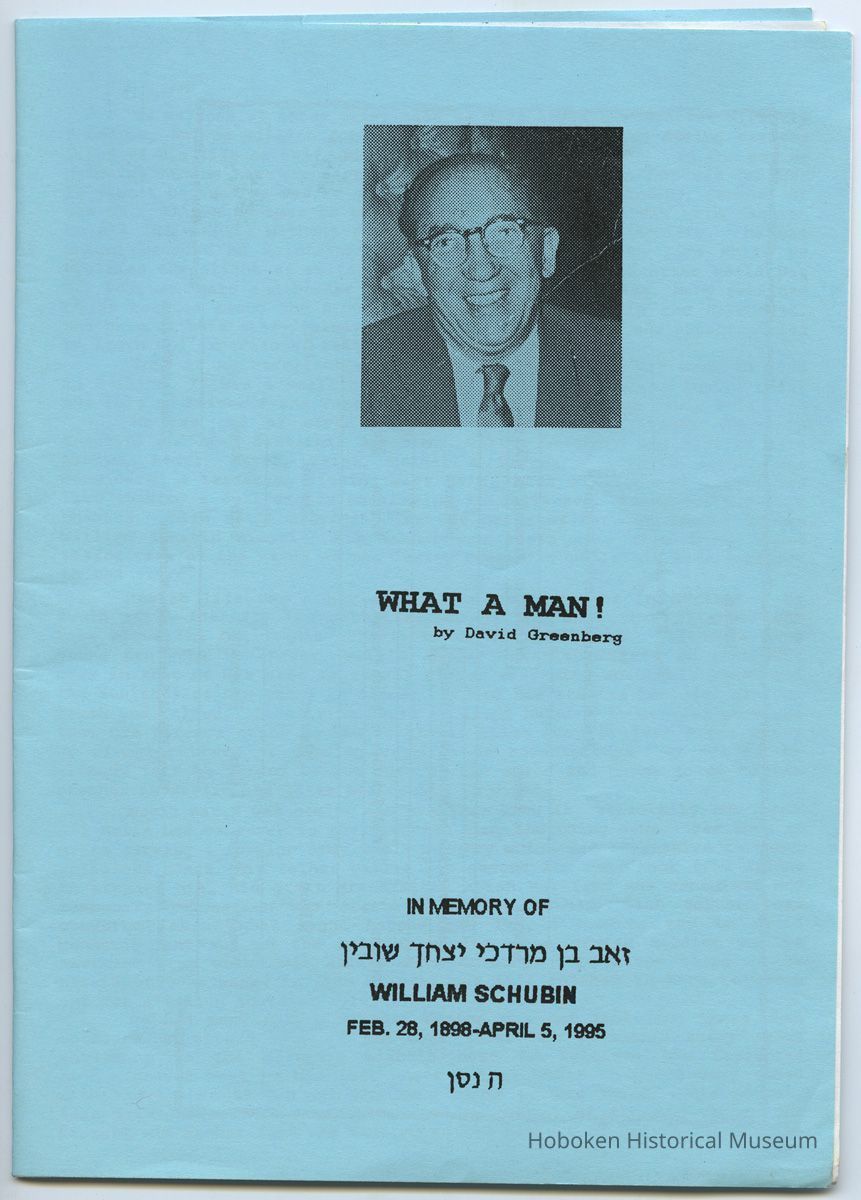
Memoriam (William Schubin): What A Man! By David Greenberg. In Memory of William Schubin. Feb. 28, 1898 - April 5, 1995.
2014.063.0001
2014.063
Greenberg, Naomi Schubin
Gift
Gift of Naomi Schubin Greenberg.
2005 - 2005
Date(s) Created: 2005 Date(s): 2005
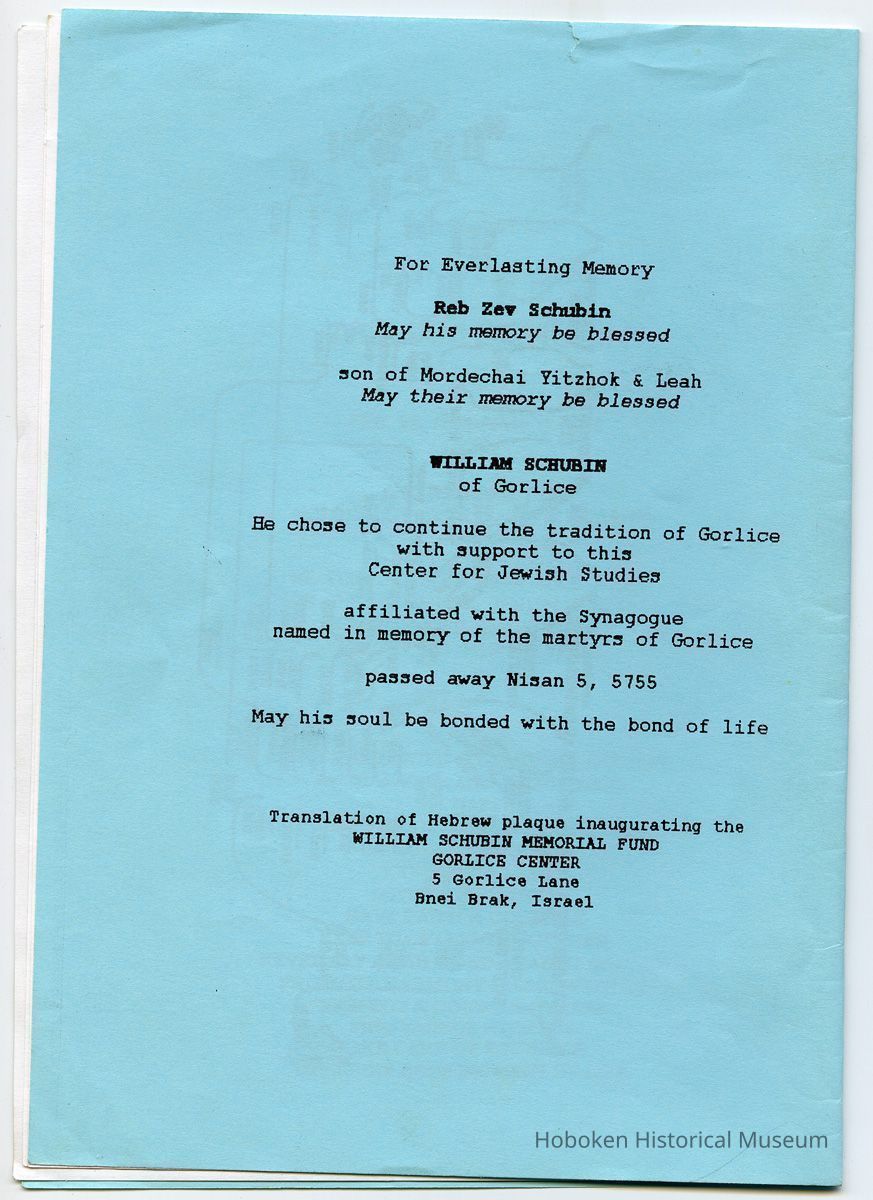
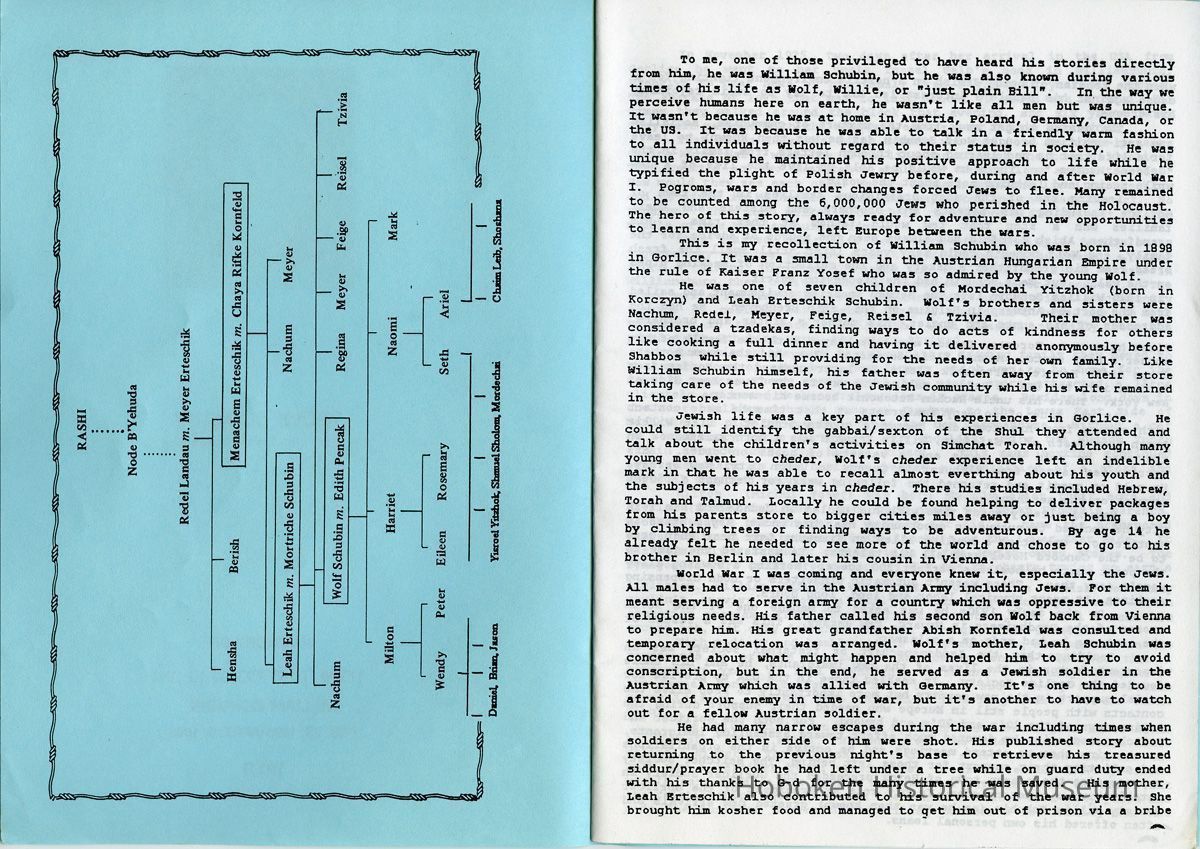
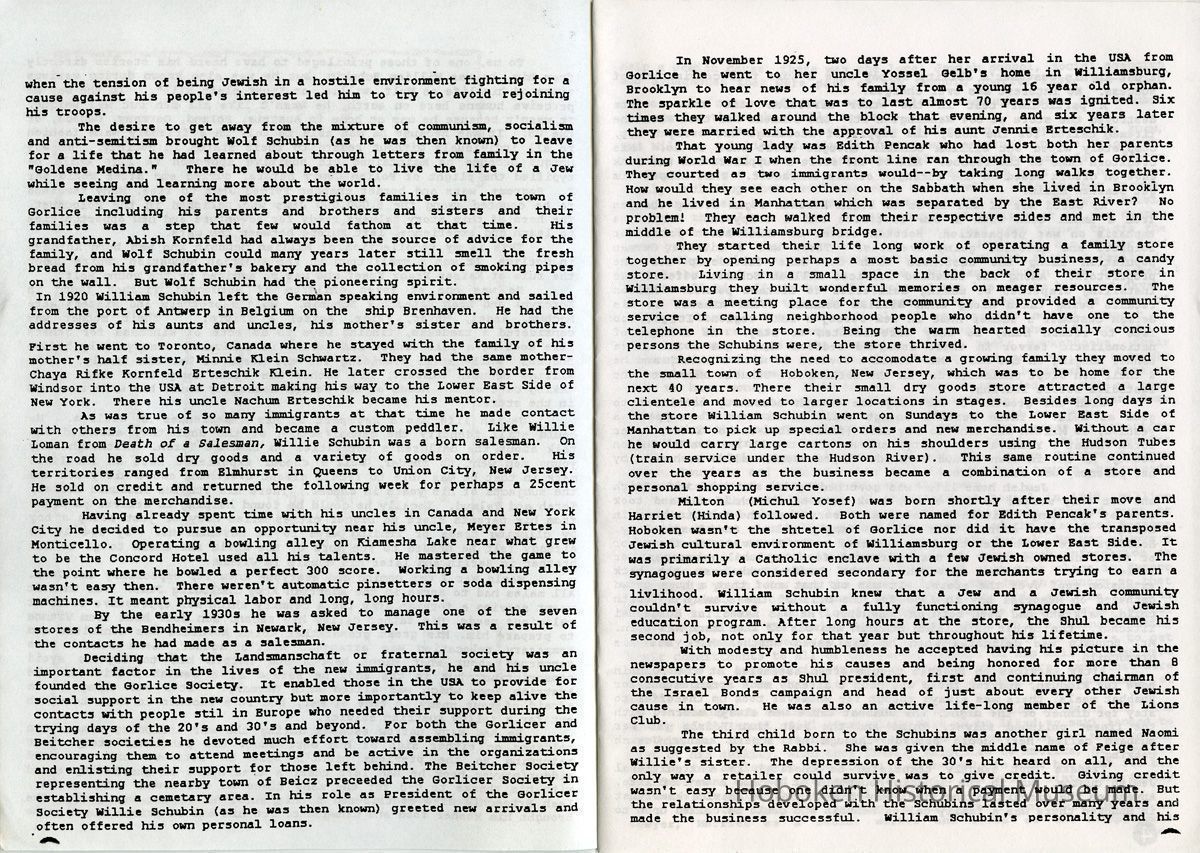
Notes: Archives 2014.063.0001 ==== What A Man! By David Greenberg. In Memory of William Schubin. Feb. 28, 1898 - April 5, 1995. ==== page 1 To me, one of those privileged to have heard his stories directly from him, he was William Schubin, but he was also known during various times of his life as Wolf, Willie, or "just plain Bill". In the way we perceive humans here on earth, he wasn’t like all men but was unique. It wasn't because he was at home in Austria, Poland, Germany, Canada, or the US. It was because he was able to talk in a friendly warm fashion to all individuals without regard to their status in society. He was unique because he maintained his positive approach to life while he typified the plight of Polish Jewry before, during and after World War I. Pogroms, wars and border changes forced Jews to flee. Many remained to be counted among the 6,000,000 Jews who perished in the Holocaust. The hero of this story, always ready for adventure and new opportunities to learn and experience, left Europe between the wars. This is my recollection of William Schubin who was born in 1898 in Gorlice. It was a small town in the Austrian Hungarian Empire under the rule of Kaiser Franz Yosef who was so admired by the young Wolf. He was one of seven children of Mordechai Yitzhok (born in Korczyn) and Leah Erteschik Schubin. Wolf's brothers and sisters were Nachum, Redel, Meyer, Feige, Reisel & Tzivia. Their mother was considered a tzadekas, finding ways to do acts of kindness for others like cooking a full dinner and having it delivered anonymously before Shabbos while still providing for the needs of her own family. Like William Schubin himself, his father was often away from their store taking care of the needs of the Jewish community while his wife remained in the store. Jewish life was a key part of his experiences in Gorlice. He could still identify the gabbai/sexton of the Shul they attended and talk about the children's activities on Simchat Torah. Although many young men went to cheder. Wolf's cheder experience left an indelible mark in that he was able to recall almost everthing about his youth and the subjects of his years in chedez. There his studies included Hebrew, Torah and Talmud. Locally he could be found helping to deliver packages from his parents store to bigger cities miles away or just being a boy by climbing trees or finding ways to be adventurous. By age 14 he already felt he needed to see more of the world and chose to go to his brother in Berlin and later his cousin in Vienna. World War I was coming and everyone knew it, especially the Jews. All males had to serve in the Austrian Army including Jews. For them it meant serving a foreign army for a country which was oppressive to their religious needs. His father called his second son Wolf back from Vienna to prepare him. His great grandfather Abish Kornfeld was consulted and temporary relocation was arranged. Wolf's mother, Leah Schubin was concerned about what might happen and helped him to try to avoid conscription, but in the end, he served as a Jewish soldier in the Austrian Army which was allied with Germany. It's one thing to be afraid of your enemy in time of war, but it's another to have to watch out for a fellow Austrian soldier. He had many narrow escapes during the war including times when soldiers on either side of him were shot. His published story about returning to the previous night's base to retrieve his treasured siddur/prayer book he had left under a tree while on guard duty ended with his thanks to G-d for the many times he was saved. His mother, Leah Erteschik also contributed to his survival of the war years. She brought him kosher food and managed to get him out of prison via a bribe ==== page 2 when the tension of being Jewish in a hostile environment fighting for a cause against his people’s interest led him to try to avoid rejoining his troops. The desire to get away from the mixture of communism, socialism and anti-semitism brought Wolf Schubin (as he was then known) to leave for a life that he had learned about through letters from family in the "Goldene Medina." There he would be able to live the life of a Jew while seeing and learning more about the world. Leaving one of the most prestigious families in the town of Sorlice including his parents and brothers and sisters and their families was a step that few would fathom at that time. His grandfather, Abish Kornfeld had always been the source of advice for the family, and Wolf Schubin could many years later still smell the fresh bread from his grandfather’s bakery and the collection of smoking pipes on the wall. But Wolf Schubin had the pioneering spirit. In 1920 William Schubin left the German speaking environment and sailed from the port of Antwerp in Belgium on the ship Brenhaven [sic - Bremerhaven?]. He had the addresses of his aunts and uncles, his mother's sister and brothers. First he went to Toronto, Canada where he stayed with the family of his mother's half sister, Minnie Klein Schwartz. They had the same mother - Chaya Rifke Kornfeld Erteschik Klein. He later crossed the border from Windsor into the USA at Detroit making his way to the Lower East Side of New York. There his uncle Nachum Erteschik became his mentor. As was true of so many immigrants at that time he made contact with others from his town and became a custom peddler. Like Willie Loman from Death of a Salesman, Willie Schubin was a born salesman. On the road he sold dry goods and a variety of goods on order. His territories ranged from Elmhurst in Queens to Union City, New Jersey. He sold on credit and returned the following week for perhaps a 25 cent payment on the merchandise. Having already spent time with his uncles in Canada and New York City he decided to pursue an opportunity near his uncle, Meyer Ertes in Monticello. Operating a bowling alley on Kiamesha Lake near what grew to be the Concord Hotel used all his talents. He mastered the game to the point where he bowled a perfect 300 score. Working a bowling alley wasn't easy then. There weren't automatic pinsetters or soda dispensing machines. It meant physical labor and long, long hours. By the early 1930s he was asked to manage one of the seven stores of the Bendheimers in Newark, New Jersey. This was a result of the contacts he had made as a salesman. Deciding that the Landsmanschaft or fraternal society was an important factor in the lives of the new immigrants, he and his uncle founded the Gorlice Society. It enabled those in the USA to provide for social support in the new country but more importantly to keep alive the contacts with people stil in Europe who needed their support during the trying days of the 20's and 30's and beyond. For both the Gorlicer and Beitcher societies he devoted much effort toward assembling immigrants, encouraging them to attend meetings and be active in the organizations and enlisting their support for those left behind. The Beitcher Society representing the nearby town of Beicz preceeded the Gorlicer Society in establishing a cemetary area. In his role as President of the Gorlicer Society Willie Schubin (as he was then known) greeted new arrivals and often offered his own personal loans. ==== page 3 In November 1925, two days after her arrival in the USA from Gorlice he went to her uncle Yossel Gelb's home in Williamsburg, Brooklyn to hear news of his family from a young 16 year old orphan. The sparkle of love that was to last almost 70 years was ignited. Six times they walked around the block that evening, and six years later they were married with the approval of his aunt Jennie Erteschik. That young lady was Edith Pencak who had lost both her parents during World War I when the front line ran through the town of Gorlice. They courted as two immigrants would—by taking long walks together. How would they see each other on the Sabbath when she lived in Brooklyn and he lived in Manhattan which was separated by the East River? No problem! They each walked from their respective sides and met in the middle of the Williamsburg bridge. They started their life long work of operating a family store together by opening perhaps a most basic community business, a candy store. living in a small space in the back of their store in Williamsburg they built wonderful memories on meager resources. The store was a meeting place for the community and provided a community service of calling neighborhood people who didn’t have one to the telephone in the store. Being the warm hearted socially concious persons the Schubins were, the store thrived. Recognizing the need to accomodate a growing family they moved to the small town of Hoboken, New Jersey, which was to be home for the next 40 years. There their small dry goods store attracted a large clientele and moved to larger locations in stages. Besides long days in the store William Schubin went on Sundays to the Lower East Side of Manhattan to pick up special orders and new merchandise. Without a car he would carry large cartons on his shoulders using the Hudson Tubes (train service under the Hudson River). This same routine continued over the years as the business became a combination of a store and personal shopping service. Milton (Michul Yosef) was born shortly after their move and Harriet (Hinda) followed. Both were named for Edith Pencak’s parents. Hoboken wasn't the shtetel of Gorlice nor did it have the transposed Jewish cultural environment of Williamsburg or the Lower East Side. It was primarily a Catholic enclave with a few Jewish owned stores. The synagogues were considered secondary for the merchants trying to earn a livlihood. William Schubin knew that a Jew and a Jewish community couldn't survive without a fully functioning synagogue and Jewish education program. After long hours at the store, the Shul became his second job, not only for that year but throughout his lifetime. With modesty and humbleness he accepted having his picture in the newspapers to promote his causes and being honored for more than 8 consecutive years as Shul president, first and continuing chairman of the Israel Bonds campaign and head of just about every other Jewish cause in town. He was also an active life-long member of the Lions Club. The third child born to the Schubins was another girl named Naomi as suggested by the Rabbi. She was given the middle name of Feige after Willie's sister. The depression of the 30's hit heard on all, and the only way a retailer could survive was to give credit. Giving credit wasn’t easy because one didn’t know when a payment would be made. But the relationships developed with the Schubins lasted over many years and made the business successful. William Schubin's personality and his ==== page 4 trust in his customer's ability to pay were a sure fire combination of success. No interest was ever charged. A particular test in the other direction came when a fire destroyed the store at 604 Washington St. One comment was that when the firemen called for the hose, the supply of stockings was brought out. Completely wiped out William Schubin thought about what to do. His creditors came to the rescue. All of the store's suppliers and the bank gave on credit based on the strength of his character. That helped him get started again. As World War II was about to begin Hoboken began seeing changes from a small town with a few factories and a shipyard. With the emphasis on war preparation, Hoboken became an embarkation point for soldiers and material going overseas. There was a sizable Serman population among the customers with the same friendship for the proprietors. Among the extended services William Schubin offered was installing draperies or making deliveries to distant points. Milton recalls being taken along when William Schubin found himself at his German customer’s summer home in New Jersey's lake region. It got too late to return home, so they were invited to stay. As a sign of nationalistic fervor in their assigned bedroom there was a swatstika banner hanging on the wall. Mr. Schubin covered it with a sheet, and he & their son slept undisturbed. In the morning Mr. Schubin uncovered the swatsdika before leaving. With the growth of the city the Jewish community continued to grow as well. There weren't enough children in town to support a yeshiva, so Milton was sent to New York (first Rabbi Yaakov Yosef, later Torah Vaadat & Yeshiva University) and Harriet to the Yeshiva of Hudson County. As the in town Talmud Torah developed Naomi, called Nechamala by her parents, was sent there. Jewish home life was governed by his faithful wife Edith who not only worked in the store, took care of the children, and took care of the many visitors but also made sure that the Schubin home in Hoboken was the address for Jewish family values and hospitality. Holidays were celebrated to their fullest, be it Passover when the Mayor or other notables came to take pictures for the local newspaper, or Sukkot when visitors thronged to the family Sukkah on the back extension roof over the store. It was on that roof that a huge crowd gathered on Memorial Day in 1950 for the Bris of the Schubin’s fourth child, Mark who had been born on Shavuous. He was named for Mordechai Yitzchok, the father of william Schubin who was 52 when Mark was born. Mr. Schubin was delighted when he was asked whether Mark was his grandchild. After services on Shabbat people often assembled at the Schubin home for kiddush, and for those who hadn’t already made arrangements for Shabbat meals, there was always enough for whomever took up the offer to stay for dinner or the night. The Shabbat table was always adorned with the finest polished silver, china and the best that Edisle (as her husband called her) could provide through her superb kosher Jewish cooking. Tzedaka (not exactly translated as charity) is a traditional Jewish custom, but in the Schubin household it became a way of life. Anyone on the circuit making their way from Israel to America knew that in Hoboken there was a family called Schubin who could be called upon to ==== page 5 help a Jewish cause. There was the local Jewish school, social agencies and synagogues that were part of the Schuhin charity list. Non-Jewish causes were never left out, and the local community knew the Schubin address for their charitable needs. As the War went on, the fate of the Jewish people became know, and William Schubin’s family in Europe was entwined in the Holocaust. Setting information was almost impossible. Although tremendous efforts were made to get the family out, fate had destined that from his large family including there would be only one survivor, his brother Nachum. His grandmother, his parents, his sisters Redel, Feige, Reisel & Tzivia all lost their lives in the forest outside of Gorlice or in the nearby Belzec Extermination camp. His brother Meir, had been forced to diq the mass graves and then was shot into them. Meir and his mother and grandmother had previously visited his uncle Michul Klein & family in Israel but had returned to Poland. William Schubin was devasted. Despite all his efforts he still spoke of the loss up to his last days. To deal with the pain he increased his devotion to the cause of helping others. There were displaced persons who needed support to resettle. There was a need for people who came to the U.S. to have a place to stay. Again the Schubins opened their pocketbooks, their credentials and their home to the many who had escaped the terrible times in Europe. Some came for loans to start up a business, a home or just to have money to live on. The Schubins provided it with an open heart until the newcomers were able to get onto their own two feet. Some stayed at "Hotel Schubin" for a day, a week , a month or a year. With the end of World War II, Hoboken's port became an important embarkation point to Europe and the world. Tourist ship passengers became an added source of income to the now famous Hoboken Economy Store. Tourists and citizens were able to buy their towels, bedspreads and sheets for use in town or to take elsewhere. With the establishment of the State of Israel in 194B, William Schubin decided that the loss that the Jewish people endured must be mourned, but he also believed that the remnants of the Displaced Persons Camps in Europe must have a place to go, namely Israel. He was always a Zionist since his youth in Poland and could spout much information on Theodore Herzl or the many Zionist Congress’ that took place in Europe during his youth. Mow was the time to build the Jewish country so that the European Jews could rebuild their lives. To this end, he involved himself in Israel Bonds (local chairman from the first issue), United Israel Appeal and the Jewish National Fund. He left his business during the day to make persoanl visits to the many Jewish store owners to get their committments to all of the worthy causes. On his wall at home were the tokens of appreciation (many more plaques were stored away)that were bestowed upon him for his having raised hundreds of thousands of dollars. Having one brother who survived the War living in Paris and then moving on to Israel, Bill (just plain Bill as he liked to say) longed to see him, but in the interim, he wrote them and provided for them to the best of his ability. When they finally emigrated to America, he provided lodging and employment opportunities as he and his wife had done for his brothers sons who had proceeded him and for his wife’s sister and family who were the only other familial survivors. With the children starting to begin their own lives, Milton as lawyer, Harriet as a social worker and Naomi as an occupational ==== page 6 therapist, and later Mark as an engineer, william and Edith Schubin longed for the day when they would be blessed with sons and daughters-in-laws and grandchildren. He lived for his family, visiting them in their homes, taking them away on trips to the Catskills or the Jersey Shore to celebrate a wedding, birthday or anniversary, doing somersaults with them, providing the down payment for a home or just giving away his car to be used by the children. His daughter Harriet recalls his entertaining the children by doing finger games: "switching" fingers from each side of the middle one, "separating" the thumb, and twirling a coin. Mark recalls his looking with joy and amazement at anything he found. As the families grew he was proud of each new link and descendent. When children had to be out-of-town, they could count on leaving the grandchildren with Mom and Dad. His continuous questions to the children - "tell me everything" - were designed so that he could share in all of their happiness. He shared with his children his love and tried to meet their needs and desires which continued to stay within the modest expectations they had learned from their parents. There was no request that was too big or too small for him to fulfill exhuberantly. His greatest pleasure was at Passover when he sat at the head of the table with all the children and grandchildren, and he was as if a "Free Man" who had survived all of his trials and tribulations and now had all of his children with him to celebrate. Illness is something we all have, but William Schubin had his lot. Being hospitalized for many minor and serious illness, he always seemed to come through. Doctors were amazed. What did he have? He had the will to live, "to enjoy and to enjoy" as he would say. Each day would bring him new enjoyment and new people whom he could share his life with and try to give them his formula for life. And yet he was realistic. During a seven week hospitalization, the night before surgery he said, "We hope for the best. But if not, let’s not be greedy. Not everyone is granted 94 good years." Edith Schubin was the loyal mother, wife and friend of William Schubin. The exceptional marriage lasted over 63 years. The highlight of their marriage was the celebration of their Fiftieth Wedding Anniversary which took place at the Philharmonic Hall at Lincoln Center in New York City when over 600 members of their family paid tribute to them. The marriage was just as strong to his last days as it was on their first day of marriage. Their walking hand in hand around the campus {including their apartment complex) of the the Miami Jewish Home was an example for all young and old. Their dedication to each other day after day, even when apart for health reasons became the par example for the professional staff. The sparkle in their eyes when they saw each other was an inspiration for all. He would say, "Please look your best. ..buy a new dress...have your hair done." It made him feel good to see his wife the way he thought she should look. Even if she didn't go out and buy that new dress, he would complement his wife and say, "Is that a new dress you are wearing. You look beautiful." Being positive is not an easy task for some, but for William Schubin it was a way of life. Walking down the street in Hoboken, Manhattan, Greenwich, Phoenix or Miami, he would always say, "Good ==== page 7 Morning" to all and ask of their health as if he had known them all of hs life. Sometimes the person accompanying hiw would ask, "Do you know that person?" William Schubin was the kind of person who kept his telephone number close to his heart. By that I mean he started on the A page and went through to the "z" page calling each one at regular intervals. He didn't wait to be called or hold it against you if you didn’t call him. Besides calling everyone, he made it his business to write a Jewish New Year's card to everyone in the address book. That's not all. He didn’t forget his non-Jewish customers for over 40 years by sending them cards at appropriate times. One could cry when reading some of the responses of these non-Jewish people who told of their love for the Schubins and the favors that they had bestowed on them. William Schubin's inate ability to be a leader and an interactor with people was played out in the hospital when staff were greeted by first name and asked of their welfare. No matter how he was treated he expressed thanks for each little service. The Rabbi at the Miami Jewish Home complex made it his business to see Mr. Schubin on a daily basis just to talk to him about his experiences during his early years in Europe, the Jewish learning that he started then, and the Jewish world. The Rabbi said that Mr. Schubin was a walking encyclopedia of the Torah, Psalms and general Jewish life. They both sang and recited Yiddish and Hebrew songs (often from his youth)and psalms together and enjoyed each other's company. It wasn't only people that would delight him. Mark recalls how his father would look with joy and amazement at everything he found. Being the entrepreneur of a retail store was a lifelong ambition of William Schubin and the store became a focal point of his life in more ways than one. It was the unofficial Jewish City Hall of Hoboken, New Jersey. Be it Shul business, fund raising or just a listening ear, William Schubin became the center of life in Hoboken, New Jersey. Customers would sometimes wait or be served by others until Jewish community business was taken care of either by phone or through a conversation outside at his "private office" at the parking meter on the sidewalk. It could be the Rabbi, a family member from New York or anyone else who needed a favor. All children were encouraged to work in the store, but none chose to keep up the tradition of the family store similar to that which the Schubins had operated in their town of Borlice. Bach customer became a family friednd who would be brought upstairs (the family lived over the store) to have a drink and a bite, especially during Jewish festival periods. Most stores have one level, but the Hoboken Economy Store had a basement, and William Schubin went up and down the stairs like a 16 year old. To drag a box of curtains down from a high shelf he jumped up onto the wooden counters instead of using the ladder. Each person was treated with individuality and respect. When with mixed feelings the Schubins decided to retire to Florida in 1981, the business in Hoboken was sold to new owners. It lasted only a short time. It was the Schubins who made the difference! [end main text] ==== ==== Status: OK Status By: dw Status Date: 2014-10-06
![pg [8] + inside back cover](https://d8e7jbdw4fu0e.cloudfront.net/11047/a2d48550-fb22-11ed-a641-b3912f9925a9-vd296xW.lg@2x.jpg)