Collections Item Detail
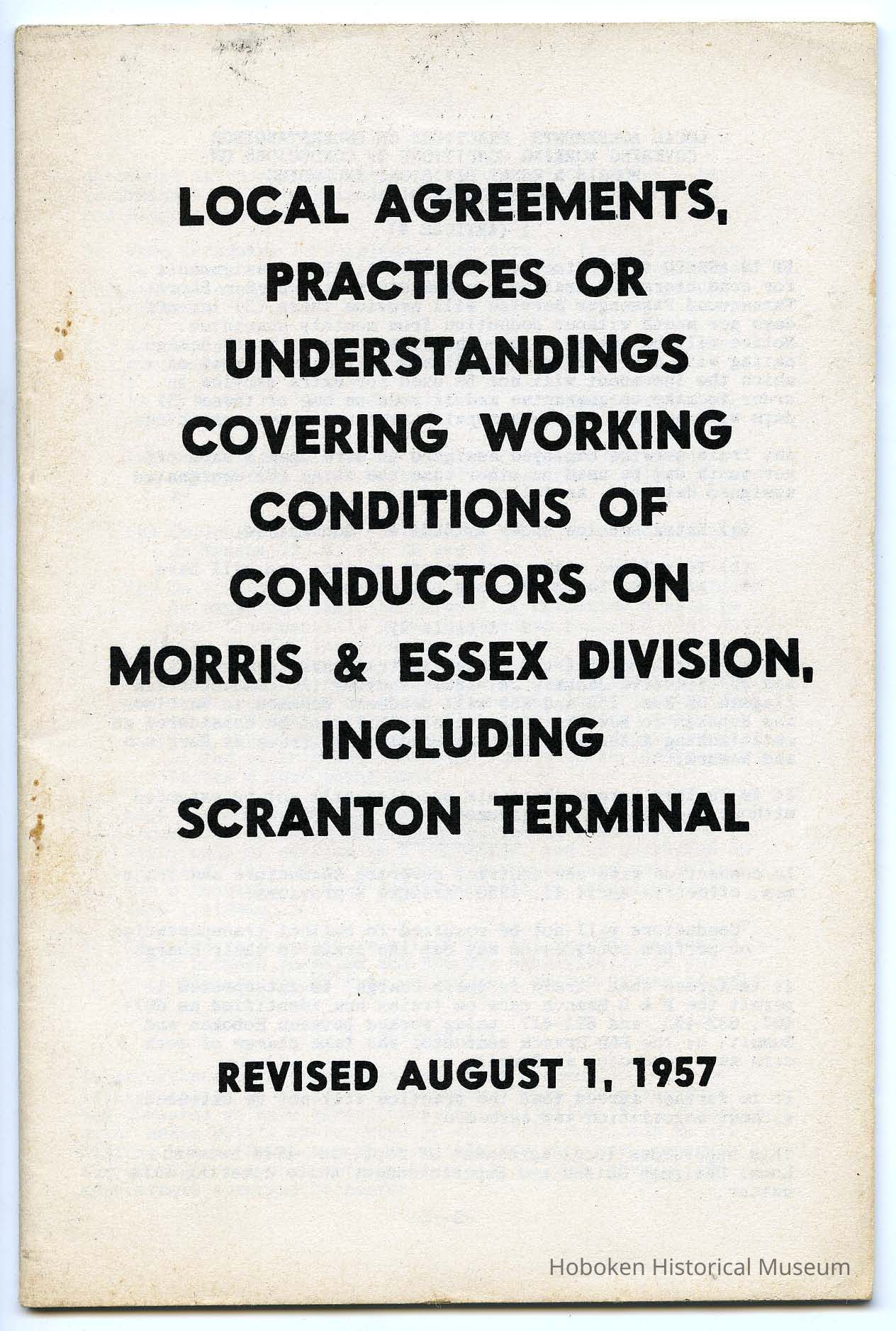
Local Agreements, Practices or Understandings Covering Working Conditions of Conductors on Morris & Essex Division, Including Scranton Terminal. 1957.
2014.013.0081
2014.013
Lukacs, Claire
Gift
Museum Collections. Gift of a friend of the Museum.
1948 - 1957
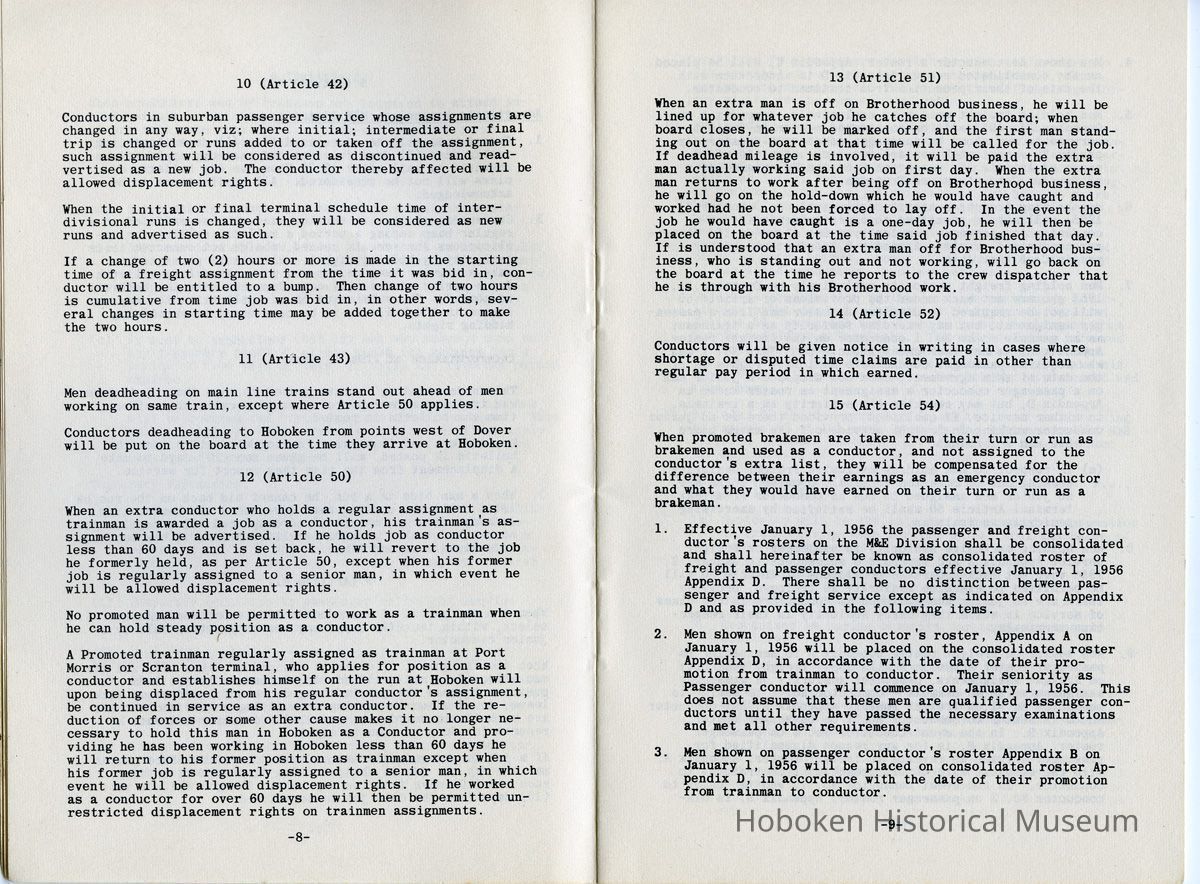
Date(s) Created: 1957 Date(s): 1948-1957
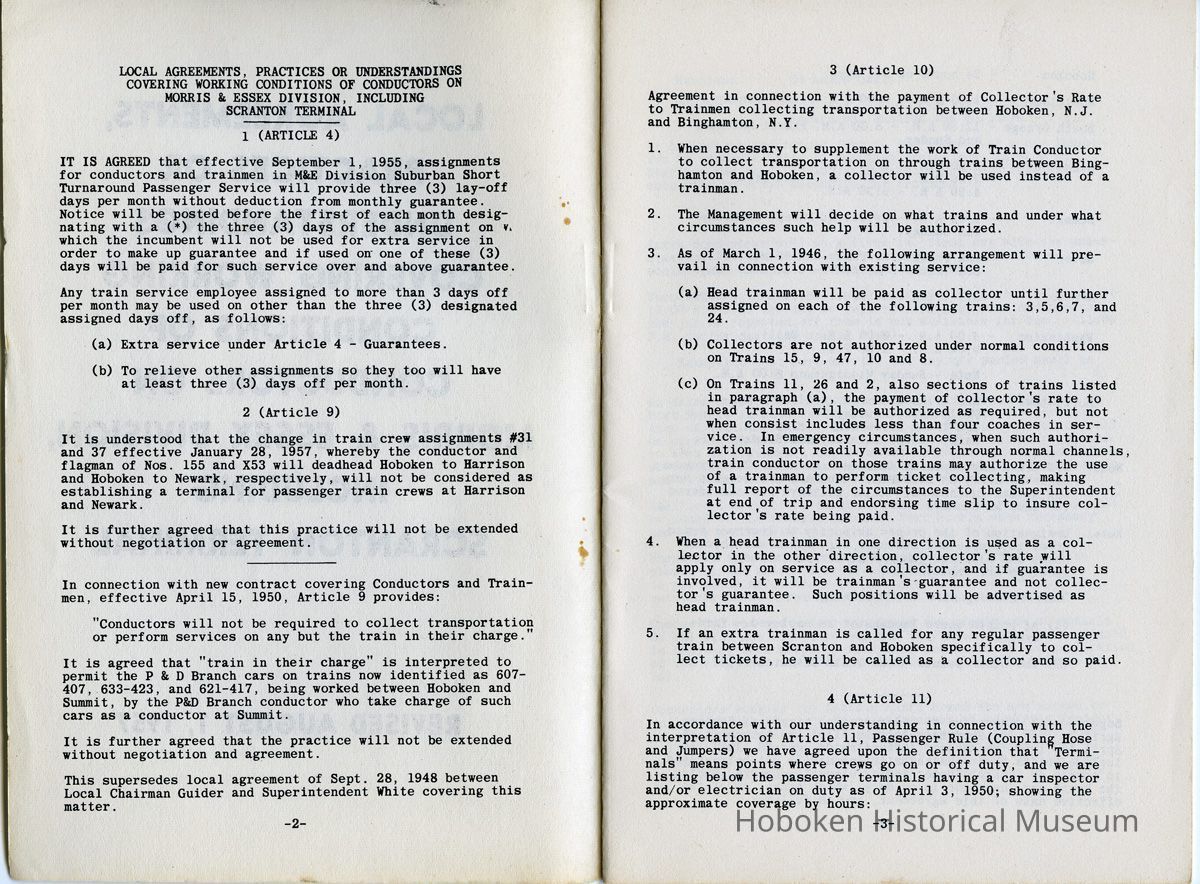
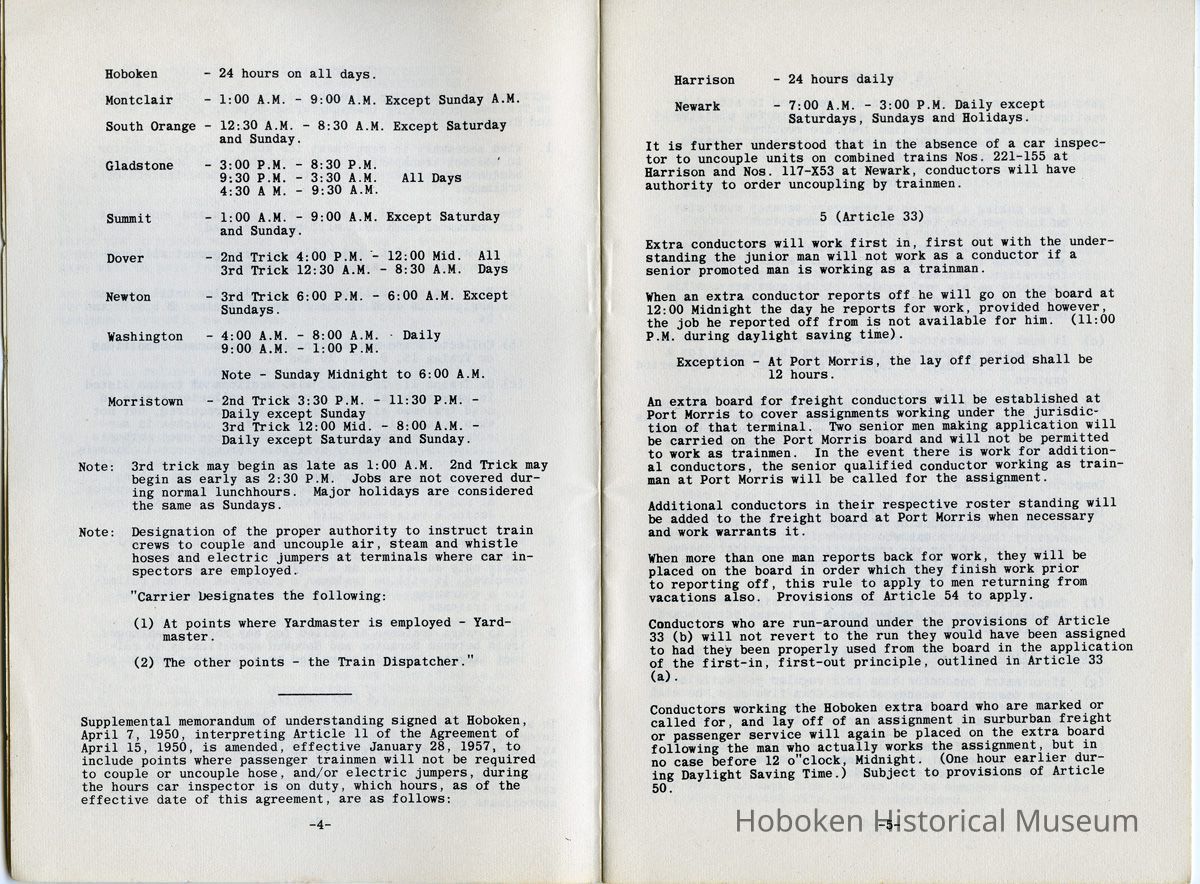
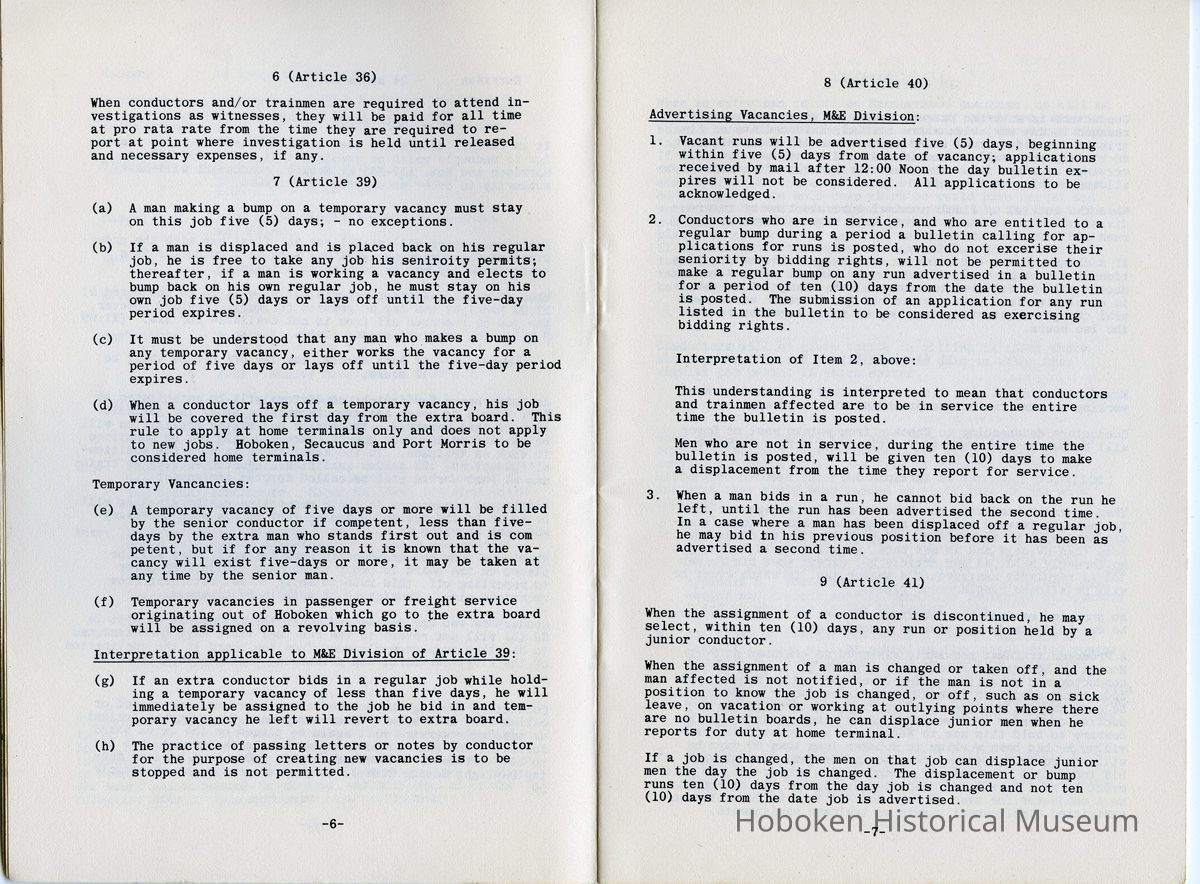
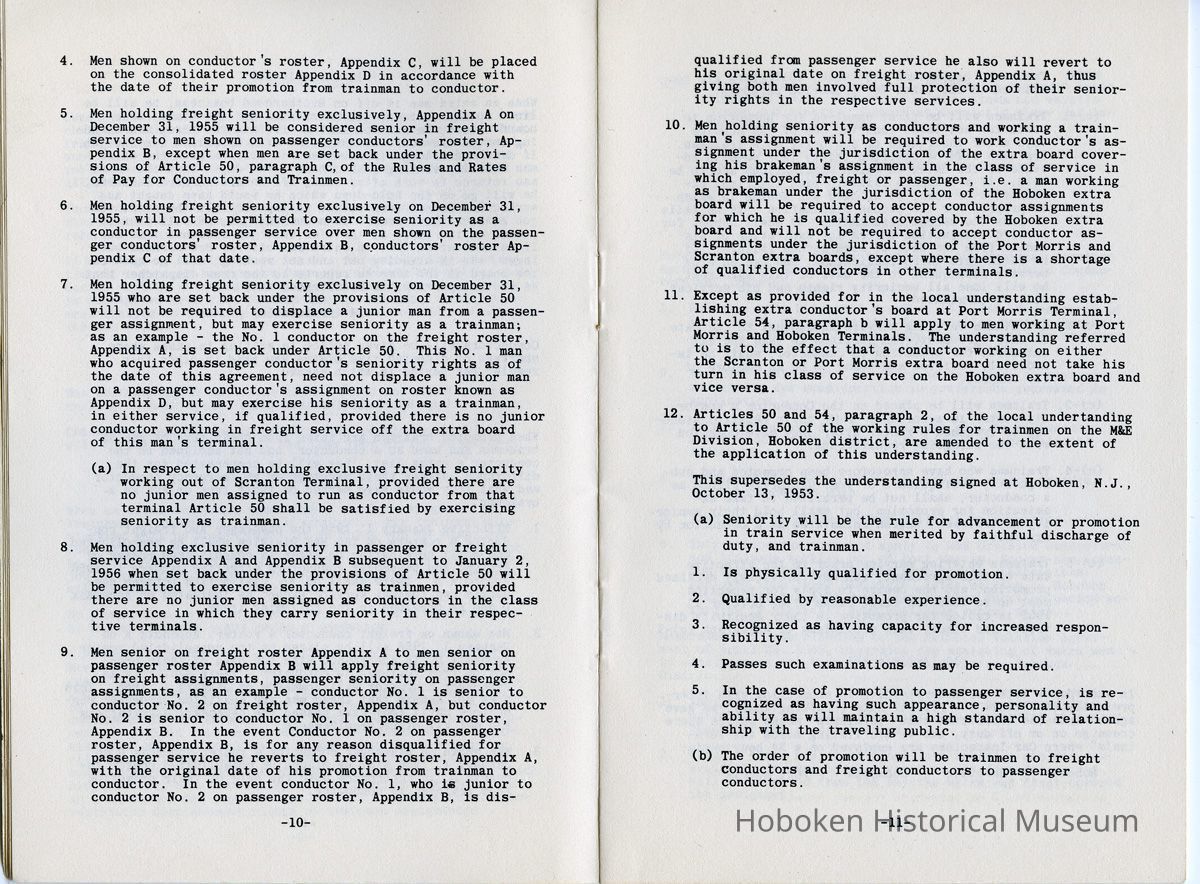
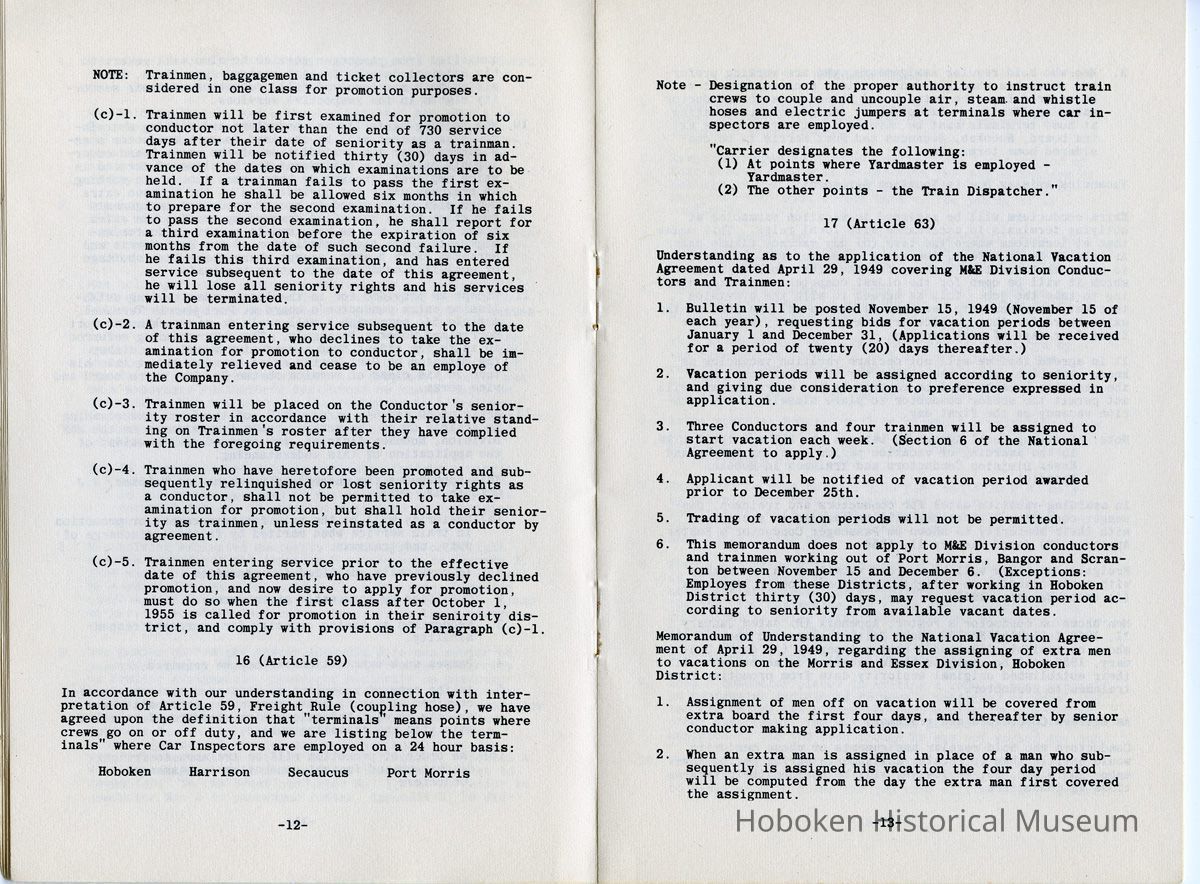
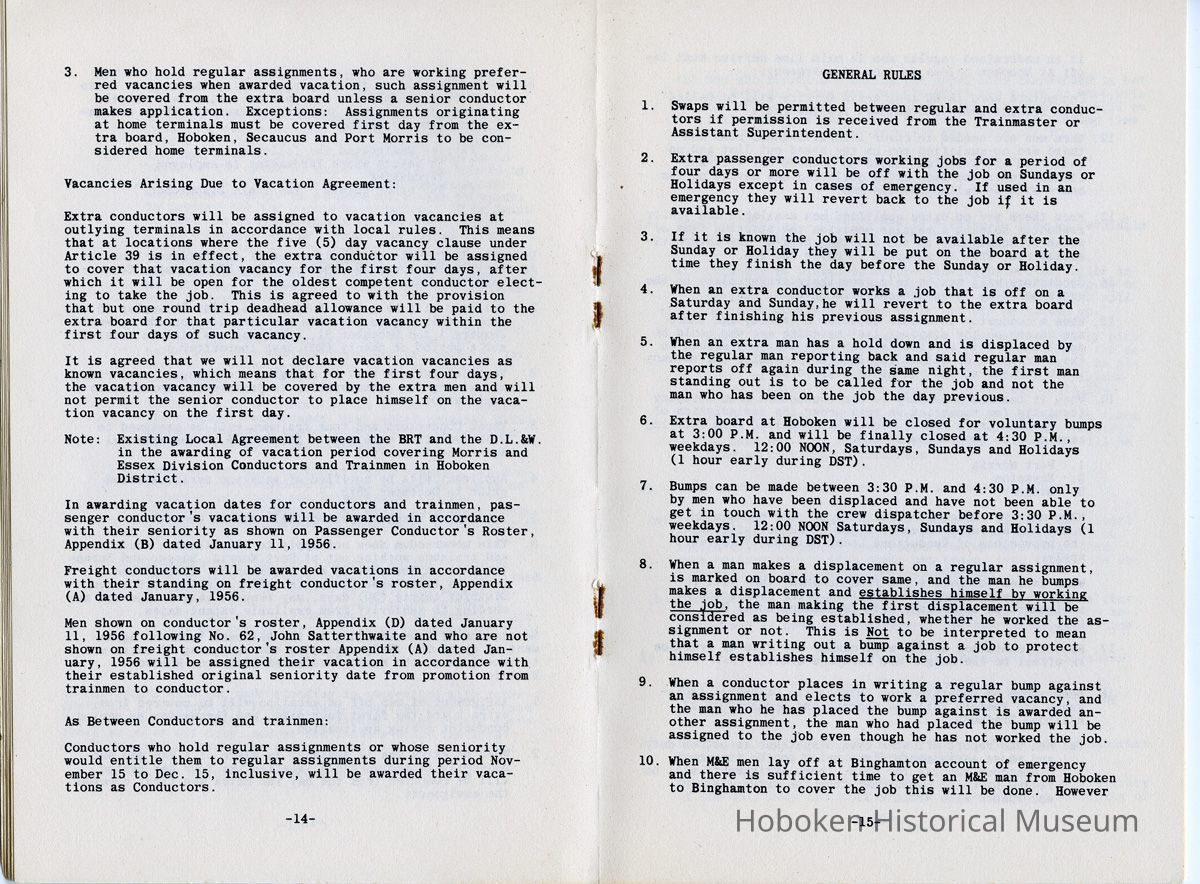
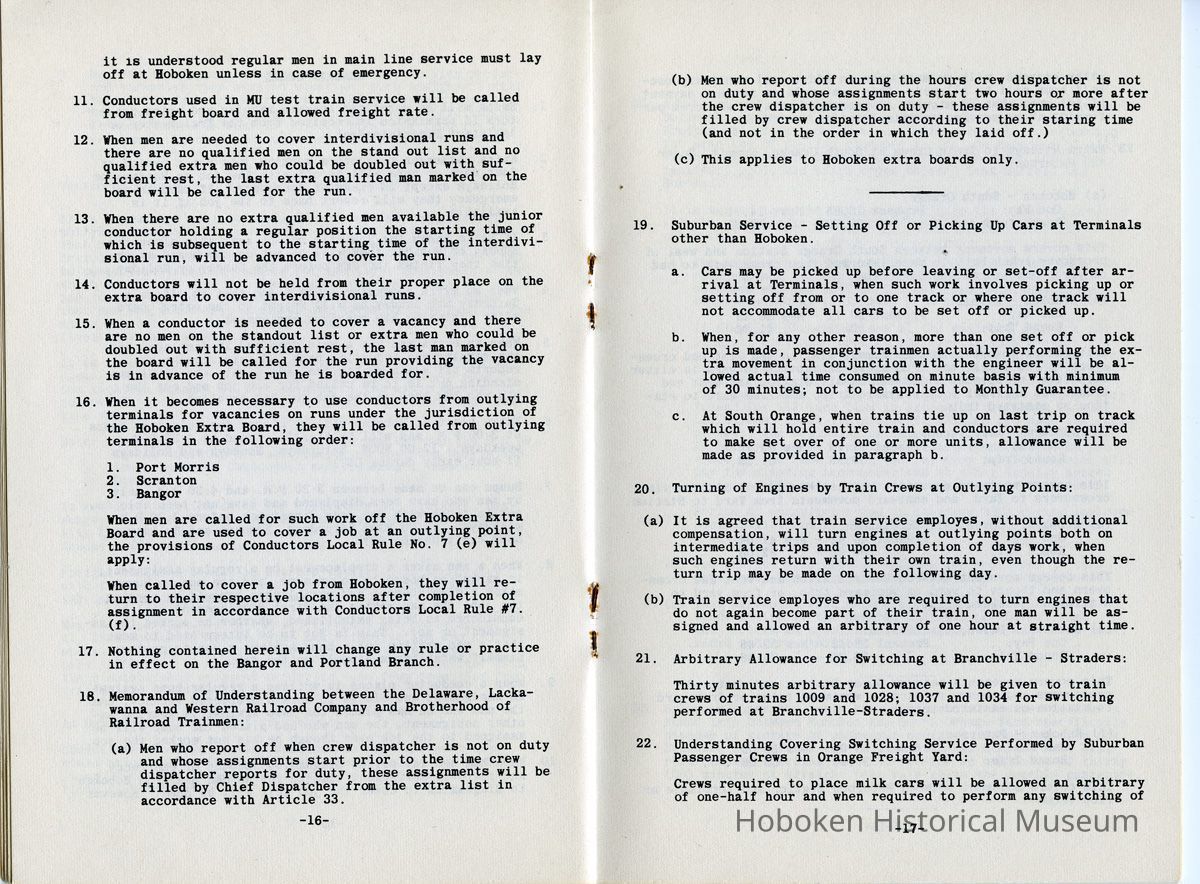
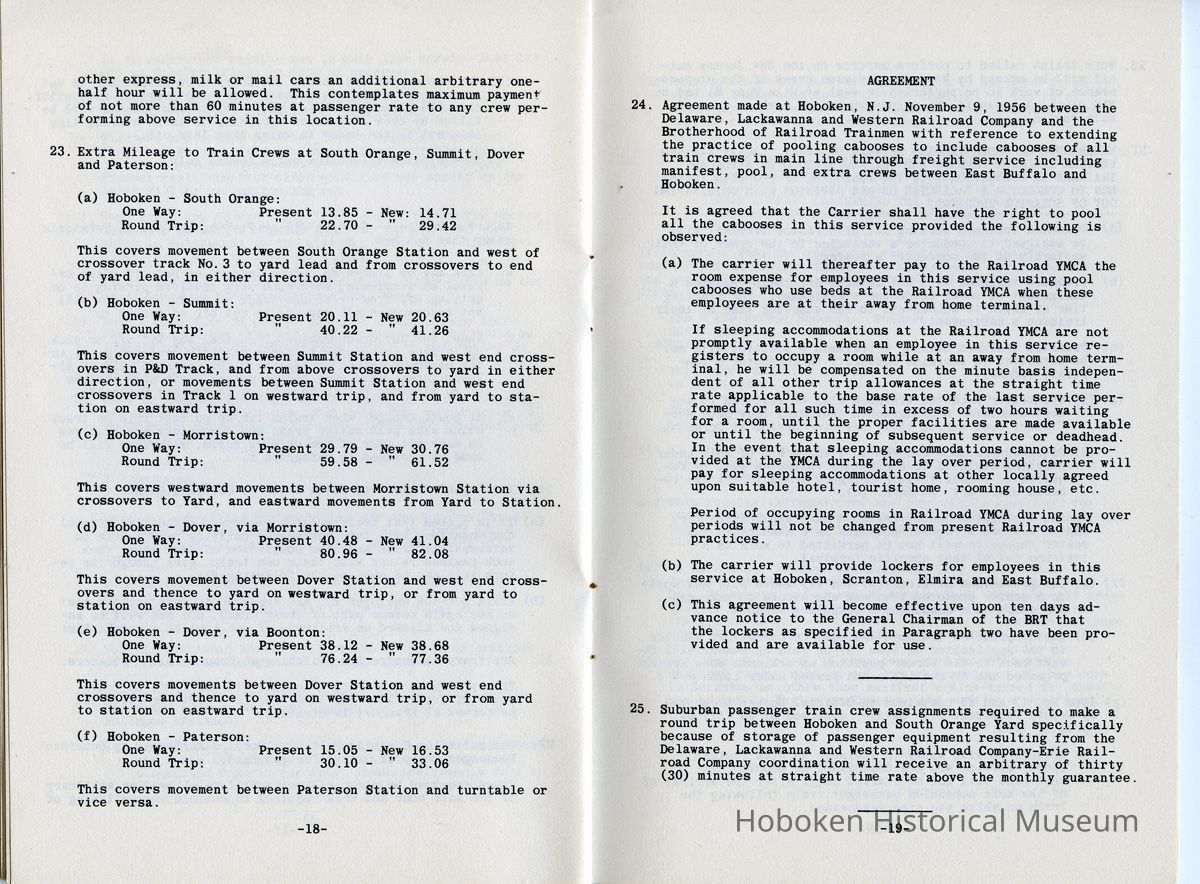
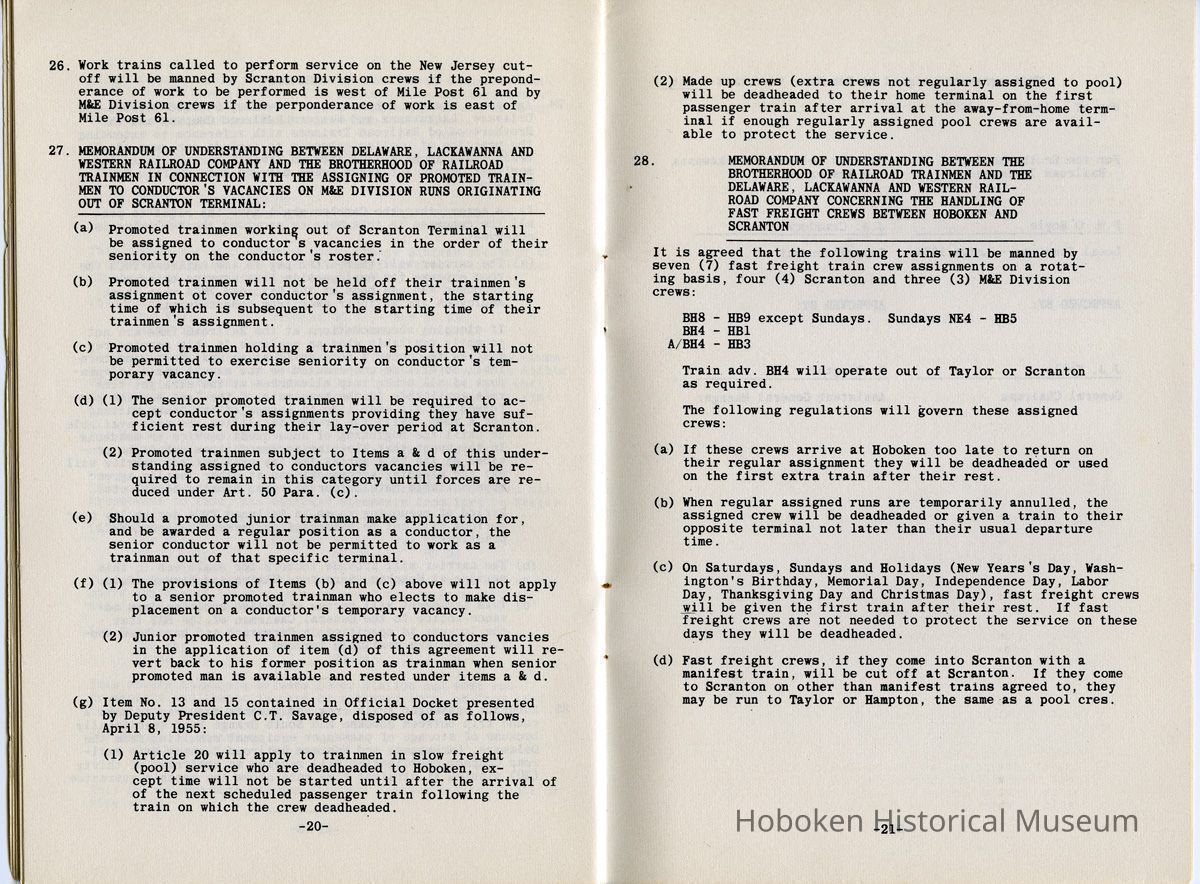
Notes: Archives 2014.013.0081 ==== [page 1 - cover] LOCAL AGREEMENTS, PRACTICES OR UNDERSTANDINGS COVERING WORKING CONDITIONS OF CONDUCTORS ON MORRIS & ESSEX DIVISION, INCLUDING SCRANTON TERMINAL Revised August 1, 1957 ==== [page 2] LOCAL AGREEMENTS, PRACTICES OR UNDERSTANDINGS COVERING WORKING CONDITIONS OF CONDUCTORS ON MORRIS & ESSEX DIVISION, INCLUDING SCRANTON TERMINAL 1 (ARTICLE 4) IT IS AGREED that effective September 1, 1955, assignments for conductors and trainmen in M&E Division Suburban Short Turnaround Passenger Service will provide three (3) lay-off days per month without deduction from monthly guarantee. Notice will be posted before the first of each month designating with a (*) the three (3) days of the assignment on which the incumbent will not be used for extra service in order to make up guarantee and if used on' one of these (3) days will be paid for such service over and above guarantee. Any train service employee assigned to more than 3 days off per month may be used on other than the three (3) designated assigned days off, as follows: (a) Extra service under Article 4 - Guarantees. (b) To relieve other assignments so they too will have at least three (3) days off per month. 2 (Article 9) It is understood that the change in train crew assignments #31 and 37 effective January 28, 1957, whereby the conductor and flagman of Nos. 155 and X53 will deadhead Hoboken to Harrison and Hoboken to Newark, respectively, will not be considered as establishing a terminal for passenger train crews at Harrison and Newark. It is further agreed that this practice will not be extended without negotiation or agreement. In connection with new contract covering Conductors and Trainmen, effective April 15, 1950, Article 9 provides: "Conductors will not be required to collect transportation or perform services on any but the train in their charge." It is agreed that "train in their charge" is interpreted to permit the P & D Branch cars on trains now identified as 607-407, 633-423, and 621-417, being worked between Hoboken and Summit, by the P&D Branch conductor who take charge of such cars as a conductor at Summit. It is further agreed that the practice will not be extended without negotiation and agreement. This supersedes local agreement of Sept. 28, 1948 between Local Chairman Guider and Superintendent White covering this matter. -2- ==== [page 3] 3 (Article 10) Agreement in connection with the payment of Collector's Rate to Trainmen collecting transportation between Hoboken, N.J. and Binghamton, N.Y. 1. When necessary to supplement the work of Train Conductor to collect transportation on through trains between Binghamton and Hoboken, a collector will be used instead of a trainman. 2. The Management will decide on what trains and under what circumstances such help will be authorized. 3. As of March 1, 1946, the following arrangement will prevail in connection with existing service: (a) Head trainman will be paid as collector until further assigned on each of the following trains: 3,5,6,7, and 24. (b) Collectors are not authorized under normal conditions on Trains 15, 9, 47, 10 and 8. (c) On Trains 11, 26 and 2, also sections of trains listed in paragraph (a), the payment of collector's rate to head trainman will be authorized as required, but not when consist includes less than four coaches in service . In emergency circumstances, when such authorization is not readily available through normal channels, train conductor on those trains may authorize the use of a trainman to perform ticket collecting, making full report of the circumstances to the Superintendent at end of trip and endorsing time slip to insure collector's rate being paid. 4. When a head trainman in one direction is used as a collector in the other direction, collector’s rate will apply only on service as a collector, and if guarantee is involved, it will be trainman's guarantee and not collector's guarantee. Such positions will be advertised as head trainman. 5. If an extra trainman is called for any regular passenger train between Scranton and Hoboken specifically to collect tickets, he will be called as a collector and so paid. 4 (Article 11) In accordance with our understanding in connection with the interpretation of Article 11, Passenger Rule (Coupling Hose and Jumpers) we have agreed upon the definition that Terminals" means points where crews go on or off duty, and we are listing below the passenger terminals having a car inspector and/or electrician on duty as of April 3, 1950; showing the approximate coverage by hours: -3- ==== [page 4] Hoboken - 24 hours on all days. Montclair - 1:00 A.M. - 9:00 A.M. Except Sunday A.M. South Orange - 12:30 A.M. - 8:30 A.M. Except Saturday and Sunday. Gladstone - 3:00 P.M. - 8:30 P.M. 9:30 P.M. - 3:30 A.M. All Days 4:30 AM.- 9:30 A.M. Summit - 1:00 A.M. - 9:00 A.M. Except Saturday and Sunday. Dover - 2nd Trick 4:00 P.M. - 12:00 Mid. All 3rd Trick 12:30 A.M. - 8:30 A.M. Days Newton - 3rd Trick 6:00 P.M. - 6:00 A.M. Except Sundays. Washington - 4:00 A.M. - 8:00 A.M. - Daily 9:00 A.M. - 1:00 P.M. Note - Sunday Midnight to 6:00 A.M. Morristown - 2nd Trick 3:30 P.M. - 11:30 P.M. - Daily except Sunday 3rd Trick 12:00 Mid. - 8:00 A.M. -Daily except Saturday and Sunday. Note: 3rd trick may begin as late as 1:00 A.M. 2nd Trick may begin as early as 2:30 P.M. Jobs are not covered during normal lunch hours. Major holidays are considered the same as Sundays. Note: Designation of the proper authority to instruct train crews to couple and uncouple air, steam and whistle hoses and electric jumpers at terminals where car inspectors are employed. "Carrier Designates the following: (1) At points where Yardmaster is employed - Yard-master . (2) The other points - the Train Dispatcher." Supplemental memorandum of understanding signed at Hoboken, April 7, 1950, interpreting Article 11 of the Agreement of April 15, 1950, is amended, effective January 28, 1957, to include points where passenger trainmen will not be required to couple or uncouple hose, and/or electric jumpers, during the hours car inspector is on duty, which hours, as of the effective date of this agreement, are as follows: -4- ==== [page 5] Harrison - 24 hours daily Newark - 7:00 A.M. - 3:00 P.M. Daily except Saturdays, Sundays and Holidays. It is further understood that in the absence of a car inspector to uncouple units on combined trains Nos. 221-155 at Harrison and Nos. 117-X53 at Newark, conductors will have authority to order uncoupling by trainmen. 5 (Article 33) Extra conductors will work first in, first out with the understanding the junior man will not work as a conductor if a senior promoted man is working as a trainman. When an extra conductor reports off he will go on the board at 12:00 Midnight the day he reports for work, provided however, the job he reported off from is not available for him. (11:00 P.M. during daylight saving time). Exception - At Port Morris, the lay off period shall be 12 hours. An extra board for freight conductors will be established at Port Morris to cover assignments working under the jurisdiction of that terminal. Two senior men making application will be carried on the Port Morris board and will not be permitted to work as trainmen. In the event there is work for additional conductors, the senior qualified conductor working as trainman at Port Morris will be called for the assignment. Additional conductors in their respective roster standing will be added to the freight board at Port Morris when necessary and work warrants it. When more than one man reports back for work, they will be placed on the board in order which they finish work prior to reporting off, this rule to apply to men returning from vacations also. Provisions of Article 54 to apply. Conductors who are run-around under the provisions of Article 33 (b) will not revert to the run they would have been assigned to had they been properly used from the board in the application of the first-in, first-out principle, outlined in Article 33 (a). Conductors working the Hoboken extra board who are marked or called for, and lay off of an assignment in surburban freight or passenger service will again be placed on the extra board following the man who actually works the assignment, but in no case before 12 o'clock, Midnight. (One hour earlier during Daylight Saving Time.) Subject to provisions of Article 50. -5- ==== [page 6] 6 (Article 36) When conductors and/or trainmen are required to attend investigations as witnesses, they will be paid for all time at pro rata rate from the time they are required to report at point where investigation is held until released and necessary expenses, if any. 7 (Article 39) (a) A man making a bump on a temporary vacancy must stay on this job five (5) days; - no exceptions. (b) If a man is displaced and is placed back on his regular job, he is free to take any job his seniroity permits; thereafter, if a man is working a vacancy and elects to bump back on his own regular job, he must stay on his own job five (5) days or lays off until the five-day period expires. (c) It must be understood that any man who makes a bump on any temporary vacancy, either works the vacancy for a period of five days or lays off until the five-day period expires. (d) When a conductor lays off a temporary vacancy, his job will be covered the first day from the extra board. This rule to apply at home terminals only and does not apply to new jobs. Hoboken, Secaucus and Port Morris to be considered home terminals. Temporary Vancancies: (e) A temporary vacancy of five days or more will be filled by the senior conductor if competent, less than five-days by the extra man who stands first out and is com petent, but if for any reason it is known that the vacancy will exist five-days or more, it may be taken at any time by the senior man. (f) Temporary vacancies in passenger or freight service originating out of Hoboken which go to the extra board will be assigned on a revolving basis. Interpretation applicable to M&E Division of Article 39: (g) If an extra conductor bids in a regular job while holding a temporary vacancy of less than five days, he will immediately be assigned to the job he bid in and temporary vacancy he left will revert to extra board. (h) The practice of passing letters or notes by conductor for the purpose of creating new vacancies is to be stopped and is not permitted. -6- ==== [page 7] 8 (Article 40) Advertising Vacancies, M&E Division: 1. Vacant runs will be advertised five (5) days, beginning within five (5) days from date of vacancy; applications received by mail after 12:00 Noon the day bulletin expires will not be considered. All applications to be acknowledged. 2. Conductors who are in service, and who are entitled to a regular bump during a period a bulletin calling for applications for runs is posted, who do not exercise their seniority by bidding rights, will not be permitted to make a regular bump on any run advertised in a bulletin for a period of ten (10) days from the date the bulletin is posted. The submission of an application for any run listed in the bulletin to be considered as exercising bidding rights. Interpretation of Item 2, above: This understanding is interpreted to mean that conductors and trainmen affected are to be in service the entire time the bulletin is posted. Men who are not in service, during the entire time the bulletin is posted, will be given ten (10) days to make a displacement from the time they report for service. 3. When a man bids in a run, he cannot bid back on the run he left, until the run has been advertised the second time. In a case where a man has been displaced off a regular job, he may bid tn his previous position before it has been as advertised a second time. 9 (Article 41) When the assignment of a conductor is discontinued, he may select, within ten (10) days, any run or position held by a junior conductor. When the assignment of a man is changed or taken off, and the man affected is not notified, or if the man is not in a position to know the job is changed, or off, such as on sick leave, on vacation or working at outlying points where there are no bulletin boards, he can displace junior men when he reports for duty at home terminal. If a job is changed, the men on that job can displace junior men the day the job is changed. The displacement or bump runs ten (10) days from the day job is changed and not ten (10) days from the date job is advertised. -7- ==== [page 8] 10 (Article 42) Conductors in suburban passenger service whose assignments are changed in any way, viz; where initial; intermediate or final trip is changed or runs added to or taken off the assignment, such assignment will be considered as discontinued and readvertised as a new job. The conductor thereby affected will be allowed displacement rights. When the initial or final terminal schedule time of inter-divisional runs is changed, they will be considered as new runs and advertised as such. If a change of two (2) hours or more is made in the starting time of a freight assignment from the time it was bid in, conductor will be entitled to a bump. Then change of two hours is cumulative from time job was bid in, in other words, several changes in starting time may be added together to make the two hours. 11 (Article 43) Men deadheading on main line trains stand out ahead of men working on same train, except where Article 50 applies. Conductors deadheading to Hoboken from points west of Dover will be put on the board at the time they arrive at Hoboken. 12 (Article 50) When an extra conductor who holds a regular assignment as trainman is awarded a job as a conductor, his trainman's assignment will be advertised. If he holds job as conductor less than 60 days and is set back, he will revert to the job he formerly held, as per Article 50, except when his former job is regularly assigned to a senior man, in which event he will be allowed displacement rights. No promoted man will be permitted to work as a trainman when he can hold steady position as a conductor. A Promoted trainman regularly assigned as trainman at Port Morris or Scranton terminal, who applies for position as a conductor and establishes himself on the run at Hoboken will upon being displaced from his regular conductor's assignment, be continued in service as an extra conductor. If the reduction of forces or some other cause makes it no longer necessary to hold this man in Hoboken as a Conductor and providing he has been working in Hoboken less than 60 days he will return to his former position as trainman except when his former job is regularly assigned to a senior man, in which event he will be allowed displacement rights. If he worked as a conductor for over 60 days he will then be permitted unrestricted displacement rights on trainmen assignments. -8- ==== [page 9] 13 (Article 51) When an extra man is off on Brotherhood business, he will be lined up for whatever job he catches off the board; when board closes, he will be marked off, and the first man standing out on the board at that time will be called for the job. If deadhead mileage is involved, it will be paid the extra man actually working said job on first day. When the extra man returns to work after being off on Brotherhood business, he will go on the hold-down which he would have caught and worked had he not been forced to lay off. In the event the job he would have caught is a one-day job, he will then be placed on the board at the time said job finished that day. If is understood that an extra man off for Brotherhood business, who is standing out and not working, will go back on the board at the time he reports to the crew dispatcher that he is through with his Brotherhood work. 14 (Article 52) Conductors will be given notice in writing in cases where shortage or disputed time claims are paid in other than regular pay period in which earned. 15 (Article 54) When promoted brakemen are taken from their turn or run as brakemen and used as a conductor, and not assigned to the conductor's extra list, they will be compensated for the difference between their earnings as an emergency conductor and what they would have earned on their turn or run as a brakeman. 1. Effective January 1, 1956 the passenger and freight conductor's rosters on the M&E Division shall be consolidated and shall hereinafter be known as consolidated roster of freight and passenger conductors effective January 1, 1956 Appendix D. There shall be no distinction between passenger and freight service except as indicated on Appendix D and as provided in the following items. 2. Men shown on freight conductor's roster, Appendix A on January 1, 1956 will be placed on the consolidated roster Appendix D, in accordance with the date of their promotion from trainman to conductor. Their seniority as Passenger conductor will commence on January 1, 1956. This does not assume that these men are qualified passenger conductors until they have passed the necessary examinations and met all other requirements. 3. Men shown on passenger conductor's roster Appendix B on January 1, 1956 will be placed on consolidated roster Appendix D, in accordance with the date of their promotion from trainman to conductor. -9- ==== [page 10] 4. Men shown on conductor's roster, Appendix C, will be placed on the consolidated roster Appendix D in accordance with the date of their promotion from trainman to conductor. 5. Men holding freight seniority exclusively, Appendix A on December 31, 1955 will be considered senior in freight service to men shown on passenger conductors’ roster, Appendix B, except when men are set back under the provisions of Article 50, paragraph C, of the Rules and Rates of Pay for Conductors and Trainmen. 6. Men holding freight seniority exclusively on December 31, 1955, will not be permitted to exercise seniority as a conductor in passenger service over men shown on the passenger conductors' roster, Appendix B, conductors' roster Appendix C of that date. 7. Men holding freight seniority exclusively on December 31, 1955 who are set back under the provisions of Article 50 will not be required to displace a junior man from a passenger assignment, but may exercise seniority as a trainman; as an example - the No. 1 conductor on the freight roster, Appendix A, is set back under Article 50. This No. 1 man who acquired passenger conductor's seniority rights as of the date of this agreement, need not displace a junior man on a passenger conductor's assignment on roster known as Appendix D, but may exercise his seniority as a trainman, in either service, if qualified, provided there is no junior conductor working in freight service off the extra board of this man's terminal. (a) In respect to men holding exclusive freight seniority working out of Scranton Terminal, provided there are no junior men assigned to run as conductor from that terminal Article 50 shall be satisfied by exercising seniority as trainman. 8. Men holding exclusive seniority in passenger or freight service Appendix A and Appendix B subsequent to January 2, 1956 when set back under the provisions of Article 50 will be permitted to exercise seniority as trainmen, provided there are no junior men assigned as conductors in the class of service in which they carry seniority in their respective terminals. 9. Men senior on freight roster Appendix A to men senior on passenger roster Appendix B will apply freight seniority on freight assignments, passenger seniority on passenger assignments, as an example - conductor No. 1 is senior to conductor No. 2 on freight roster, Appendix A, but conductor No. 2 is senior to conductor No. 1 on passenger roster, Appendix B. In the event Conductor No. 2 on passenger roster, Appendix B, is for any reason disqualified for passenger service he reverts to freight roster, Appendix A, with the original date of his promotion from trainman to conductor. In the event conductor No. 1, who is junior to conductor No. 2 on passenger roster, Appendix B, is dis- -10- ==== [page 11] qualified from passenger service he also will revert to his original date on freight roster, Appendix A, thus giving both men involved full protection of their seniority rights in the respective services. 10. Men holding seniority as conductors and working a trainman 's assignment will be required to work conductor's assignment under the jurisdiction of the extra board covering his brakeman's assignment in the class of service in which employed, freight or passenger, i.e. a man working as brakeman under the jurisdiction of the Hoboken extra board will be required to accept conductor assignments for which he is qualified covered by the Hoboken extra board and will not be required to accept conductor assignments under the jurisdiction of the Port Morris and Scranton extra boards, except where there is a shortage of qualified conductors in other terminals. 11. Except as provided for in the local understanding establishing extra conductor's board at Port Morris Terminal, Article 54, paragraph b will apply to men working at Port Morris and Hoboken Terminals. The understanding referred to is to the effect that a conductor working on either the Scranton or Port Morris extra board need not take his turn in his class of service on the Hoboken extra board and vice versa. 12. Articles 50 and 54, paragraph 2, of the local undertanding to Article 50 of the working rules for trainmen on the M&E Division, Hoboken district, are amended to the extent of the application of this understanding. This supersedes the understanding signed at Hoboken, N.J., October 13, 1953. (a) Seniority will be the rule for advancement or promotion in train service when merited by faithful discharge of duty, and trainman. 1. Is physically qualified for promotion. 2. Qualified by reasonable experience. 3. Recognized as having capacity for increased responsibility . 4. Passes such examinations as may be required. 5. In the case of promotion to passenger service, is recognized as having such appearance, personality and ability as will maintain a high standard of relationship with the traveling public. (b) The order of promotion will be trainmen to freight conductors and freight conductors to passenger conductors. -11- ==== [page 12] NOTE: Trainmen, baggagemen and ticket collectors are considered in one class for promotion purposes. (c)-1. Trainmen will be first examined for promotion to conductor not later than the end of 730 service days after their date of seniority as a trainman. Trainmen will be notified thirty (30) days in advance of the dates on which examinations are to be held. If a trainman fails to pass the first examination he shall be allowed six months in which to prepare for the second examination. If he fails to pass the second examination, he shall report for a third examination before the expiration of six months from the date of such second failure. If he fails this third examination, and has entered service subsequent to the date of this agreement, he will lose all seniority rights and his services will be terminated. (c)-2. A trainman entering service subsequent to the date of this agreement, who declines to take the examination for promotion to conductor, shall be immediately relieved and cease to be an employe of the Company. (c)-3. Trainmen will be placed on the Conductor’s seniority roster in accordance with their relative standing on Trainmen's roster after they have complied with the foregoing requirements. (c)-4. Trainmen who have heretofore been promoted and subsequently relinquished or lost seniority rights as a conductor, shall not be permitted to take examination for promotion, but shall hold their senior ity as trainmen, unless reinstated as a conductor by agreement. (c)-5. Trainmen entering service prior to the effective date of this agreement, who have previously declined promotion, and now desire to apply for promotion, must do so when the first class after October 1, 1955 is called for promotion in their seniroity district, and comply with provisions of Paragraph (c)-1. 16 (Article 59) In accordance with our understanding in connection with interpretation of Article 59, Freight Rule (coupling hose), we have agreed upon the definition that "terminals' means points where crews go on or off duty, and we are listing below the terminals" where Car Inspectors are employed on a 24 hour basis: Hoboken Harrison Secaucus Port Morris -12- ==== [page 13] Note - Designation of the proper authority to instruct train crews to couple and uncouple air, steam, and whistle hoses and electric jumpers at terminals where car inspectors are employed. "Carrier designates the following: (1) At points where Yardmaster is employed -Yardmaster. (2) The other points - the Train Dispatcher." 17 (Article 63) Understanding as to the application of the National Vacation Agreement dated April 29, 1949 covering M&E Division Conductors and Trainmen: 1. Bulletin will be posted November 15, 1949 (November 15 of each year), requesting bids for vacation periods between January 1 and December 31, (Applications will be received for a period of twenty (20) days thereafter.) 2. Vacation periods will be assigned according to seniority, and giving due consideration to preference expressed in application. 3. Three Conductors and four trainmen will be assigned to start vacation each week. (Section 6 of the National Agreement to apply.) 4. Applicant will be notified of vacation period awarded prior to December 25th. 5. Trading of vacation periods will not be permitted. 6. This memorandum does not apply to M&E Division conductors and trainmen working out of Port Morris, Bangor and Scranton between November 15 and December 6. (Exceptions: Employes from these Districts, after working in Hoboken District thirty (30) days, may request vacation period according to seniority from available vacant dates. Memorandum of Understanding to the National Vacation Agreement of April 29, 1949, regarding the assigning of extra men to vacations on the Morris and Essex Division, Hoboken District: 1. Assignment of men off on vacation will be covered from extra board the first four days, and thereafter by senior conductor making application. 2. When an extra man is assigned in place of a man who subsequently is assigned his vacation the four day period will be computed from the day the extra man first covered the assignment. -13- ==== [page 14] 3. Men who hold regular assignments, who are working preferred vacancies when awarded vacation, such assignment will be covered from the extra board unless a senior conductor makes application. Exceptions: Assignments originating at home terminals must be covered first day from the extra board, Hoboken, Secaucus and Port Morris to be considered home terminals. Vacancies Arising Due to Vacation Agreement: Extra conductors will be assigned to vacation vacancies at outlying terminals in accordance with local rules. This means that at locations where the five (5) day vacancy clause under Article 39 is in effect, the extra conductor will be assigned to cover that vacation vacancy for the first four days, after which it will be open for the oldest competent conductor electing to take the job. This is agreed to with the provision that but one round trip deadhead allowance will be paid to the extra board for that particular vacation vacancy within the first four days of such vacancy. It is agreed that we will not declare vacation vacancies as known vacancies, which means that for the first four days, the vacation vacancy will be covered by the extra men and will not permit the senior conductor to place himself on the vacation vacancy on the first day. Note: Existing Local Agreement between the BRT and the D.L.&W. in the awarding of vacation period covering Morris and Essex Division Conductors and Trainmen in Hoboken District. In awarding vacation dates for conductors and trainmen, passenger conductor's vacations will be awarded in accordance with their seniority as shown on Passenger Conductor's Roster, Appendix (B) dated January 11, 1956. Freight conductors will be awarded vacations in accordance with their standing on freight conductor's roster, Appendix (A) dated January, 1956. Men shown on conductor's roster, Appendix (D) dated January 11, 1956 following No. 62, John Satterthwaite and who are not shown on freight conductor's roster Appendix (A) dated January, 1956 will be assigned their vacation in accordance with their established original seniority date from promotion from trainmen to conductor. As Between Conductors and trainmen: Conductors who hold regular assignments or whose seniority would entitle them to regular assignments during period November 15 to Dec. 15, inclusive, will be awarded their vacations as Conductors. -14- ==== [page 15] GENERAL RULES 1. Swaps will be permitted between regular and extra conductors if permission is received from the Trainmaster or Assistant Superintendent. 2. Extra passenger conductors working jobs for a period of four days or more will be off with the job on Sundays or Holidays except in cases of emergency. If used in an emergency they will revert back to the job if it is available. 3. If it is known the job will not be available after the Sunday or Holiday they will be put on the board at the time they finish the day before the Sunday or ... [truncated due to length]
![pg [1] front cover](https://d8e7jbdw4fu0e.cloudfront.net/11047/c8e6e9a0-fb5d-11ed-a641-b3912f9925a9-wx0aUtz.lg@2x.jpg)
![pg 22 [end]](https://d8e7jbdw4fu0e.cloudfront.net/11047/d6062290-fb5d-11ed-a641-b3912f9925a9-wx0aUtz.lg@2x.jpg)