Collections Item Detail
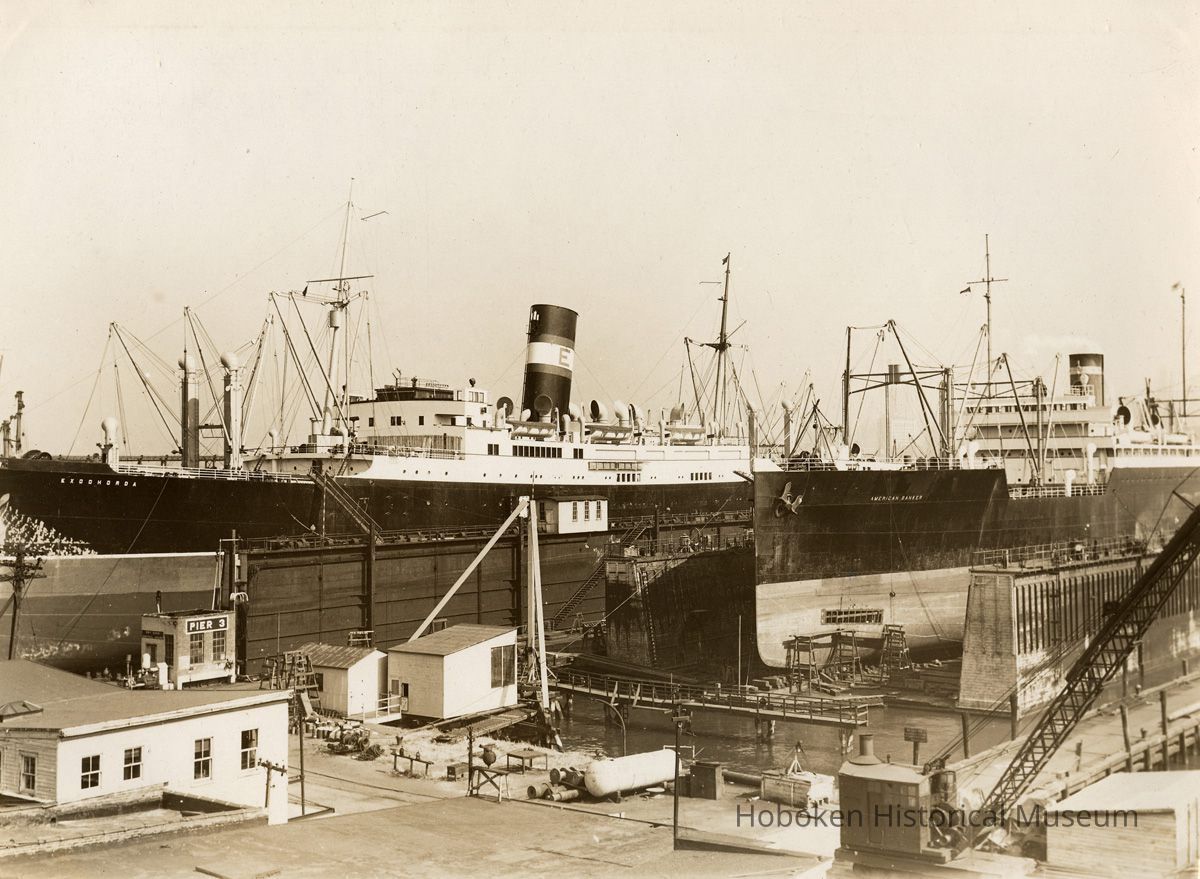
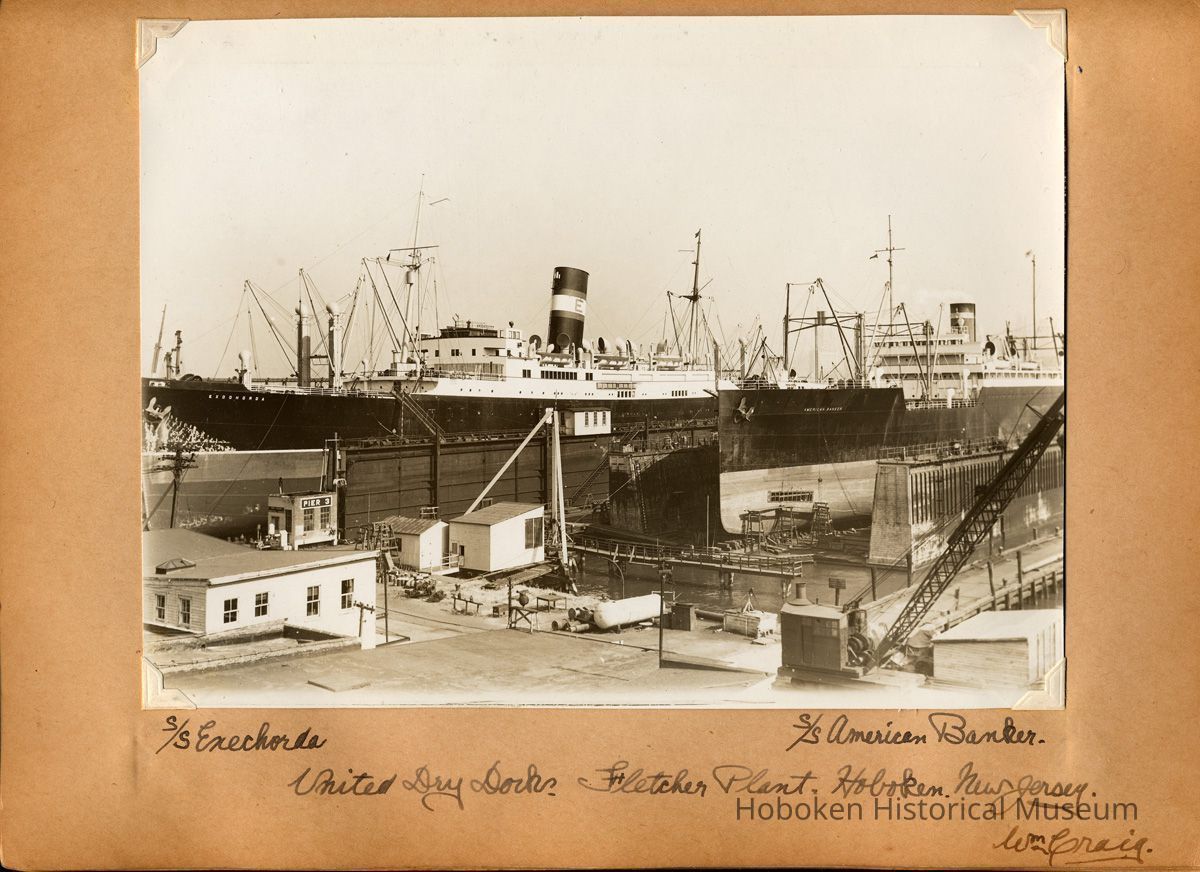
Image: S.S. Exochorda & S.S. American Banker in dry docks at United Dry Docks, Fletcher Plant, Hoboken, N.J., no date, ca. 1935-38.
2002.209.0011
2002.209
Grabowski, Craig
Donation
The William Craig Archive - Gift of Craig Grabowski.
Craig, William
1935 - 1938
Date: 1935-1938
8 in
10 in
Display Value: Fair Notes: This is G o o g l e's cache of http://www.ussharrylee.com/History.htm. G o o g l e's cache is the snapshot that we took of the page as we crawled the web. The page may have changed since that time. To link to or bookmark this page, use the following url: http://www.google.com/search?q=cache:XkLW1-TW6TAC:www.ussharrylee.com/History.htm++%22american+export+lines%22&hl=en&ie=UTF-8 Google is not affiliated with the authors of this page nor responsible for its content. These search terms have been highlighted: american export lines -------------------------------------------------------------------------------- Whatever Happened to the Harry Lee? The USS Harry Lee had a varied career both before and after its stint in the U.S. Navy. Built in 1931 by the New York Shipbuilding Company in Camden, New Jersey, the ship was originally a commercial supply ship which sailed under the houseflag of American Export Lines as the Exochorda. She plied the New York-Mediterranean run until 1940, when she was acquired by the U.S. Navy and sailed as the transport Harry Lee. The Lee's career in the Navy ended in 1946 when she was declared surplus and was returned to American Export, which again named her Exochorda, then quickly sold her to the Turkish government. Renamed Tarsus by her new owners, she disappeared from the maritime world for three years. After an extensive refit at Bethlehem Steel Company's yard in Baltimore during 1949-50 that saw her passenger capacity increase from 140 to 465, the Tarsus was ready to resume her pre-war sailings between New York and Istanbul, but under the houseflag of Turkish Maritime Lines. Only three round voyages were made by the Tarsus, the first in 1951, the second in 1954, and the third in 1955. It can only be presumed that her transatlantic activities were not financially successful. After the third voyage, she was confined to trading in the Mediterranean. The Disaster On December 14, 1960, the Yugoslav tanker, Peter Zoranic was sailing through the Bosphorus ladened with gasoline and kerosene. About midway through, she crashed into the empty Greek tanker, World Harmony sailing from the Sea of Marmara to the Black Sea. A tremendous fire broke out on the Peter Zoranic, and several explosions occurred aboard the Greek Tanker. After the collision, the Yugoslav tanker, burning fiercely and out of control, started to drift with the current across the Strait. The Peter Zoranic collided with the Tarsus, which was anchored outside a dry dock awaiting repairs. The fire spread from the tanker to the Tarsus and she was completely destroyed. More information can be found in the short biography, The Harry Lee, Biography of an Attack Transport Ship in W.W.II, by Dr. Steven J. Waszak ==== ==== This is G o o g l e's cache of http://www.waszak.com/harrylee.htm. G o o g l e's cache is the snapshot that we took of the page as we crawled the web. The page may have changed since that time. To link to or bookmark this page, use the following url: http://www.google.com/search?q=cache:7tELatG1KssC:www.waszak.com/harrylee.htm++%22american+export+lines%22&hl=en&ie=UTF-8 Google is not affiliated with the authors of this page nor responsible for its content. These search terms have been highlighted: american export lines _____________________________________________ The U.S.S. Harry Lee Biography of an Attack Transport Ship in WWII The U.S.S. Harry Lee was built as the passenger ship Exochorda by New York Shipbuilding Co., Camden, New Jersey in 1931 and operated in the Mediterranean area for American Export Lines. The ship was acquired by the Navy on October 30, 1940. She was converted at Tietjen and Lang Dry Dock Company, Hoboken, N.J., and commissioned the Harry Lee (AP17) on December 27, 1940, with Captain R. P. Hinrichs in command. The Harry Lee was redesignated APA-10, on February 1, 1943. after she underwent further wartime modifications. The USS Harry Lee under way Vital Statistics Displacement: 9,989 tons Length: 475' 4" Beam: 61' 6" Draft: 25' 4" Armament as AP17: 4 x 40 mm guns Speed: 16 knots Compliment: 453 Armament as APA10: 4 x 40 mm guns one 6" gun mounted forward one 6" gun mounted aft Commissioned Service The USS Harry Lee spent the first few months of her commissioned service transporting Marine combat units to the Caribbean for training exercises, helping to build the amphibious teams which were to find such great success in the later stages of World War II. After a stay at Norfolk, the transport was assigned in July to the Iceland route, carrying troops and supplies to that country from Norfolk and New York. After making two such passages, she returned to Boston on December 22, 1941, to take part in additional training exercises. With America then in the war, the Harry Lee spent the next 18 months in amphibious maneuvers in the Caribbean area. During this time training exercises were carried out in landing craft and boat control procedures, all of which bore fruit in the dangerous months to come. Mediterranean Fleet Service. Returning to Boston on April 6, 1943, the Harry Lee was designated for use in the upcoming offensive in the Mediterranean, and sailed June 8, 1943, for Algeria. She anchored at Oran on June 22, 1943 to prepare for the landing and she found herself off the southwest coast of Sicily on July 10, 1943, with Vice Admiral Hewitt's Western Naval Task Force. During these giant invasions the Harry Lee debarked her troops through the heavy surf at Scoglitti and withstood several Axis air attacks before retiring two days later. Pacific Fleet Service 1943. After the success of the Sicilian operation, the transport returned German prisoners of war to the United States, arriving at Norfolk on August 3, 1943. It was then decided that her amphibious prowess was needed in the Pacific and she sailed August 24, 1943 for Wellington, New Zealand, via the Panama Canal and San Francisco, arriving October 12, 1943. At Wellington, the Harry Lee loaded Marines in preparation for the big push of the invasion of the Gilbert Islands. She proceeded to Efate, New Hebrides, November 1-7, 1943, and for the next few weeks held amphibious practice landings in preparation for the landings on Tarawa. The transport departed for Tarawa on November 13, 1943, and arrived offshore on November 20, 1943. There she launched her Marines onto the bloody beaches, under threat of submarine attack and air attack and sailed the next day for Pearl Harbor. 1944 The Harry Lee participated in rehearsal landings in Hawaiian waters after her arrival at Pearl Harbor on December 7, 1943, the second anniversary of the Japanese attack on Pearl Harbor, and sailed January 23, 1944 for the invasion of the Marshall Islands, next step on the island road to Japan. She arrived off Kwajalein on January 31, 1944. She effectively carried out her role in this complicated operation by landing troops on two small islands in the atoll; they met little opposition. The Harry Lee remained off Kwajalein until departing for Funafuti on February 5, 1944. From there she sailed to Noumea on February 24, 1944 and by March 14, 1944, she was anchored off Guadalcanal to load troops and continue her amphibious preparation. After carrying troops to Bougainville and New Guinea in April, the Harry Lee sailed to Aitape, New Guinea, under Rear Admiral Barbey for the Hollandia operation. She arrived April, 23, 1944, after the initial assault, unloaded her troops, and proceeded to bring reinforcements from other points in New Guinea to the landing area. This accomplished, the transport arrived in Espirtu Santo on May 11, 1944. The Harry Lee was next to take part in the invasion of the Marianas. After landing operations conducted around Guadalcanal the ship sailed to Kwajalein and got underway in convoy for Guam on June 12, 1944. During this gigantic operation, in which troops were projected over 1,000 miles of ocean from the nearest advance base, the Harry Lee was held in reserve for the Guam landings. She arrived off Agat, Guam, on July 21, 1944 and debarked her troops. The transport then remained offshore loading and relanding troops for tactical purposes until July 25, 1944, when she steamed with her fellow transports to Eniwetok. They arrived on July 29, 1944, and two days later sailed for Pearl Harbor. Arriving Pearl Harbor on August 7, 1944, the Harry Lee set course for California and a much-needed overhaul. She arrived San Pedro on August 18, 1944 and remained in California until departing on October 21, 1944, with troops for Seeadler Harbor, Manus. Until December 31, 1944, the ship conducted practice landings in New Guinea and the Solomons for the upcoming invasion of Luzon, in the Phillipines, and departed the last day of 1944 for Lingayan Gulf. Enroute, Japanese planes attacked the task force savagely with suicide planes and bombers, but the Harry Lee by effective gunfire and luck escaped damage. 1945 She entered Lingayen Gulf on January 9, 1945, and began landing troops under constant air alert. That night the transports retired off the beaches under smoke screens, returning the next day to resume the dangerous job of landing supplies. Harry Lee sailed on January 10, 1945, for Leyte Gulf, anchoring there on January 14, 1945. With troops ashore at Lingayen, the Harry Lee departed on January 19, 1945 for Eolith and arrived two days later. She soon was back in action, however, sailing on February 17, 1945, for Iwo Jima and her last amphibious operation of the war. The transport arrived via Guam on February 22, 1945, three days after the landings , and after sending a reconnaissance unit ashore on February 24, 1945, disembarked her troops. The ship remained off Iwo Jima until March 6, 1945, acting as a hospital evacuation vessel. She then sailed with casualties to Saipan from March 6-9, 1945. Harry Lee spent the rest of her time in the Pacific transporting troops and supplies, as the American thrust at Japan neared its final phase. She touched at Tulagi, Noumea, New Guinea, Manus and the Phillipines, bringing reinforcements and vitally needed supplies. The ship was at Leyte Gulf on July 20, 1945, when ordered back to the United States and she arrived for a brief stay on August 8, 1945. It was during this time that news of Japan's surrender reached the veteran transport. For a description of what might have happened if the invasion of Japan had taken place, see An Invasion Not Found in History Books, by James Martin Davis, reprinted from the Omaha World Herald, November, 1987. The ship reached Manila on September 16, 1945, and aided in the occupation of Japan, and after loading troops at various points in the Philippines arrived Tokyo Bay on October 13, 1945. Assigned to Operation Magic Carpet, and the huge job of bringing American veterans home from the Pacific, the Harry Lee arrived in San Francisco on November 4, 1945, and made another round trip to the Philippines and back, arriving January 20, 1946. 1946 From San Francisco she sailed January 23, 1945, for New York, via Norfolk. The ship arrived February 9, 1946, and decommissioned at Brooklyn Navy Yard on May 9, 1946. After a period in Reserve Fleet, she was sold to Turkey in April 1948. Renamed the Tarsus, she was burned in the Bosphorus after a rare three ship collision in December 1960. For more information about this ship and her crew look at the other USS Harry Lee web site especially for veterans who served aboard the Harry Lee. The Six Long Years - autobiographical observations of a sailor who served on a destroyer in the Pacific during the time the Harry Lee was in commission. The USS Harry Lee received seven battle stars for her World War II service to our nation. The USS Harry Lee in the Todd Shipyard, Brooklyn, N.Y., 1946 Historical research for this article was provided by Steve Waszak who interviewed a veteran, Jim Kirkwood of WWII naval service aboard the U.S.S. Harry Lee at his home in Seattle, Washington, in 1996. Photos of Jim during his service aboard the USS Harry Lee can be viewed here. ==== ==== Original or Copy: Digital Copy Status: OK Status By: dw Status Date: 2002-08-06